Online Reporter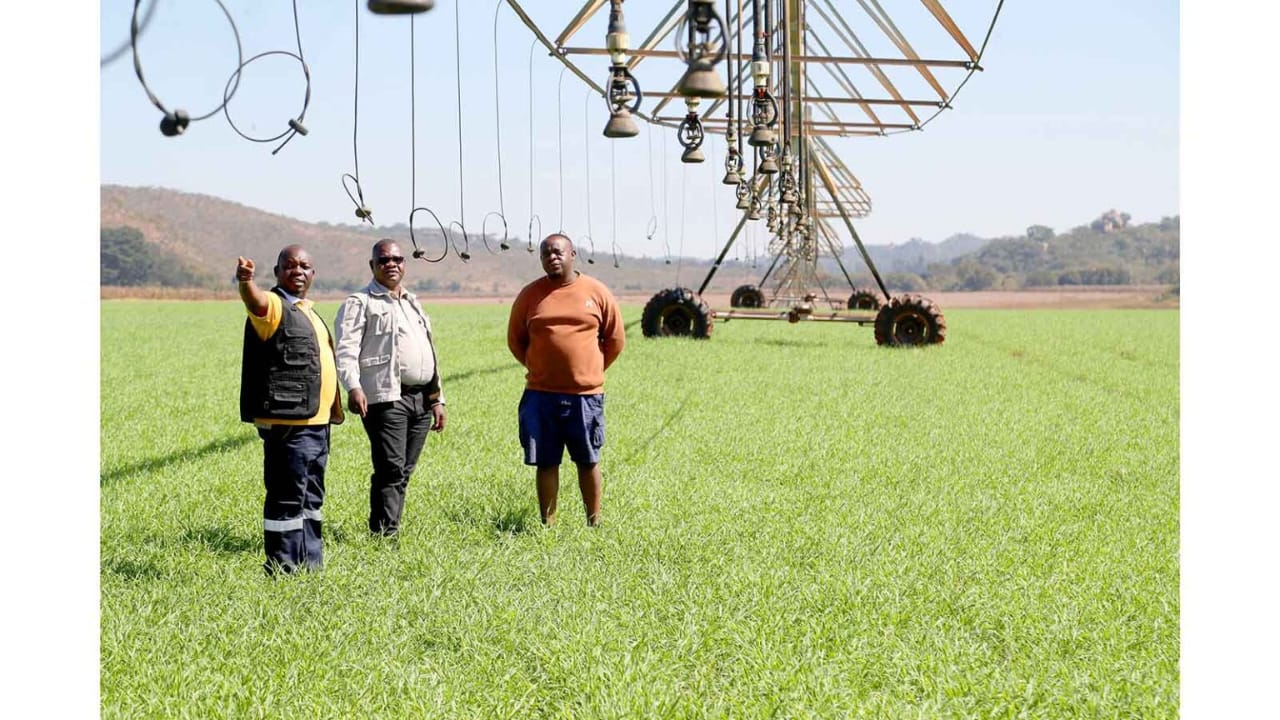
Theseus Mauruki Shambare
FARMERS have planted 126 394 hectares of winter wheat, surpassing the national target of 125 000 hectares, with Government now shifting focus to agronomic interventions aimed at maximising yields and securing a potentially record harvest that could further strengthen national food security buffers ahead of anticipated climate shocks.
The achievement represents 101 percent of the national target and follows a coordinated nationwide production drive involving farmers, extension officers and other stakeholders, with authorities now prioritising irrigation management, fertiliser application, crop hardening, weed control and pest management to optimise output from the crop.
The country’s winter wheat sector has recorded consecutive production milestones since 2022, when farmers broke a 56-year-old record by harvesting over 375 000 metric tonnes from about 78 063 hectares, achieving national self-sufficiency for the first time.
Output rose to 467 905 tonnes in 2023 from 90 186 hectares, before increasing to 518 502 tonnes in 2024 from 106 238 hectares and peaking at 640 195 tonnes in 2025 from 122 146 hectares, as the country strengthened its position as a regional leader in wheat production and food security.
Building on this trajectory, farmers have completed planting for the 2026 winter wheat season on Monday with 126 394 hectares under crop, while Government is targeting a new production benchmark of 662 500 metric tonnes.
National annual wheat consumption is estimated at about 360 000 tonnes, meaning the current production trajectory has the potential to generate a surplus capable of strengthening the Strategic Grain Reserve and insulating the country against climate-induced shocks and global market volatility.
Permanent Secretary in the Ministry of Lands, Agriculture, Fisheries, Water and Rural Development Professor Obert Jiri said Government had deliberately shifted focus from planting to yield optimisation following the successful attainment of the hectarage target.
“We have surpassed the target already, way past the 125 000 hectares,” he said.
“Now we are focusing on agronomic interventions to ensure we get the best yield — hardening, fertilising regimes, weed and pest control, irrigation application.”
Prof Jiri said although the traditional winter wheat planting deadline is May 31 to allow optimal crop establishment under winter conditions, the Ministry extended the window to June 15 this season due to prolonged wet conditions that delayed summer harvests and slowed land preparation.
“We had to extend the planting window to ensure farmers were not left behind because of weather-related delays,” he said.
He said extension services were now intensifying advisory support across planting zones to ensure optimal crop performance at different growth stages.
Agricultural and Rural Development Advisory Services (ARDAS) Chief Director Mrs Medlinah Magwenzi said the wheat programme reflected strong national coordination and confirmed the crop’s strategic role in food security.
“We are happy that we have planted 126 394 hectares above our target of 125 000 hectares.
“Wheat production in Zimbabwe is no longer just for bread, buns and scones. It is now part of our staple food and a key pillar of food security,” she said.
Mrs Magwenzi said improved input distribution, preparedness and extension support had enabled farmers to meet and exceed targets, adding that Government was now focusing on production efficiency across all wheat-growing areas.
She said wheat production had evolved into a strategic buffer crop alongside maize, particularly in anticipation of climate variability.
Strategic Grain Reserve (SGR) 200-hectare-plus Club chairman Mr Tichaona Mapfoche said the organisation was committed to supporting Government’s food security drive through expanded production and collaboration with stakeholders.
“As the SGR 200-plus Club, our ambition is to fully support all Government programmes aimed at achieving national food security.
“We are aligned to the national vision and remain committed to strengthening the Strategic Grain Reserve,” he said.
He said the initiative complemented broader Government efforts to stabilise grain supplies and strengthen resilience against climate shocks.
While wheat continues to stabilise bread and flour markets, Government is also scaling up production of traditional grains such as sorghum and millets, which are increasingly being promoted as climate-resilient substitutes for maize in drier regions.
To align production with ecological conditions, the Grain Marketing Board has introduced a grain swap programme allowing farmers and households to exchange traditional grains for maize, or vice versa, on a 1:1 ratio of up to five 50kg bags per month, ensuring dietary flexibility while strengthening national grain security systems.



 Bongani Ndlovu