admin
admin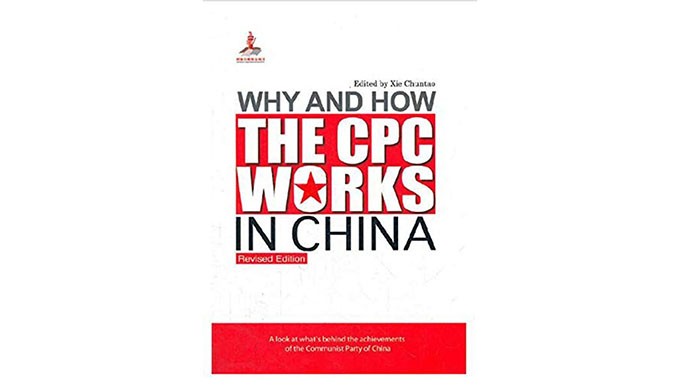
Lovemore Chikova
Development Dialogue
The Communist Party of China (CPC) marked its 100th anniversary last week, with the party now a giant, actually the most followed political party in the world with more than 95 million members.
What distinguishes the CPC is how it stirred China both politically and economically for the last 100 years into the second biggest economy in the world.
I found myself going through various literature about the CPC and China last week, trying to find out how such a humble party and country could have developed so fast within such a short period.
The probe led me to a book titled: “Why and How The CPC Works in China” that was edited by Xie Chuntao.
Going through the book, it became clear that the answer to China’s astonishing speed in development was mainly attributed to the time its former leader Deng Xiaoping decided to defy the Soviet Union’s model of socialism.
Deng introduced the reform and opening up policy that led to the famous line “socialism with Chinese characters”, which has helped bring China to where it is today.
I will look back through the lenses of the book on what really transpired and what was going on in Deng’s mind when he decided to take China on its own path towards its own development model. According to the book, leader of the Soviet Union Joseph Stalin forbade any criticism of his country’s experience which he regarded as the only model of socialism.
“After the Cold War started, in order to counter the US-led capitalist camp, the Soviet Union held the socialist countries in Eastern Europe in a tight grip, and socialism there had to be pursued in accordance with the Soviet model,” reads the book.
“Theoretical conservatism and pressure from the Soviet Union made the Eastern European countries unable to break out of this mold, so bad old practices… were hard to get rid of, and those countries eventually fell apart.”
But compared with the Eastern European countries, China broke away from the influence of the Soviet model earlier, and explored its own road to development.
China’s First Five-Year Plan (1953-1957) was completed with the help of the Soviet Union, but the then leader of China, Mao Zedong, said, “After liberation, during the three-year recovery period, we were unclear about construction, so we could only basically copy the methods of the Soviet Union. But I never felt comfortable about that.”
Stalin passed away in 1953 and in February 1956 Nikita Khrushchev was elected by the Twelfth National Congress of the Soviet Communist Party, and the new administration published a “Secret Report,” revealing Stalin’s mistakes.
Things fell apart as the revealing of these mistakes led to many other communist countries questioning why they should follow the Soviet Union’s example. April 25, 1956, Mao made a speech titled, “On the Ten Major Relationships,” which clearly stated, “Recently some shortcomings and mistakes of the Soviet Union in its process of building socialism have been exposed. Would you like to follow the roundabout course they have taken?”
This signalled that China was ready to follow its own path towards developing its country and economy.
Mao was then succeeded by Deng Xiaoping in 1978, signalling the beginning of the reform and opening up policy accredited for China’s success.
Deng then made his famous speech: “What kind of form for productive relations shall we adopt? Perhaps we shall take such an attitude in addressing this issue, that is, whatever forms there are to help restore and develop agricultural production more easily and relatively quickly in a certain place, we shall adopt them; whatever forms people are willing to take, we shall adopt them; and the illegal form should be made legal.
“Whether it is a black cat or a white cat, it is a good cat only if it catches mice.”
This saw the success of reforms in the countryside, especially in agriculture, and the next step was the state-owned enterprises whose reform was given priority.
“In this process,” reads the book. “Capital, technology, knowledge and other factors of production were emancipated; the enthusiasm and creativity of rural surplus labour and private entrepreneurs with entrepreneurial ability were liberated, too, and productivity was greatly emancipated as a result.”
In the early 1980s in China, everyone could feel the great changes brought about by the reforms.
And on October 1, 1984, celebrating the 35th anniversary of the founding of the People’s Republic of China, a streamer with “Hello Xiaoping” was suddenly held aloft in the parade.
But the country’s real opening started with the establishment of special economic zones. The book notes that in April 1979, the CPC Guangdong Provincial Committee put forward a suggestion to the Central Committee regarding establishing export processing zones in Shenzhen and Zhuhai, which are adjacent to Hong Kong and Macao respectively.
“Deng Xiaoping quickly grasped the importance of this, and said immediately: “You’d better call it the Special Administrative Region (SAR)”. The Shaanxi-Gansu-Ningxia Border Region used to be a special administrative region. Since the central authorities have no money, you can build it yourself, blazing a new trail.”
Within only a few years, the old fishing village in Shenzhen became a modern city of skyscrapers.
In 1984, after Deng visited the region, he said, “The SAR is a window. It is a window of technology, a window of management, a window of knowledge, and a window of foreign policy as well.”
What followed was a deliberate effort in gradually opening up China to the world, with special economic zones, open coastal cities, areas along the borders and the Yangtze River, and inland areas taking priority.
When other socialist and communist countries encountered devastating problems in the 1980s, China also suffered political turmoil in 1989 in Beijing and other cities.
“China withstood the severe test,” reads the book. “All the insightful people inside and outside the CPC and those around the world believed that the fundamental reason why China did not fall was that China adhered to the reform and opening-up policy, promoted economic and social development and gained the support of the people.”
Regarding the political turmoil, Deng is quoted as saying: “Why was our country able to keep its stability after the turmoil? It was because we carried out the reform and opening up and promoted economic development, and the people’s lives kept improving.”
In 1992, Deng said: “If we do not adhere to socialism, do not reform or open up or develop the economy or improve the people’s lives, we will face a dead end.”
China, under the CPC, carried out its reform as follows: Start with the economy; with economic and social development gradually moving forward and place political reform on the agenda step by step.
In this process, close attention was paid to dealing with the relations between reform, development and stability. In fact, the three words – reform, development and stability – are mentioned or discussed almost in every chapter of the third volume of the Selected Works of Deng Xiaoping.
In the process of reform and development, the CPC and the Chinese government adopted a developmental strategy of “proceeding step by step in an orderly way.”
The CPC also recognised that stability and unity at home was the prerequisite and guarantee for reform and development. On many occasions, Deng illustrated the importance of stability.
He is quoted as having said: “Eighty percent of China’s population lives in the rural areas, and whether China is stable or not depends on this eighty percent. If the rural areas are not stable, the whole political situation will be unstable. If the peasants do not shake off poverty, our country will not get rid of poverty.”
In the view of the CPC and Deng, stability had two aspects – stability of the political situation, and policy stability, both leading to the success of the reform and opening up policy of China as we know it today.


 Online Reporter