Online Reporter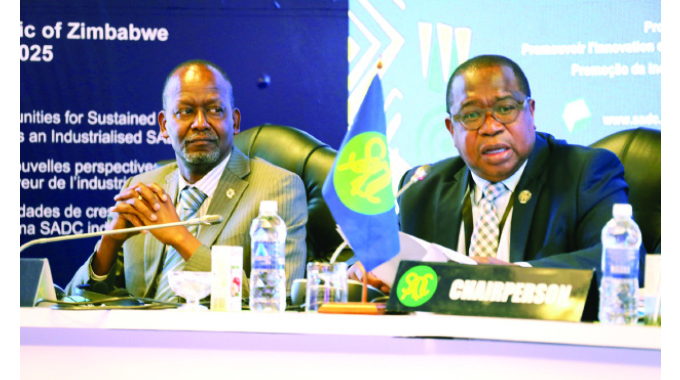
Rutendo Nyeve-Victoria Falls Reporter
THE Southern African Development Community (SADC) Committee of Ministers of Finance and Investment and the Peer Review Panel are stepping up efforts towards the operationalisation of the SADC Regional Development Fund (RDF), which has been identified as a critical mechanism to bridge financing gaps and reduce dependence on external funding.
In the face of shifting geopolitical developments and declining international financial flows, the internal financial instrument is set to transform Zimbabwe’s economic landscape and bolster regional integration.
Speaking during the official opening of the Committee of Ministers of Finance and Investment and the Peer Review Panel in Victoria Falls yesterday, Finance, Economic Development and Investment Promotion Minister Professor Mthuli Ncube highlighted the progress made towards activating the Fund, while SADC Executive Secretary Mr Elias Magosi provided updates on resource mobilisation efforts.
The SADC RDF is envisioned as a standalone Special Purpose Vehicle (SPV) with a Permanent Capital Structure, designed to channel investments into priority sectors such as infrastructure, renewable energy and agribusiness.
For Zimbabwe, which has been at the forefront of its operationalisation, the Fund represents a lifeline to address fiscal constraints and unlock new growth opportunities.
Prof Ncube reaffirmed Zimbabwe’s commitment to fast-tracking the ratification of the 2016 Agreement on the Fund’s operationalisation, urging other Member States to follow suit.
“The decision of the Ministers of Finance and Investment to operationalise the SADC Regional Development Fund utilising a standalone Special Purpose Vehicle (SPV) with a permanent capital structure was endorsed by the Council of Ministers at its meeting held in Zimbabwe in March 2025.
“We also encourage all Member States to expedite the signature and ratification of this crucial agreement. Its entry into force will signal our collective dedication to regional economic integration and strengthen our capacity to implement the Fund effectively,” he said.
Mr Magosi provided a detailed update on the strides made since December 2024, when ministers mandated the Secretariat to engage the African Development Bank (AfDB) for resource mobilisation.
“I’m pleased to inform the meeting that significant progress has been made towards mobilising the resources required for the operationalisation of Stage 1: Proof of Concept phase,” said Mr Magosi.
He revealed that the AfDB had committed to supporting the Fund’s initial phase, with a Project Proposal Note submitted to access 5 million Units of Account (approximately $6.5 million) under the Bank’s Transition Support Facility.
A second request for $10 million is slated for July 2025.
Mr Magosi also acknowledged the outgoing AfDB president, Dr Akinwumi Adesina, for his unwavering support and expressed optimism about continued collaboration with his successor, Dr Sidi Ould Tah.
“We’re deeply appreciative of Dr Adesina’s gracious acceptance and unwavering support for the request from SADC Ministers of Finance and Investment for the AfDB to assist in the operationalisation of the SADC Regional Development Fund,” he said.
For Zimbabwe, the RDF is a strategic tool to mobilise domestic resources and reduce reliance on volatile external funding, and strengthen fiscal resilience. The fund is also expected to boost infrastructure development through funding critical projects in energy, transport, and digital connectivity. Furthermore, the fund will support high-growth sectors, investing in renewable energy, AI and agribusiness to create jobs and diversify the economy while also enhancing regional trade as it improves cross-border infrastructure to unlock new markets under the African Continental Free Trade Area (AfCFTA).
Prof Ncube said there is need for urgency of scalable solutions, particularly for youth employment, where 360 million young people in Africa will attempt to enter a workforce that is expected to only offer opportunities to 150 million.
He said the Fund could catalyse initiatives in vocational training, SME support, and innovation to address this gap.
While progress in operationalisation of the Fund is encouraging, challenges remain.
Member States must formalise their equity participation commitments to meet the Fund’s capital requirements, a development which Mr Magosi urged swift action to be taken.
“It is, therefore, my humble plea to Member States to provide expressions of interest to enable the Secretariat and the Bank to progress this matter,” he said.
With geopolitical tensions, climate shocks, and debt distress further complicating the regional outlook, Prof Ncube warned that foreign direct investment flows are being re-directed along geopolitical lines, making the RDF even more vital for self-reliance. The RDF embodies SADC’s ambition to shape its own economic destiny.
For Zimbabwe, the Fund is not just a financial instrument, but a testament to what regional solidarity can achieve.