Chronicle Editor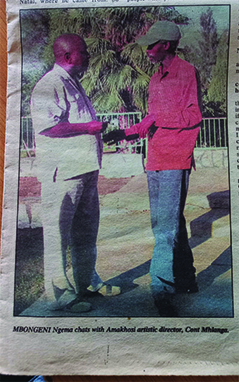
December 2023 brought sorrow to the Creative and Cultural Industries (CCIs) as the dark shadow of tragedy enveloped the arts scene with the untimely demise of Mbongeni Ngema. The renowned playwright, musician, and director lost his life in a devastating head-on car accident while returning from a funeral in Lusikisiki, Eastern Cape, South Africa on Wednesday.
Ngema’s impact on the arts was profound, evident in his award-winning works such as Sarafina and Woza Albert, which gained international acclaim and reshaped the narrative during South Africa’s challenging apartheid era.
During a pivotal encounter in 2007, Ngema met with the late arts doyen Cont Mhlanga in Bulawayo, Zimbabwe. This meeting was in preparation for Mzilikazi — The Musical, Ngema’s co-production with then Amakhosi’s special products director, Cont Mhlanga. It was aimed at remaking the Ndebele nation’s founder’s journey from South Africa up until the time he founded the Ndebele nation.
Below is the interview which was conducted by the then Sunday Leisure magazine editor Lawson Mabhena (LM) with Mbongeni Ngema (MN) at Amakhosi Cultural Centre. The article was published in the Sunday News on February 4, 2007 where Ngema shared insights into the production, highlighting the involvement of both Zimbabwean and South African artistes.
LM: Welcome to Zimbabwe. Is this your first time here?
MN: No. It’s my first time koBulawayo. I’ve been to Harare about three times, but ngiyaqala ukuza la koBulawayo.
LM: Have you worked with Zimbabwean artistes before?
MN: There is one engike ngasebenza laye eSouth Africa kodwa, not la. David Chinyanga; he is a mbira player. We worked together on my latest album; there is a song that he composed.
LM: Tell us about how you came up with the idea of Mzilikazi The Musical?
MN: It’s been something that has been there in my mind for so many years, because Mzilikazi’s story is among our legendary stories in South Africa, particularly in KwaZulu-Natal, where he came from. So growing up as a child you are told about Shaka, Dingane, Mzilikazi, Sotshangane and Cetshwayo. These are the historical stories we grew up listening to the elders talk about around the fire. When I realised that I’m an artiste or a writer, I wished that one day I could write about Mzilikazi.
LM: How do you see the project going?
MN: It’s a long process, it’s not something that can be accomplished tomorrow. This visit was just to see — a look-and-feel kind of situation because you can’t write about a people when you have never been to their place. So it’s for me to just walk around, meet the people and see the artistes that are here. It’s going to be like that for quite a while because we still have to do research and all sorts of things, so this is only the beginning phase.
LM: When and how did you first meet Cont Mhlanga?
MN: UCont? We met eDurban, in South Africa. There’s another show, my latest musical, it’s running in South Africa. One of the actors, Chris Hurst, who is from here, is close friends with Cont. He is always talking about the development of theatre in Southern Africa, with my influence. He was telling me that I have influenced a lot of people and one of them is Cont. So one day Cont came to Durban and there was affinity for one another immediately, so that’s when the whole thing started.
LM: Tell us about Mbongeni Ngema.
MN: Eh that’s a lot. It can actually take days. I can send you my CV if you like.
LM: Being a playwright, lyricist, composer, musician and director, how do you juggle all these?
MN: Whatever stimulates me for that moment, if I feel there’s a song in my mind I can go to the piano and if there is an idea for a play then I can start writing. I try to place myself so that if I’m doing a project I know that for these months I’m concentrating on research, for these months I’m concentrating on the script or composing and then the casting, until I bring the whole thing together.
LM: You were groomed by the godfather of township theatre, Gibson Kente, tell us more about this man?
MN: He was a great man you know; a self-taught man in theatre and a remarkable composer. I learnt quite a lot from him because growing up as an artiste he was my icon. Even though I was writing music, I could feel that there was no way that I could reach his standard unless I worked with him, which is the decision I finally took. I said let me go and work under this man and learn from him. You know, a lot of us learnt from Gibson. Others used what they learnt, others didn’t. I happen to be the one who used what he learnt from Gibson.
LM: How is South African Township theatre at the moment?
MN: There are a lot of productions that are coming up in South Africa, different styles of township theatre. I think that it’s something South Africa is known for all over the world. It is a trademark, it will always be there.
LM: Does theatre pay?
MN: It depends on which scale you are doing it. It can pay a lot of money and sometimes it cannot pay.
LM: You have received a number of accolades, including being nominated for four Tony Awards in 1987. What do you attribute to your success?
MN: Hard work and determination.
LM: Obviously, your biggest project was Sarafina. Tell us about this production?
MN: Sarafina was a milestone for Africans in the continent and people of African decent all over the world. It is one single project every person of African decent prides themselves of. To date, it has the unsurpassed record of the biggest ever production from the continent to be on Broadway and be successful.
LM: What of Sarafina II.
MN: Sarafina II was not a commercial production. It was a production earmarked to raise HIV/Aids awareness inside South Africa, in the rural areas and in the townships.
LM: You married Sarafina star, Leleti Khumalo, what attracted you to her?
MN: She is a hard-working actress. When I found her she was like these kids (at Amakhosi), younger than most and she was in a group like this. I spotted her and saw that she stood out among the others and I spoke to her parents about working with her when I had just written the script for Sarafina and I cast her in that part. We worked a lot spend a long time in rehearsal moulding artistes and the result is the star that we have today.
LM: You played the part of a policeman who wanted Sarafina, was this deliberate?
MN: No, I wrote that part as part of my experiences in the townships, that the worst guys during the apartheid era were the black policemen. They were the ones who were harsher to their own than the whites. It’s what I had seen in the townships, so when I was writing Sarafina, I put that part in.
LM: What other productions are you working on at the moment?
MN: I’ve just opened a big musical, it’s called 1906.
LM: Which production could you describe as your best ever?
MN: It’s 1906 and The Zulu, another one which I wrote and toured Europe extensively about the battle of Isandlwana, the Anglo-Zulu war. 1906 is huge but is still very new, so we are still doing trial runs. The official opening will be on 30 April in Pretoria.
LM: What do you think was your biggest achievement?
MN: It’s to be able to do productions on Broadway.
LM: What can you say about your music career?
MN: It’s going very well, I have started my own record company and at the end of February we are releasing one CD by me and another by a young artiste that I have discovered and recorded. We will do all first releases at the end of February.
LM: What advice would you give to those aspiring to be like Mbongeni Ngema?
MN: They should dream very high but then begin to turn their dreams into reality by starting to work towards that goal.
*** The loss of Mbongeni Ngema is a profound tragedy for the Creative and Cultural Industries. However, his artistic legacy and influence will endure, serving as a source of inspiration for current and future generations in the vibrant world of the arts.


 Online Reporter