Online Reporter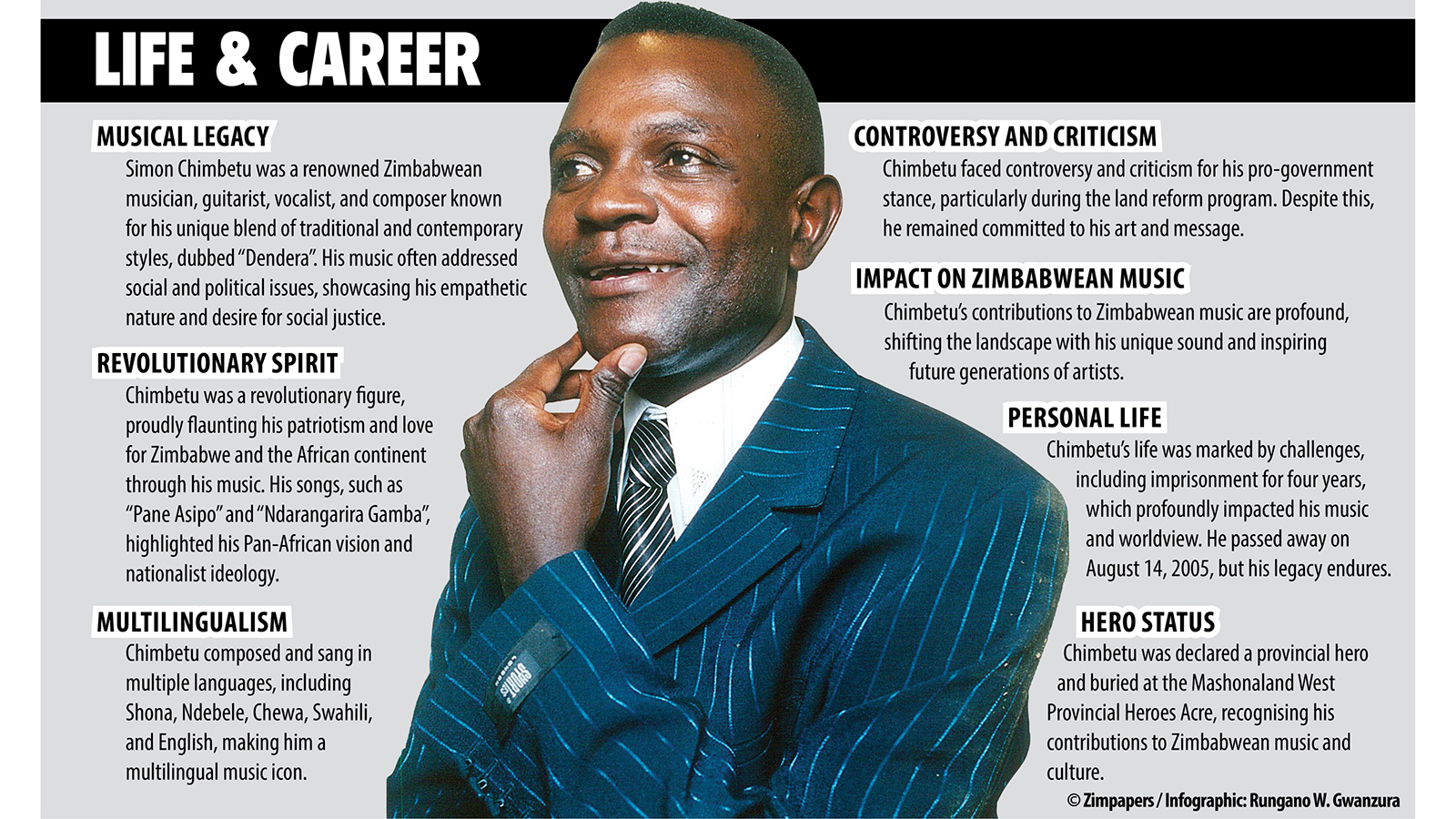
Itayi Musengeyi-Day Editor
DENDERA music maestro Simon Chimbetu, who departed today 20 years ago, was many things rolled into one.
His fans affectionately called him the Master of Song while some described him as a lyrical genius or wordsmith for his artistry in composing and arranging great hits.
Chimbetu, also nicknamed Chopper by his legion of fans and admirers, was a multilingual who composed and sang melodiously in Shona, Ndebele (“Khami Road”, one of a couple of tracks where he sings about his tribulations during his imprisonment at Khami Prison in Bulawayo for car theft), Chewa, Swahili and English.
Chopper was a fashion connoisseur and trendsetter, always smartly dressed on and off the stage. He had a charming stage presence and captivating dance moves during live shows, which rubbed off on his band members.
“The smart guy with bashful eyes, a soulful voice, a boyish haircut and an unshakable Pan-African vision will be sorely missed by the rest of us!” award-winning novelist and University of Zimbabwe academic Memory Chirere wrote in a tribute to Chimbetu in The Southern Times in 2005.
Writing on www.intimatemomentswithzimmusicians.blogspot.com in 2011, veteran journalist Wonder Guchu described Chimbetu as “a closed box-intrigue”.
“Simon Chimbetu was an intrigue. Those who knew him well talk about a man who was a picture album. There were parts of his life he never spoke openly about. Whatever secrets he harboured, they went with him into his grave. He never made it a secret though that he was a staunch ZANU PF supporter even claiming to have gone to Tanzania to train as a guerrilla.
“It was for this reason that he included a song about the liberation war on every album. And most if not all such songs stand out even today. Who can forget Ndarangirira Gamba or Pane Asipo?” wrote Guchu.
In his own words, Chopper told another veteran Zimbabwean journalist Mduduzi Mathuthu, in an interview in England, where he performed countless times: “I fought in the liberation war and still think of my comrades who died in my arms. They never fought for their own families alone but they fought so that Zimbabweans can repossess what had been taken away from them by the whites. I look at the opposition parties across Africa, just as I look at all new things that come up, and I realise that they have no base. I am a revolutionary and what I see in most of our opposition parties is a group of people who have no foundation, they can’t think on their own.”
Musically, Chopper was a guitarist, vocalist, composer and dancer but above all, he was a revolutionary, as he asserted in his interview with Mathuthu.
He proudly flaunted his patriotism, love for his Motherland, Zimbabwe and the African continent in his adeptly composed songs.
Few examples are Zimbabwe, Hatikanganwe, Pane Asipo, Ndarangarira Gamba, Africa Inaliya, One Way and Maneno Yawongo (sang in Swahili and English, lamenting the lies detractors tell about Africa).
His coterie of Pan-African and revolutionary songs reveal Chimbetu’s other attributes as a nationalist and an intellectual, and Chirere aptly captures this when he argues the media missed these traits of the Dendera icon: “One does not see some fundamental questions asked (and answered) every time the media reflect on music and ideology in Zimbabwe. Can any music (especially the lyrics) ever be neutral? Is music (or any art for that matter) divorced from the major and minor struggles in any society? Is the musician not entitled to a side, a view? If he does, must it not come out in his music? Whilst singing is a business, how much of that singing should target money and money alone?” In his final living years, Chimbetu was demonised for songs such as “Hoko”, which he sang in support of the land reform programme and “Kure Kachana” (commonly called KuState House Kure), a critique of the opposition.
But when he died, the outpouring of grief that greeted his demise suggested a nation in love with its music hero despite the misunderstandings arising from some of his compositions.
Zimbabweans swarmed a city funeral parlour in Harare to catch a glimpse of his funeral procession and formed a long hearse to his house in Mabelreign in honour of their musical hero.
“Memories of cars of different makes and sizes that snaked in roads adjacent to his house in Mabelreign as people came to honour the fallen music and provincial hero are still vivid,” The Herald reminisced about Chimbetu in 2016. Chirere avers that Chopper withstood the demonisation in a true sense of an unwavering revolutionary.
“His last album “Ten Million Pounds: Reward” reminds one of the singer’s unique music and his intricate circumstances as a musician and nationalist. For the four years preceding his death, Chimbetu had been under the spotlight. Sadly, his case did not receive adequate analysis and understanding in Zimbabwe and abroad.
There had been open hate messages towards Chimbetu, show boycotts and even open demonisation by some sections of the local media.
But the man soldiered on.” As a contemporary critic, Chopper never shied away from calling out present-day challenges in his songs.
This characteristic of Chopper’s music, Chirere says, was missed by many because while he was a patriot, he was not blind to life’s ills and hardships. “In fact Chimbetu, makes very subtle and intelligent criticism of the establishment in many of his songs. In an older song called “Vana Vaye” (from the “Survival” album) the singer pleads with the leader not to forget (the prices of) bread and mealie-meal ‘zvevana vangu’ (for my children).”
Chopper was not only a musical hero but a revolutionary and was befittingly buried at the Mashonaland West Provincial Heroes Acre, the site of the prodigious Chinhoyi Battle that marked the first battle of the Second Chimurenga. Two decades later, the Dendera beat plays on and the consciousness endures!