admin
admin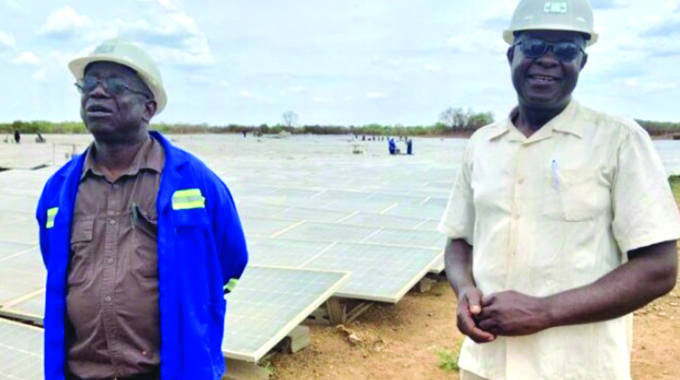
Gibson Mhaka, Zimpapers Politics Hub
THE mining industry is one of the most energy-intensive industries in the World, often relying on fossil fuels for its operations.
In an era focused on sustainability, the integration of renewable energy sources, particularly solar power, is becoming increasingly crucial.
By harnessing solar energy, mining companies can significantly reduce their reliance on traditional power sources, lower operational costs, and minimise their environmental impact.
Power supply is one of the major operational constraints weighing on the mining industry, a key sector of the economy that generates more than 80 percent of the country’s exports.
Studies have shown that mining companies that successfully implement renewable energy solutions are better positioned for long-term success.
Not only does this approach align with global sustainability goals, but it also offers a strategic advantage by mitigating exposure to fluctuating energy prices and ensuring a reliable power supply, especially in remote mining locations.
Renewable energy development on mine lands offers an exceptional opportunity to produce clean energy while respecting communities and local landscapes.
By integrating solar power into their operations, mining companies can also significantly reduce their environmental impact, minimise ecological disturbances, and contribute to a more sustainable future.
Government is also on record reaffirming its commitment to advancing renewable energy solutions, aiming to achieve 1 100 megawatts (MW) from renewable energy sources by 2025 and 2 100 MW by 2030.
These targets, set within the National Renewable Energy Policy (NREP), are intended to address Zimbabwe’s electricity shortages and reduce dependency on traditional hydroelectric power, which has been impacted by erratic rainfall and climate change.
Turk Mine in Bubi District, Matabeleland North Province, owned by Casymn, is one of the mining companies in the country that has demonstrated that renewable energy can be a game-changer for the power-intensive mining sector.
The company transformed a decade-old dump site, known as a tailings dam in mining circles, into a solar farm that produces 4.4MW of power.
The transformation was also part of the company’s broader environmental rehabilitation and green energy initiatives, demonstrating its commitment to sustainable mining practices.
By implementing a renewable energy project to generate its own power, the company has reduced operational costs, eased the strain on the country’s stressed Hwange and Kariba power plants, and contributed to a more sustainable and environmentally friendly mining operation.
This initiative covers approximately 30 percent of the mine’s needs and provides a reliable energy source that also mitigates environmental impact.
The solar farm comprises 8 064 solar panels, 36 inverters, and four transformers, producing an impressive output of 4.4 MW that is fed into Turk Mine, allowing it to run effectively off the national grid during the day when it is peak time for the solar panels to harvest power.
The rehabilitated waste dump site covered an area of 3.6 hectares, the same area that the new solar farm now sits on.
The tailings dam was a whopping 1.5 million tonnes of waste, accumulated over decades of mining and inherited by Turk Mine from previous owners, some of whom had been mining in the area as far back as the 1920s.
Speaking to journalists during a media tour of the solar project organised by the Zimbabwe Energy Regulatory Authority (Zera) recently, Turk Mine’s Safety, Health, Environment, and Quality (SHEQ) officer, Mr Taurai Danda, said the project site, initiated in 2022, once a solid waste dump, was repurposed to support green energy production.
“This area was a dump site for solid waste from gold production, but now it is a green energy plant. It has been there for years, and over the years, this dumpsite was being washed away by rains.
“Those who have passed through here can see the evidence, and whatever was washed away was going downstream into our main rivers. So, when we decided to be responsible enough to manage our environment, we had to target this area and reclaim the solid waste that had been lying here for years.
“Then, after that, we decided not to go into virgin land to clear new areas, cut down trees, and so on.
“So, we strategically targeted this area, which was already a monument to us and the solar plant was put in this area. So, this is the background of why we chose this area,” he said.
He said the drive was to turn a wasteland into a green energy zone.
“This was a positive step for us to say that history can be rewritten. Once a dumpsite, now it is a green energy plant. This is our effort as a mine to be environmentally responsible and manage the land we operate on.
“We opted to repurpose this existing site rather than clearing new land. The solar plant was quickly installed, ensuring a reliable power supply and preventing potential mine closures,” he said.
Mr Danda said the construction of the solar farm not only preserved virgin land by building it on a rehabilitated waste dump site but was also equivalent to saving 5.4 million kilogrammes of coal, which would have been needed to produce 4.4 MW of electricity.
“If we look closely, the energy we are producing here is enough to run our mine. If we do the calculations, as environmentalists do, we will see that generating 4.4MW of solar power saves millions of litres of water that would have been used for traditional power generation and tonnes of coal that would have been burnt.
“This not only reduces carbon dioxide and carbon monoxide emissions but also minimises the environmental impact associated with burning fossil fuels,” he said.
This approach demonstrates the potential of green energy to support production, maintain the environment, and ensure sustainable reliance on natural resources like solar power.
By embracing renewable energy solutions, mining companies can contribute to a greener future while securing their long-term operations.
The project’s lead engineer, Wilson Mujuru, said the venture provided stable power, especially during peak production times, without adding pressure to the national grid.
He said the total cost of the investment, which significantly reduces Turk Mine’s carbon footprint by decreasing its reliance on coal and the water-intensive processes needed for hydroelectric power, was US$2.1 million.
“The plant operates at approximately six megavolt-amperes (MVA), equivalent to the mine’s peak demand.
“We are currently not exporting power to the grid, but we have a license from ZERA to do so if there is a surplus. The solar installation saves the mine approximately US$80 000 to US$90 000 monthly.
“With this grid connection, we are also stabilising power not just for the mine but also for community essentials like water supply,” said Eng Mujuru.
The figures demonstrate the significant financial benefits of investing in renewable energy, showcasing how solar power can reduce operational costs and enhance the bottom line for mining companies.
Caledonia Mining Corporation also constructed a 12MW solar plant at Blanket Mine in Gwanda, Matabeleland South which is already generating power and improving the quality and security of Blanket’s electricity supply while reducing its environmental footprint.
The plant reportedly provides about 27 percent of Blanket Mine’s total daily electricity needs, thereby replacing expensive power from the grid and diesel generators.
These solar projects align with Government’s strategy to boost power production and the growing trend of mining companies investing in renewable energy solutions to reduce operational costs, enhance energy security, and minimise their environmental impact.
There is no doubt that by harnessing solar power, these companies can contribute to a more sustainable future while ensuring the long-term viability of their operations.
As a transformative step for Zimbabwe’s mining sector and the broader economy, the country’s leading renewable energy provider, Grid Africa, and Chinese technology giant Huawei also signed a solar energy deal, which involves the construction of a 72MW solar power plant to exclusively supply electricity across mines in Zimbabwe.
The move is expected to reduce operational costs, enhance energy efficiency, and relieve pressure on the country’s overstretched national grid.
Engineer Malcolm Skonkomwe, a solar energy expert, emphasised the long-term benefits of solar power, describing it as the future of energy.
“Solar is not only about reducing costs, it is about sustainability and efficiency. Unlike traditional fossil fuels, solar energy is infinite and can be harnessed in even the most remote locations.
It makes sense for Zimbabwe, a country with abundant sunlight, to tap into this resource to power industries like mining,” he noted.
Another advocate for renewable energy, Eng Shaun Chipangura, also highlighted how the switch to solar would reduce reliance on expensive fossil fuel energy, which has historically been a huge burden for companies’ dependent on generator power.
“Diesel prices fluctuate with international markets, but solar is a much more stable and predictable energy source. Once the infrastructure is in place, companies can reap the benefits for decades,” he said.
Speaking at the inaugural Zimbabwe-Zambia Energy Projects Summit held recently in Victoria Falls, ZERA chief executive Mr Addington Mazambani also highlighted that private sector investment into alternative energy was key, given the backdrop of ongoing droughts and the need to create a much wider door for the global investment community.
“As we stand on the brink of a transformative era in energy, the Zimbabwe-Zambia Energy Projects Summit embodies our commitment to a sustainable future.
“Together, we will explore the vast opportunities in renewables, modernise our grids, and ensure energy access for all. Let us unite in our vision to power Zimbabwe and Zambia’s sustainable energy future, unlocking potential for growth, innovation, and collaboration,” said Mr Mazambani.
The summit, hosted by ZERA, brought key energy players together with one goal and was officially opened by the Vice President Constantino Chiwenga.
It was set to drive projects in both countries more quickly to financial close and establish a clear pathway for risk mitigation.
Zimbabwe and Zambia are facing power shortages and are having to move away from reliance on Zambezi hydropower, as low flows in the river have slashed output from their Kariba power stations, which had been the main source of power for both countries.



 Online Reporter