Chronicle Editor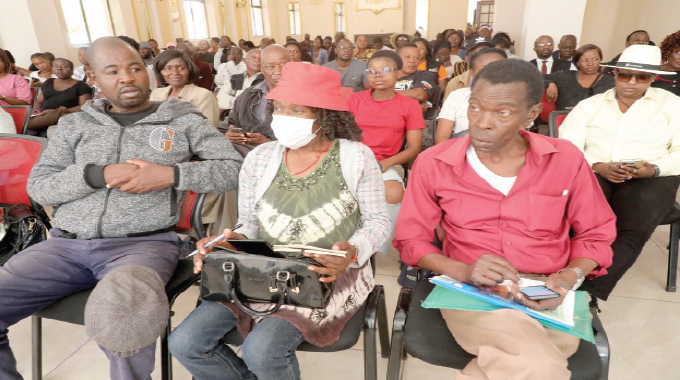
Thandeka Moyo-Ndlovu, [email protected]
A MAJORITY of Bulawayo residents who attended the ongoing public hearings being conducted by the National Assembly’s Portfolio Committee on Justice, Legal and Parliamentary Affairs and the Senate’s Thematic Committee on Human Rights yesterday reiterated the need for the abolishment of capital punishment.
They argued that there was a possibility that some people could have been wrongly convicted and sentenced for crimes they never committed.
The Death Penalty Abolition Bill was gazetted last year. The Bill will amend the Criminal Law Code and the Criminal Procedure and Evidence Act.
It was brought to Parliament by Dzivarasekwa legislator, Mr Edwin Mushoriwa as a private member’s Bill.
In February, Cabinet approved the principles of the Bill that seeks to abolish capital punishment which is expected to make its passage in Parliament smooth.
While Zimbabwe carried out its last executions in 2005, courts have continued to impose the death sentence and there are currently 63 prisoners on death row.
The Constitution maintains the death sentence but excludes women, men under the age of 21 and men over the age of 70 from being sent to the gallows.
President Mnangagwa has publicly denounced the death penalty after surviving the hangman’s noose on a technicality during the liberation struggle.
Bulawayo residents said the justice system is also skewed toward the rich and influential who may evade the death penalty because of power, putting those who are poor at the mercy of the law.
Ms Joy Nkomo from Gwabalanda suburb said the death penalty should be abolished as it was an archaic law that did not resonate with present times and Christian ethos and values.
“Firstly as Africans, our culture has never provided for the death penalty. People compensate each other without shedding blood and the death penalty is a foreign law adopted by our colonisers and we need it abolished,” she said.
“Secondly, as a Christian nation, we believe in rehabilitation as opposed to retribution. Why should we pass judgment on criminals without affording them a chance to repent?”
Mr Melusi Nkomo said the law is discriminatory and gender insensitive.

“Those with money have always benefited because they can afford lawyers leaving the poor at the mercy of a crooked justice system. The death penalty should be abolished and replaced by equally deterrent sentences,” he said.
“I think the death penalty should be abolished, it’s very discriminatory as it states that men aged between 21-70 can be executed. This means it’s only men who are capable of committing murder, which is it’s a wrong perception because we have women too who have been convicted of murder.”
Ms Nolwazi Mathe said the death penalty should stay, arguing that abolishing it would encourage criminals to kill with impunity.
“It is easy to say the law has to be abolished especially if you have never lost a loved one to criminals. I do not think it’s fair for anyone to take life and be given a chance to live,” she said.
“We cannot condone murder and there is a need for a stiffer sentence so that they respect the sanctity of life.”
In an interview, Senator Robson Mavenyengwa said he was disappointed by the low turnout of residents in Mashonaland West and Midlands provinces.
He said the tour was meant to capture views on the death penalty, the administration of deeds and protection of children bills that are before Parliament.
“We are not here to deal with the death penalty only but the Administration of the Estates Bill and the Criminal Law Amendment Bill which deals with the protection of children. As Parliament whenever we are amending acts or our laws we need to involve the public, which is why we conduct these outreach programmes to gather their views,” said Sen Mavenyengwa.
“We want to find out from the people as we are proposing that the death penalty be abolished and replaced by other punishments like life imprisonment so it’s up for the citizens to support. We also need to hear their views on the age of consent.
“In terms of the administration of deeds, we are suggesting that a nine-member board be introduced to assist the master of court so that bereaved spouses get the help.” The Administration of Estates Amendment Bill seeks to restructure the office of the Master of the High Court.
Today, the team will be in Lupane before proceeding to Filabusi tomorrow.
The public hearings provide an opportunity for citizens, legal experts and civil society organisations to express their views on the death penalty and the committees will consider these, as they deliberate on potential legislative changes.


 Online Reporter