

 Online Reporter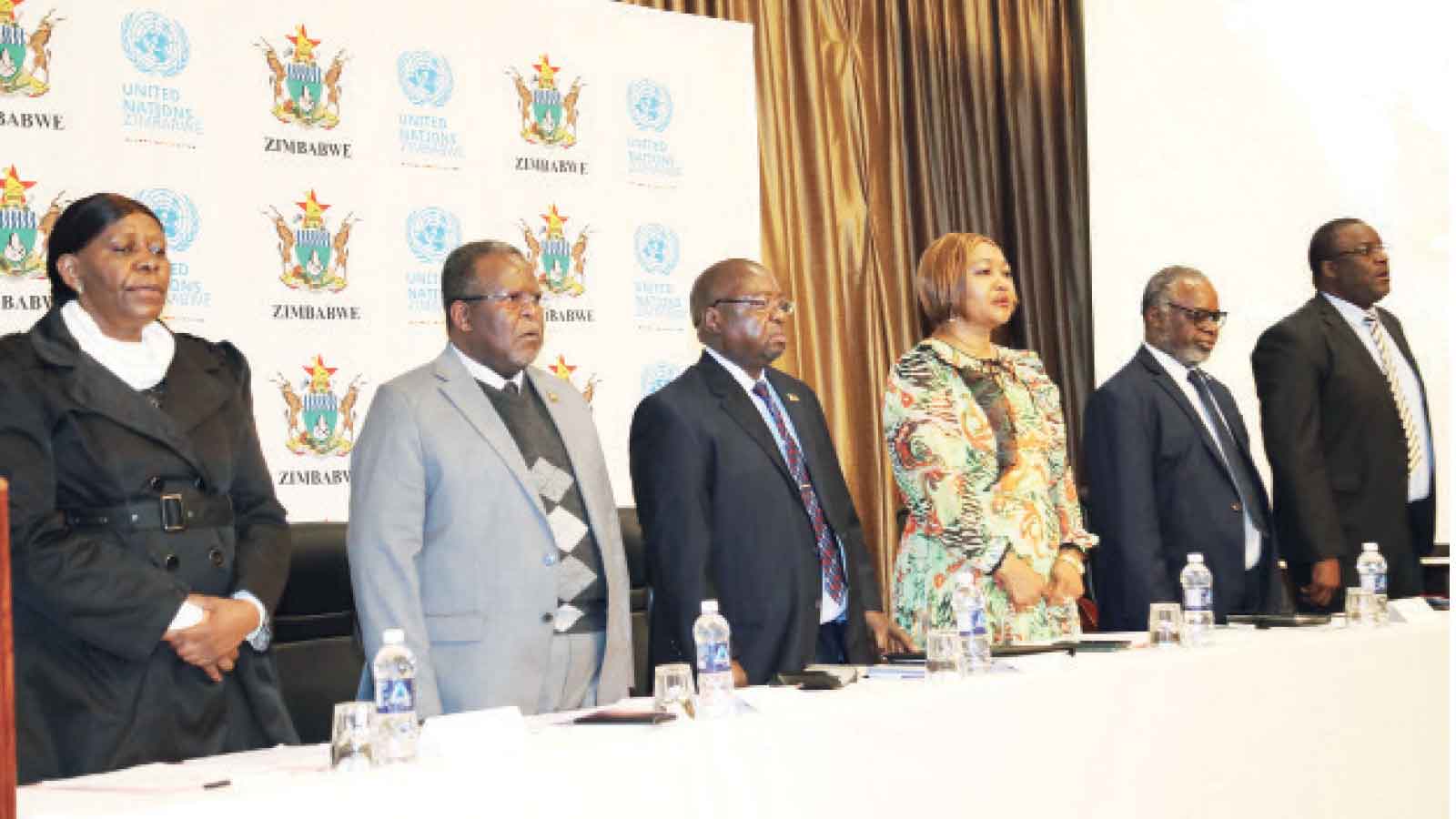
Wallace Ruzvidzo
Herald Reporter
ZIMBABWE’S results-based governance systems, underpinned by performance contracting, are being recognised regionally and continentally, Chief Secretary in the Office of the President and Cabinet Dr Martin Rushwaya has said.
Speaking at a stakeholder validation breakfast meeting in Harare on the National Development Strategy 2 (NDS2) Key Performance Indicators (KPIs) handbook yesterday, Dr Rushwaya said Zimbabwe is accelerating its e-government rollout to ensure planning is guided by digital systems rather than manual processes.
The KPI handbook, set to be launched by President Mnangagwa, will enable Government to co-ordinate and monitor performance across ten thematic areas from 2026 to 2030.
“National key performance indicators, therefore, play a significant role in the automation of performance management systems by providing standardised measurements that align organisational activities with national development objectives.
“These indicators establish clear and measurable targets that enable automated systems to collect, process and analyse performance data consistently across various MDAs (Ministries, Departments and Agencies within Government).
“Consequently, performance of MDAs can be objectively assessed and the results compared using uniform standards,” he said.
Dr Rushwaya said the use of national KPIs also improves efficiency by automating reporting processes.
Performance management systems can generate accurate and timely reports based on KPI data, reducing the need for manual reporting and saving valuable time and resources.
Since assuming office, President Mnangagwa has continued to reiterate the need for efficiency and productivity across all arms of Government, hence the introduction of performance contracting in 2022, as well as other mechanisms and initiatives.
“Automated systems can further use KPI data to trigger alerts and notifications whenever performance falls below expected levels.
“Such early warning mechanisms enable public sector officials to respond quickly and implement corrective measures before the problems escalate.
“Government is making great strides in implementing the Ease of Doing Business reforms to ensure that the economic environment is facilitative of establishing businesses by both local and international investors,” he said.
The Chief Secretary said that, in this regard, key performance indicators play an important role in attracting investment and improving the ease of doing business by providing measurable targets and standards for assessing economic performance, governance and service delivery.
“They also measure critical business processes such as licensing, taxation, business registration and investment approvals, enabling Government to streamline procedures and reduce barriers to doing business”, he said.
“To date, Government has reviewed the regulatory environment in 12 sectors of the economy under the Ease of Doing Business reforms.

“It is befitting to recognise that all the achievements Government is recording under the Second Republic are a result of the visionary and astute leadership of His Excellency, President Mnangagwa.
“His administration is consistently demanding that public service delivery shift away from passive budget absorption and move towards measurable, data-driven and transformational results under the President’s leadership,” he said.
Dr Rushwaya said the culture of non-accountability has been successfully eliminated in MDAs under the Second Republic.
“Today, the National KPIs Handbook further strengthens the building of a high-performing and results-oriented Government system that prioritises the people as the core beneficiaries of our policies, programmes and projects.
“This handbook is our single source of truth.
“Lessons learned from the past reveal that there was fragmentation in performance indicators, definitions, use of unverified baselines and separate data sources across the ministries, weakening the consistency and credibility of our national tracking and evaluation systems.
“We cannot manage what we do not measure,” he said.
In his vote of thanks, Deputy Chief Secretary of Social Services in the OPC, Reverend Paul Damasane, said the KPI handbook is an active operational tool to drive, deliver and enforce institutional accountability and anchor the performance-based contracting system.
“The directives that have been issued to us today leave no room for ambiguity. We are leaving this room with a very clear instruction.
“Our governance architecture has officially shifted into an active, rapid-results mode that has started around three strict 100-day implementation cycles per year. The timelines are absolute, which means we cannot change them,” he said.
Head of National Monitoring, Evaluation and Learning in the OPC, Ms Fananai Madambi, said the primary focus is on delivering measurable results across the board.
“As we move into the full implementation of the National Development Strategy 2, the focus is on delivering measurable results.
“This framework will serve as a critical tool for validating baselines, addressing structural gaps and ensuring that national development interventions translate into tangible deliverables for the improvement of the lives of the people of Zimbabwe,” she said.
United Nations Population Fund (UNFPA) country representative Ms Miranda Tabifor said the UN is committed to assisting Zimbabwe in achieving its national goals.
Deputy Chief Secretaries, Permanent Secretaries, development partners and other senior Government officials also attended the meeting in the OPC.



