malvernmugadzikwa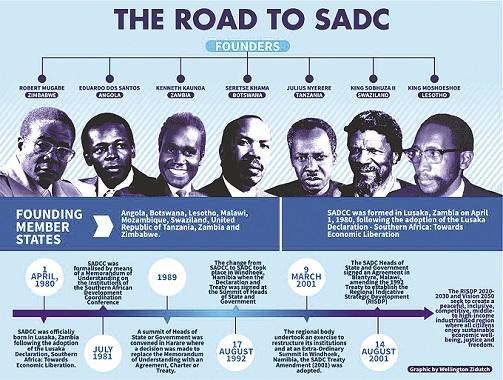
Zimpapers Politics Hub
THE Southern African Development Community (SADC), formerly the Southern African Development Coordination Conference (SADCC), was officially born on April 1, 1980 in Lusaka, Zambia, following adoption of the Lusaka Declaration — Southern Africa: Towards Economic Liberation.
The founding member states of SADCC were Angola, Botswana, Lesotho, Malawi, Mozambique, Swaziland, Tanzania, Zambia and Zimbabwe.
The regional body was initially formed as an alliance of nine majority-ruled states in Southern Africa with the main aim of coordinating development projects in order to lessen economic dependence on the then-apartheid South Africa.
At its inception, SADCC was formed to advance the cause of national political liberation in Southern Africa and reduce dependence on the then-apartheid South Africa through effective coordination and harnessing strengths and resources of member states.
But its objectives also included economic development and regional integration.
Its four principal objectives were:
Reducing of member states’ dependence, particularly, but not only, on apartheid South Africa
Forging linkages to create genuine and equitable regional integration
Mobilisation of member states’ resources to promote the implementation of national, interstate and regional policies
Concerted action to secure international cooperation within the framework of the strategy for economic liberation
The road to SADC
The change from SADCC to SADC took place on August 17, 1992 in Windhoek, Namibia, when the Declaration and Treaty was signed at the Summit of Heads of State and Government, giving the regional body a legal character.
The member states that witnessed the transformation were Angola, Botswana, the Democratic Republic of Congo, Lesotho, Madagascar, Malawi, Mauritius, Mozambique, Namibia, Seychelles, South Africa, Swaziland, Tanzania, Zambia and Zimbabwe.
The SADC headquarters were then established in Gaborone, Botswana.
The transition process from SADCC to SADC involved wide consultations among regional leaders.
From 1977, active consultations were undertaken by representatives of Angola, Botswana, Lesotho, Mozambique, Swaziland, Tanzania and Zambia, working as Frontline States.
This culminated in a meeting of foreign ministries of the Frontline States in Gaborone, Botswana, in May 1979, which called for a meeting of ministers responsible for economic development.
The meeting of foreign ministers was later convened in Arusha, Tanzania, in May 1979, which called for a meeting of ministers responsible for economic development.
In July of the same year, a meeting of ministers responsible for economic development was held in Arusha.
It was at that meeting that the birth of SADCC was initiated.
SADCC was formalised by means of a memorandum of understanding (MOU) on the Institutions of the Southern African Development Coordination Conference on July 1981.
Eight years later, after the signing of the MOU, a summit of Heads of State and Government was convened in Harare in 1989, where a decision was made to formalise SADCC to “to give it an appropriate legal status . . . to replace the memorandum of understanding with an Agreement, Charter or Treaty”.
The SADC Treaty
On August 17, 1992, at a summit held in Windhoek, Namibia, the Heads of State and Government signed the SADC Declaration and Treaty that effectively transformed the SADCC into the Southern African Development Community (SADC).
The new regional outfit was established under Article 2 of the SADC Treaty by SADC member states represented by their respective Heads of State and Government, or duly authorised representatives, to spearhead economic integration following the independence of the rest of the Southern African countries.
This treaty sets the main objectives of SADC, which include the need to achieve development and economic growth, alleviate poverty, enhance the standard and quality of life of the peoples of Southern Africa and support the socially disadvantaged through regional integration.
These objectives are to be achieved through increased regional integration, built on democratic principles and equitable and sustainable development.
The SADC Treaty established a series of institutional mechanisms, including the following:
Summit of Heads of State and Government
Council of Ministers
Standing Committee of Officials
Secretariat
Tribunal
Amendment of the SADC Treaty
After the signing of the SADC Treaty, the regional body undertook an exercise to restructure its institutions and at an Extraordinary Summit on March 9, 2001 in Windhoek, Namibia, the SADC Treaty Amendment (2001) was adopted.
This restructuring was part of institutional reform necessitated by a number of difficulties and constraints encountered in the transition from a coordinating conference into a community.
The reforms established eight institutions under the guidance of Article 9 of the Treaty Amendment:
Summit of Heads of State and Government
Organ on Politics, Defence and Security Cooperation
Council of Ministers
Secretariat
Tribunal
The Troika
Standing Committee of Officials
SADC National Committees
On August 14, 2001, in Blantyre, Malawi, the SADC Heads of State and Government signed an agreement amending the 1992 Treaty to establish the Regional Indicative Strategic Development Plan (RISDP).
The plan is based on the strategic priorities of SADC and the Common Agenda.
It is designed to provide strategic direction with respect to SADC projects, programmes and activities.
The RISDP (2020-2030) and Vision 2050 seek to create a peaceful; inclusive; competitive; and middle- to high-income industrialised region, where all citizens enjoy sustainable economic well-being, justice and freedom.



 Online Reporter