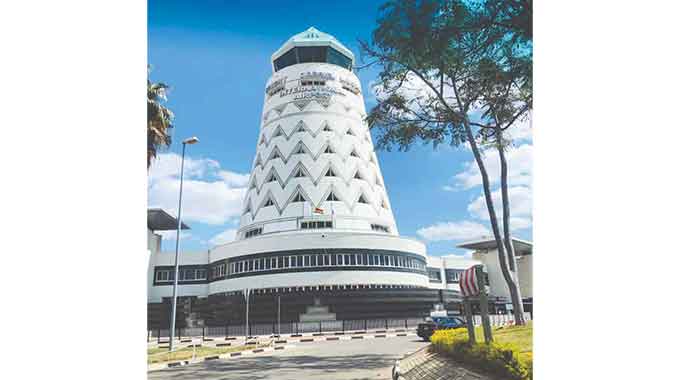
Freeman Razemba and Tonde Mangombe
THE proposed US$1,3 billion cargo village at Robert Gabriel Mugabe International Airport in Harare has been granted National Project Status, paving the way for investment and the development of a major regional logistics hub.
The Airports Company of Zimbabwe (ACZ), which recently partnered locally-based logistics, agriculture and aviation firm Transvaal Africa to develop the facility, said the designation marked an important milestone in the expansion of the country’s aviation and logistics infrastructure.
The proposed smart-city facility is expected to provide a range of logistics services, including the grading, sorting and packaging of goods, in support of regional trade and export growth.
The smart city facility, which dovetails with Government plans to develop a regional hub for passenger and cargo services, will provide all logistical services, including grading, sorting and packaging.
The Government has already invested US$153 million in upgrading the airport, including the construction of a new terminal and expanded facilities to increase passenger and cargo handling capacity.
In a statement, ACZ said, “The proposed Robert Gabriel Mugabe International Airport (RGMIA) Cargo Village has been awarded National Project Status, marking a significant milestone in the development of Zimbabwe’s aviation and logistics infrastructure.
“This strategic designation is expected to unlock investment opportunities, facilitate access to fiscal incentives, reduce project implementation costs and accelerate the development of critical cargo-handling and logistics infrastructure.”
According to ACZ, once developed, the Cargo Village will enhance Zimbabwe’s air cargo capacity, strengthen export competitiveness, facilitate international trade and create new opportunities for economic growth and employment.
“The project will also reinforce RGMIA’s position as a strategic regional aviation, logistics and distribution hub, supporting Zimbabwe’s ambitions to become a competitive player in regional and international trade.”
ACZ chief executive officer Mr Tawanda Gusha announced the partnership recently.
“We have partnered with a local company called Transvaal Africa to develop the Robert Gabriel Mugabe International Airport cargo village, which is going to be a mega project that will ensure that the airport is a cargo hub, not only for the country but for the sub-region,” he said.
“We are also going to be including the development of a secondary runway, which will then also speak to this new interchange that is being developed . . . So, this is all speaking to the infrastructure development that is happening within and around the airport.”
The Government is set to construct nine new interchanges along the Joshua Mqabuko Nkomo Expressway (formerly Airport Road) under a US$250 million project that will transform the route into Zimbabwe’s first high-capacity, controlled-access road linking the RGMIA with Harare’s city centre.
The ambitious infrastructure project is expected to modernise one of Harare’s busiest transport corridors, ease congestion, reduce travel times to the country’s busiest airport and improve road safety.
The expressway is being constructed by local contractor Makomo Engineering, while Ascon Africa is serving as the consulting engineer.
Once completed, the road will become a high-speed dual carriageway designed to accommodate heavy traffic volumes between the airport and the city centre.
The route will start at the intersection of Emmerson Dambudzo Mnangagwa Road (formerly Enterprise Road) and Glenara Avenue before terminating at the airport.
Key components of the project include grade-separated interchanges at major intersections such as Dieppe Road and Harare Drive to allow uninterrupted traffic flow.
The project will also feature a viaduct, an elevated road structure supported by pillars, enabling traffic to move over congested sections and natural obstacles without disruption.
Additional engineering works will include flyovers above railway marshalling yards and bridges across the Mukuvisi River to ensure seamless movement along the corridor.
At the airport, the road will terminate with traffic circles and expanded access roads designed to distribute traffic efficiently to the new passenger terminals.
Supporting infrastructure such as drainage systems, street lighting and landscaping will also form part of the development.
Transport and Infrastructural Development Minister Felix Mhona recently toured the site of the new interchange being constructed at the intersection of Harare Drive and Joshua Mqabuko Nkomo Expressway, where preliminary works, including land clearing, have commenced.
Minister Mhona was accompanied by Permanent Secretary Engineer Joy Makumbe and other senior Government officials.
“And we are saying tentatively within two-and-a-half years we must be done with the entire project,” said Minister Mhona during a tour of the project.
The Government, he added, had adopted a financing model involving private sector participation to reduce pressure on the fiscus.
“We have been working on this particular project for years and trying to come up with a model that would also help lessen the burden on the fiscus, and we have precisely done that,” he said.
“We are not talking about just one interchange. Tentatively, we are talking about US$250 million for the entire project, which will also include diversion routes at the end of the day.”