admin
admin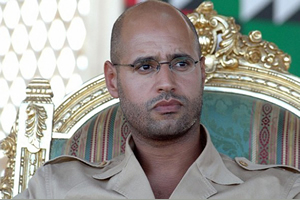
said his family has forged an alliance with Islamist insurgents.
The unity of the revolutionaries became the latest casualty of the shock assassination of a top general, as a key rebel group demanded senior ministers and military brass be fired.
The February 17 coalition – whose members kick-started the revolt against Gaddafi – told AFP the ministers of defence and international affairs must be sacked following last week’s murder of General Abdel Fatah Younes.
Abdulsalam el-Musmari, a judge who heads the coalition, criticised the events leading up to Younes’ murder and the handling of its aftermath by the rebels’ governing National Transitional Council.
The facts surrounding the general’s death have been opaque, with senior members of the NTC giving incomplete and contradictory accounts of how he died, who killed him and the motive for the murder.
“We have two main demands. The resignations of the defence minister (Jallal al-Digheily) and his deputy and for all the armed groups to fall under the national army or lay down their weapons,” Musmari said.
In a separate written statement, the February 17 Coalition also demanded the sacking of Ali Alasawi – the NTC’s minister for international affairs – and a probe into why he approved a warrant for Younes’ arrest. The group’s blistering criticism marks the most public sign yet of tensions between Libya’s revolutionaries and the NTC that has come to be their de facto government.
After five months of fighting against Gaddafi’s regime, the NTC has come under increasing scrutiny, with unease fuelled by slow progress on the military front.
That lack of progress was laid bare on Wednesday in the eastern town of Zliten, where Gaddafi forces appeared to have repelled a rebel attack.
A day after punching into the centre of Zliten, sparking fierce clashes, rebel sources admitted they had pulled back from the centre.
The rebels scored a minor victory. Meanwhile, Seif al-Islam Gaddafi, a high-profile son of the Libyan strongman who rebels have been fighting to oust for five months, said his family had forged an alliance with Islamist rebels among the insurgents to drive out the secular opposition to his father’s 40-year rule.
Seif, who along with his father had long branded the entire opposition as radical extremists, told The New York Times that the rebels would be crushed, following an alliance he had forged with Islamist insurgents.
“The liberals will escape or be killed . . . We will do it together,” he said in the newspaper interview. Libya will look like Saudi Arabia, like Iran. So what?” he added, in what the Times described as an hour-long interview that stretched past midnight in a nearly deserted Tripoli hotel.
He claimed to have negotiated the pact with Ali Sallabi, a leading Islamist in the rebel-held east. Sallabi acknowledged their conversations to the Times but denied the Islamists had switched sides.
The Gaddafi regime has long accused the revolt of being an Al-Qaeda plot and has sought to portray itself as a bulwark against an Islamist takeover of the oil-rich North African country. The rebels include some Islamists, but insist they are united in wanting to overthrow Gaddafi and establish a democratic government.
Gaddafi said the Islamists were “the real force on the ground” and that Western powers would have to come to terms with them. Seif repeated the government’s contention that Islamists were behind the killing of Younes, who was Gaddafi’s right-hand man for decades prior to his defection earlier this year.
“They decided to get rid of those people – the ex-military people like Abdel Fatah and the liberals – to take control of the whole operation,” Seif told the Times.
“In other words, to take off the mask.”
According to a Xinhua report, the Libyan opposition’s internal strife has embarrassed the West. Washington has said that the death of Younes was another challenge facing the opposition, calling for unity among the rebels.
US State Department spokesman Mark Toner said the rebels should stick to their pledges and commitment to unity and representation of all Libyans.
“They’ve had now to overcome many challenges in their struggle and I think what’s important is that they work both diligently and transparently to ensure the unity of the Libyan opposition,” Toner said.
From sparing no efforts to prop up Libya’s opposition to proposing requirements on the opposition’s internal relations, the subtle changes of the US stance on the situation mirrors its embarrassment. That’s because the West has no other choice than to support the Libyan rebels.
Norway, a Nato member, withdrew from military operations against Libya on Monday. France and the United States face presidential elections next year and Britain is busy dealing with its phone-hacking scandal. Calls for ending the Libyan conflict are intensifying in the West as domestic pressures rise. Thus, the West’s patience in Libya is being tested. – AFP-Xinhua.



 Online Reporter