Vusumuzi Dube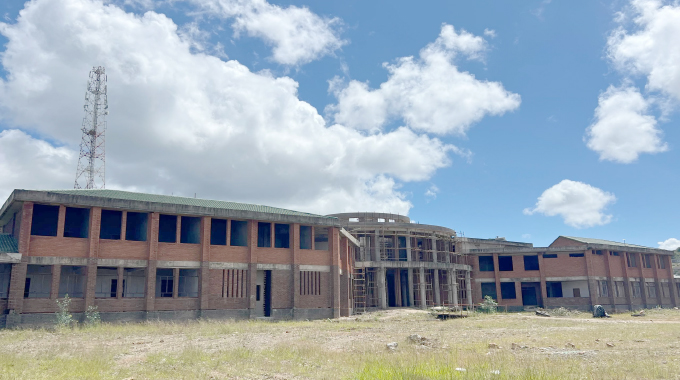
Sukulwenkosi Dube-Matutu, [email protected]
THE construction of the Gwanda Magistrate’s Court Complex, one of the Second Republic’s flagship infrastructure projects in Matabeleland South, is steadily gathering momentum, its rising walls now standing as a tangible promise of progress. With the project about 70 percent complete, authorities are confident that the modern complex will be delivered before the end of the year, marking the culmination of a long and often interrupted journey.
The court complex forms part of a broader package of legacy developments unfolding across the province as Matabeleland South prepares to host this year’s Independence Day celebrations. In this context, the development is more than a building; it is a statement of intent, underscoring Government’s determination to accelerate socio-economic transformation in regions that have for years carried the label of marginalisation.
Once completed, the complex is expected to significantly strengthen access to justice, aligning with the goals of the National Development Strategy 2 (NDS2), while relieving pressure on facilities that have operated in cramped and constrained conditions for nearly two decades. For many in Gwanda and surrounding areas, the promise of a functional and dignified justice system represents not just convenience, but a restoration of confidence in public institutions.
Government has already disbursed more than US$7 million towards the project, a substantial investment that reflects its importance on the national development agenda. An additional US$3 million is required to complete the main structure, with authorities indicating that the remaining funds will be released in the coming months to ensure continuity and timely completion.
During a recent tour of the construction site, Finance, Economic Development and Investment Promotion Minister Professor Mthuli Ncube described the project as central to Zimbabwe’s development trajectory, noting that an effective justice delivery system is a cornerstone of sustainable economic growth.
“Access to justice is a key pillar within NDS2 and we are determined to complete this court complex soon. We are pleased with the progress made so far, with the project now at roofing level. Once roofing is complete, internal works such as plumbing and electrical installations will follow. Treasury will continue to prioritise funding to ensure the project is delivered on schedule.”
The modern complex, which will house Zimbabwe’s sixth High Court, is designed to transform the justice landscape in the province by enabling the handling of serious criminal cases such as murder, as well as major civil matters, within Gwanda itself. This represents a significant shift for local communities who have long had to look beyond their district for such services.
At present, the Gwanda Magistrates’ Court operates from offices within the District Development Coordinator’s premises, a temporary arrangement that has severely limited service delivery due to insufficient space. The new facility is expected to accommodate about 500 workers and bring together all key arms of the justice delivery system, including magistrates’ and regional courts, a configuration intended to improve efficiency and reduce case backlogs.
Professor Ncube emphasised that the benefits of the project extend beyond the justice system, noting its potential to stimulate local economic activity while improving working conditions for justice officials.
“We have invested over US$7 million so far, and once complete, the total cost will be around US$10 million. This is part of our broader thrust to modernise public infrastructure across the country,” he said.
He also revealed that plans were in motion to construct residential accommodation for court officials, ensuring they are based within the district they serve.
For provincial leadership, the court complex represents a defining moment. Matabeleland South Minister of State for Provincial Affairs and Devolution Albert Nguluvhe described the project as a turning point for the province’s justice system.
“This is a landmark development that will transform the justice delivery system in our province. It will reduce the need for people to travel long distances to access services and improve overall efficiency,” he said.
On the technical side, Matabeleland South Public Works deputy director and structural engineer Mr Martin Mukoroverwa said construction had picked up pace following improved funding flows.
“The structural component is now complete and we are at roofing stage. All materials for mechanical and electrical works have already been procured and delivered on site,” he said.
Looking ahead, he expressed confidence in the project timeline.
“If funding continues to be released as planned, we are confident of completing the project by the end of October. Outstanding works include roofing, internal finishes, civil works, as well as the construction of the access road and parking area.”
The story of the Gwanda Magistrate’s Court Complex is also one of resilience. Construction first began in June 2004 but came to a halt in 2008 due to financial constraints, leaving the site dormant for years. After intermittent activity in 2019, full-scale works only resumed in April 2022 following renewed Government funding. Today, as the complex steadily nears completion, it stands as a reminder that some developments may take time, but with commitment and continuity, progress can still be reclaimed.



 Online Reporter