admin
admin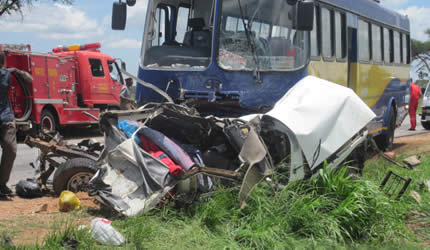
holidays. Star FM’s Leander Kandiero (LK) speaks to Superintendent Andrew Phiri (AP) on the accidents and what the police are doing to end the loss of life on our roads
LK: It is 2013 and we are meeting on a sad note, where we have a shocking and alarming number of deaths on our roads. Care to share with us the difference between 2012 festive season 2011 holidays. What has been the major difference?
AP: Thank you it is really disturbing to notice that this year the country has witnessed a huge difference in terms of deaths on the roads although there has been no major difference on the statistics of accidents.
We started monitoring these statistics from December 15, since we believed companies were closing down for the festive season and people were travelling to their rural homes. Schoolchildren had closed and were also travelling.
So from December 15, 2012 to January 8, 2013 at 9am we recorded 228 deaths on our roads compared to 118 deaths that were recorded over the same period last year. That is almost a 100 percent increase in the number of deaths. When we look at the traffic accidents themselves we had 1 399 last year compared to 1 476 accidents this year, a difference 77 accidents.
Looking at the fact that new cars that are being brought into the country, we are saying the vehicle population versus the roads has increased and yes we are bound to have an increase on the number of accidents. However, what is disturbing is that the number of deaths has alarmingly gone up.
LK: Let us look closely at that: We do understand that the volume of vehicles on the roads has increased and the roads are busier. What other contributing factors could be behind these accidents?
AP: The major cause of these accidents is human error. If I may care to catalogue the causes as we have seen them this year, we have speeding, misjudgment, following too close behind, overtaking error, reversing error and turning error and this to me is centred on human behaviour. We have the Highway Code which is like the Bible for every driver.
For you to obtain a driver’s licence you have to go through this book. It spells how we are supposed to use the road, how to respect other road users. It actually details the types of road users, but we have thrown everything in the wind. We have speed limits for instance in Zimbabwe no speed should exceed 120 km an hour, but our drivers are travelling at 140 km/h, 160 km/h and sometimes madly at 170 km/h or 190km/h.
We see someone exceeding these speeds in an area with a limit of 120km/h. We have arrested some speeding drivers. The speed limit as stipulated in the Highway Code for highways is 120km/h.
On other roads the speed is determined from time to time. There are signposts telling motorists what speed to use, but you see our drivers not following those regulations. That’s why we are saying human behaviour is behind these accidents. Of course we are not ruling out mechanical defects, road engineering. The bottom line is human conduct and behaviour. The way we value property has a lot in terms of causing road accidents.
LK: But what actions have the police taken to stop the loss of life and property on the country’s roads?
AP: The starting point for me would be to say the role of the Zimbabwe Republic Police as given by the Constitution is to enforce the law of the land. In this case, it is to enforce the Road Traffic Act. Normally our traditional duty would be to arrest and prosecute those who would have violated the law.
In view of these accidents we have gone beyond this constitutional duty of just enforcing the law. We have taken proactive measures to prevent people from breaking the law. In the past we would wait for people to break the law and then come in, but now we have extended our role to that of being proactive.
We deploy officers. You know before the festive season there was an outcry from the public saying there are too many road blocks and too many police officers on the road. I can tell you that we are now receiving complaints from people who are saying there are no police officers on the roads.
People are calling us to say “we have not seen police officers on this and that stretch of road, don’t you think this is causing accidents, we need police officers here etc.” We have deployed static and motorised officers on our highways.
We have also deployed in the city centre because Harare has the highest number of traffic accidents because of the road network and the vehicle population as indicated buy our statistics.
We also have police officers on foot trying to decongest certain areas of the city. So as the police we are out on the roads to try and reduce traffic accidents, but we cannot win this war on our own.
This war should be approached from an inter agency approach. We need all stakeholders including the travellers, the passengers, everyone. We need concerted efforts by everyone to be able to tackle this issue, but the main effort should come from those behind the steering wheel.
LK: The issue of the accident that claimed 18 lives in Honde Valley just before the Christmas holiday. How did this truck pass through police roadblocks? People raised questions and even linked it corruption. There has been noise about corruption and some officers have been arrested. What are you doing as police to curb corruption within the police force?
AP: Let us start with Honde Valley accident. Of course people raised questions, but never gave us an opportunity to explain. The truck circumvented the check points. The lorry left Mbare, used the Dema Road got to Marondera just crossed the highway, used side roads and in Honde went into the main road then the accident occurred.
But all the same what I am saying is if it had passed through the checkpoints we could have asked the excess passengers to disembark. I have statistics here that say from December 15, 2012 to January 8, 2013 (9am) we had 11 849 excess passengers being asked to disembark. Some may say how do you get this? Every time we charge operators for carrying extra passengers we head count and charge US$10 for an extra person in the vehicle.
As you can see the police are doing something and in that case if the truck had gone through the check points the excess passengers would have been asked to disembark. In that case all the passengers, because that was not a passenger vehicle, but a goods vehicle. Sure there was going to be an outcry, but police would have stood to their mandate of saving property and lives.
LK: A lot of the accidents are caused by human error particularly because of drunken driving, excess speed of 160km/h and 180km/h. With the deaths on the roads you would think drivers would change. What is your appeal to the road users?
AP: My appeal to all motorists is to first consider that the road is not for them alone, but for everyone. There are other road users, pedestrians, cyclists, motorcyclists and other vehicle drivers.
We want them to stick to the Highway Code. The code specifies what we should do when we want to overtake, give way, when to proceed and when we should stop.
It even says the instructions of a police officer override that of traffic lights. When traffic lights say green it means pass, but a policeman can say stop and you have to stop even if they are green.
We have a sad incident that occurred at the 177 kilometre peg Masvingo Beitbridge Road where a Megalink Bus driver saw a police ahead sign, but for reasons best known to him he never slowed down. The officers waved him down, but he ignored hitting the block drums. One of the drums hit a police officer and as I speak that young man is late.
That is a bus carrying passengers, but speeding through a road block.



 Online Reporter