malvernmugadzikwa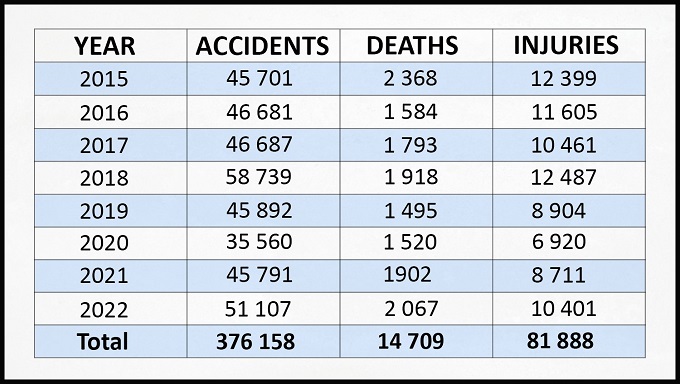
Sunday Mail Reporters
AN average of five lives are lost on Zimbabwe’s roads every day. This translates into over 1 800 deaths and countless injuries annually, a situation that leaves families shattered and communities devastated.
According to the Traffic Safety Council of Zimbabwe (TSCZ), between 2015 and 2022, the country recorded more than 376 000 road accidents in which close to 14 600 people were killed and 81 800 others were injured.
More than 38 400 road accidents occurred during the first nine months of this year, with over 1 500 fatalities being recorded over that period. In total, over 7 200 people were injured in those traffic accidents.
In a recent interview, TSCZ managing director Mr Munesu Munodawafa told The Sunday Mail that most road accidents occur around public holidays.
“It is disturbing that as of September 30 this year, we had recorded 38 482 road accidents; a total of 1 545 deaths; and 7 294 injuries on our roads,” he said.
“These numbers are worrisome.
“Putting that into context, we have a road accident every 15 minutes in Zimbabwe and about five people die, while 38 are injured in road accidents every day.”
Experts say the causes of road accidents in Zimbabwe are multifaceted and deeply rooted. Most incidents of road carnage have been attributed to reckless driving, inadequate enforcement of traffic laws and use of defective vehicles on the roads, among other reasons.
In Zimbabwe, public holidays often see a surge in travel, with people visiting families and attending different celebrations, significantly increasing the volume of traffic on the roads.
Studies have also shown that the excitement and festive atmosphere surrounding holidays often prompt some drivers to engage in risky behaviour such as speeding, overtaking dangerously and driving under the influence of alcohol or drugs.
The festive season leading up to the Christmas holidays in Zimbabwe generally starts around mid-November and extends until the beginning of January.
While the festive season brings palpable joy and celebration, it also casts a shadow over the nation on account of increased road carnage.
Causes
On the rise in road accidents that happen during this period, several factors are at play.
According to transport and logistics expert Mr Atkinson Munemo, factors behind the surge in accidents during holidays include increased traffic volume on the country’s roads, human error and reckless driving.
He said: “During holidays, many Zimbabweans travel long distances to visit family and friends, leading to significantly increased traffic volume on major highways and rural roads. This creates potential for an increase in accidents.
“In addition, buses and kombis often overload. By exceeding their carrying capacity, they compromise passenger safety.”
He said there are also human factors that contribute to road accidents.
“Driver fatigue is one factor that leads to accidents,” he continued.
“Long journeys and late-night travel can lead to driver fatigue, impacting judgement and reaction time. There is also the issue of speeding, whereby the desire to reach destinations quickly, especially during peak travel periods, can lead to reckless driving and exceeding speed limits.”
Celebrations and gatherings, he said, are often marked by alcohol consumption, which can impair driving ability and contribute to accidents.
“Using mobile phones while driving, attending to passengers or simply being overwhelmed by the holiday rush can distract drivers and increase the risk of accidents.”
Impact
The economic impact of road accidents is substantial. The World Health Organisation estimates that road traffic crashes cost Zimbabwe an estimated three percent of its gross domestic product annually.
This loss can be attributed to lost productivity, medical expenses, and damage to property and infrastructure.
Critically, a staggering 77 percent of the fatalities and injuries are of economically active people.
Mitigation
Addressing these complex challenges requires a multi-pronged approach, experts say. They argue that by investing in infrastructure, strengthening enforcement and awareness, Zimbabwe can create safer roads and save lives. Ministry of Transport and Infrastructural Development Permanent Secretary Engineer Joy Makumbe said the authorities will enhance awareness campaigns this festive season to promote road safety.
“My ministry shall deploy multi-stakeholder teams comprising Traffic Safety Council of Zimbabwe, ZRP (Zimbabwe Republic Police) and VID (Vehicle Inspection Department) officials for a full-fledged awareness campaign on road safety.
“Enforcement agencies are urged to arrest all transgressors of road traffic laws and refer them for prosecution without fear or favour.
“May I remind all transporters who violate traffic laws that the relevant authorities will be ready to enforce the law and if need be, withdraw their operators’ licences in terms of the laws.”
She said drivers should avoid speeding and overloading their vehicles.
“As we travel on our roads, let us avoid the following transgressions: speeding, remember that speed thrills but it kills; overloading; disregarding road signs; multi-tasking, such as drinking or chatting on the cellphone whilst driving; and driving under the influence of alcohol.”
She said driving vehicles with defects and worn-out tyres or those fitted with illegal additional headlights would lead to penalties.
Eng Makumbe also discouraged drivers from engaging in road rage, attempting to go past flooded rivers and bridges, and driving public service vehicles without valid certificates of fitness.
Meanwhile, Government is working on providing a national air ambulance service, which is seen as one of the ways that can help reduce deaths on the country’s roads.
Last week, Russian flight paramedic instructors arrived in the country to begin training local air ambulance personnel, paving the way for the launch of the air ambulance service.
Awareness
Zimbabwe Union of Drivers and Conductors (ZUDAC) president Shadreck Maguramhinga said his organisation was undertaking nationwide road safety awareness campaigns.
“We train our drivers in collaboration with the Traffic Safety Council of Zimbabwe,” he said.
“We have held several workshops together on how we can fight road carnage.
“We are also fighting harder to make sure our laws become effective in dealing with issues that cause accidents on our roads.”
He said studies have shown that human error contributed significantly to road accidents.
“We have the human element taking up to more than 94 percent in terms of contribution to road carnage, which means more has to be done in terms of training drivers and undertaking awareness campaigns.”
Transporter Mr Decent Rimbi, of Rimbi Coaches, said: “If any passenger notices something wrong from the manner a driver will be acting on the roads, they should report to the police.”
“We have breathalysers for testing our drivers before they start work or after work.
“It, therefore, helps us to ensure that our drivers do not drink during working hours, which can lead to carelessness on the road.”
Experts also point to limited access to emergency medical services in rural areas, which inevitably results in fatalities that could have been prevented.



 Online Reporter