malvernmugadzikwa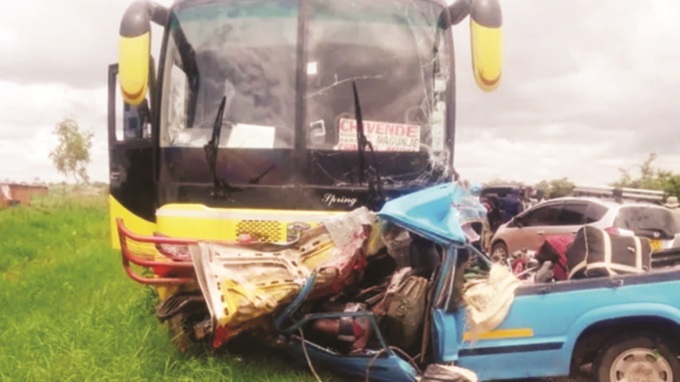
Clemence Machadu
IN 1991, a group of top Zimbabwean artistes, who included Fortune Muparutsa, Prince Tendai, Oliver Mtukudzi, Mechanic Manyeruke, Michael Lannas, Simon Chimbetu and Hosiah Chipanga, recorded the song “Bus Driver”.
The track came in the wake of the devastating Nyanga Bus Disaster, which claimed 89 lives, mostly learners, on August 3, 1991.
The heart-wrenching song was a sombre reminder that road traffic accidents are not just statistics but human tragedies that devastate families and the economy.
The driver of the bus was reportedly speeding and driving under the influence of alcohol.
Sadly, this song continues to speak deeply to the realities of present-day Zimbabwe.
Latest statistics for January to May 2024 show that there were 21 183 road traffic accidents, which resulted in 4 350 people getting injured and 860 deaths.
This translates to one accident every 10 minutes, with 29 injured people and almost six deaths every day.
In the same period in the prior year, 785 fatalities were recorded.
This growing trend is worrisome.
These fatalities could actually be higher, given that Zimbabwe mainly records deaths at the accident scene and hardly records deaths during hospitalisation or after discharge as done by the World Health Organisation.
While Sustainable Development Goal 3.6 targets to reduce the number of global deaths and injuries from road traffic accidents by 50 percent by 2030, it is sad that in Zimbabwe, these numbers are going up.
While Covid-19 claimed 5 637 lives during its peak period (2020 to 2022), road traffic accidents claimed 5 489 lives during the same period, even though there were lockdowns and traffic movement was restricted.
Road accidents are, therefore, a silent pandemic that is claiming precious lives and harming our economy.
In 2018, the Traffic Safety Council of Zimbabwe (TSCZ) estimated that the country loses about US$406 million per year from an average 40 000 road traffic accidents.
And what price can be placed on precious human lives?
What is sad to note, according to TSCZ’s 2018 study, is that 94 percent of road accidents are due to human error, rather than vehicle defects (5 percent) or road environment (1 percent).
This means virtually all accidents are caused by human error — talk of speeding, reckless driving, driving while using the phone and driving under the influence of alcohol, among others.
The authorities are doing their best to fix the roads.
We have seen numerous roadworks across the country.
However, this is not an end in itself, but a means to an end, as it will only address 1 percent of causes of road carnage.
Even if all the roads in the country are to be in perfect condition, this will not fix human errors, which account for 94 percent of road accidents.
With the vehicle population having risen from 800 000 in 2011 to 1 484 517 as of March 2023, there has also been a concomitant increase in human errors.
It was estimated that unlicensed or improperly qualified drivers were involved in about 25 percent of the 2016 fatalities on our roads.
The kind of reckless driving that we see on the roads every day can attest to this.
Jaywalking is also a major problem, as pedestrians often cross roads at undesignated points, putting themselves at risk.
On some roads, motorists have to contend with jaywalkers, which increases chances of collisions and serious injuries or fatalities.
Pedestrians need to be more aware of designated crossing points and obey traffic signals.
The TSCZ has already highlighted that most pedestrians who were struck and killed by vehicles in the past were actually at fault.
Granted, some roads also lack proper pedestrian crossing points and markings, as well as sidewalks or cycle tracks, which calls for the authorities to invest in pedestrian-friendly features to ensure safety.
A road safety performance review conducted by the United Nations in September 2021 for Zimbabwe came up with key findings that should inform road and traffic policies and strategies.
One of the key observations made was that the increase in the number of vehicles has not been accompanied by adequate road upgrades and maintenance or rehabilitation.
The review also established that, while Zimbabwe has a sound legislation and standards framework in place for vehicle inspection, certification and check management systems for public service vehicles, private cars are, however, exempt from undergoing such inspections and certifications.
Some of the private vehicles provide informal public commuter services (mishikashika), thereby operating outside the transport regulatory and enforcement framework.
The review further established that, while Zimbabwe’s road driving standards are historically high, enforcement of such standards has increasingly come under threat of corrupt practices by officers entrusted to enforce
them.
These are some of the issues that should be interrogated.
Statutory Instrument 118 of 2023, which was gazetted to control the speed of public vehicles, is a welcome development.
This regulation states that public service vehicles or heavy vehicles should have speed-monitoring and speed-limiting devices that restrict their speed to 100 kilometres per hour.
By addressing the issue of speeding, we can significantly reduce road carnage incidents.
Speeding makes it difficult for drivers to control their vehicles and stop in time to avoid collisions.
I believe having speed-monitoring devices will also act as a deterrent by encouraging drivers to be more cautious and compliant with speed limits.
It also protects vulnerable road users such as pedestrians and cyclists.
While this legislation only requires speed-limiting and monitoring devices on passenger public service vehicles and heavy trucks, it is my view that it can make a bigger impact if such requirements are extended to private vehicles to control those who try to bring Formula 1 on our highways. Allowing unchecked speeds on private vehicles also puts all road users at risk.
A speed limit of at least 120km/hr would go a long way in ensuring that we foster safety on our roads.
For Zimbabwe to achieve SDG 3,6, which targets to reduce the number of global deaths and injuries from road traffic accidents by 50 percent by 2030, all hands must be on deck.
We should have concrete policies and strategies in place to ensure safe road management, safe roads, safe vehicles, safe road users and effective post-accidents response.
Clemence Machadu writes about socio-economic issues. Feedback: [email protected]



 Online Reporter