Online Reporter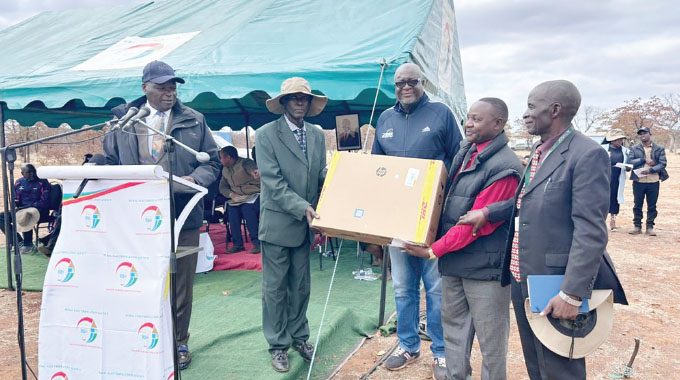
Nqobile Bhebhe, [email protected]
FOR years, Ms Mercy Mpofu relied on gas to keep her small business running in Majindane, Umguza District. The costs were high, transporting gas cylinders from Bulawayo was risky and expansion remained a distant dream.
Today, her outlook is brighter.
The commissioning of the Majindane Electrification Project has brought electricity to her community, opening up opportunities for business growth, improved security and a better quality of life.
“We are so excited that we now have electricity. We were using gas and it is expensive for us in terms of cost, transportation and also the dangers associated with transporting it from Bulawayo,” said Ms Mpofu.
“I now look forward to expanding my business. Security around the premises is also enhanced because we have lighting.”
Ms Mpofu’s excitement reflects the hopes of many residents in Majindane, where the Government is accelerating rural electrification as part of efforts to transform livelihoods and ensure equitable development.
Speaking during the commissioning of the project on Saturday, Minister of Energy and Power Development July Moyo said the initiative forms part of Government’s broader vision to provide universal access to modern energy and improve living standards in rural communities.
The project involved the installation of 8,6 kilometres of 11kV power line, 0,49 kilometres of medium-voltage line and a 50kVA transformer substation to electrify Majindane Primary School, Majindane Business Centre and a community borehole.
Completed in just 50 days for ZiG3 million, the project is expected to unlock socio-economic opportunities for the community.
“Electricity or energy in general is a key driver to industrialisation, modernity, economic development and improved conditions of living of people in rural communities of Zimbabwe. As a country, we cannot talk about the quality of education of our children, health care for all and village business units (VBU) without the availability of electricity,” he said.
The minister said that for decades, rural communities lagged as electrification efforts largely benefitted urban centres, commercial farms and mining operations.
“Over the years, electricity was mainly available in towns and cities as well as in large-scale commercial farms and mines, while rural communities, where the majority of our population lives, were neglected and disadvantaged,” he said.
He noted the absence of electricity had negatively affected education, leaving rural learners at a disadvantage.
“Communities did not enjoy any meaningful development as many schools, the primary source of education and development, lagged in technology because of the non-availability of electricity. The bad situation disadvantaged rural school boys and girls as compared to fellow urban students,” he said.
Health facilities were equally affected.
“Clinics were not offering quality health care services due to a lack of refrigerators for vaccines and machinery powered by electricity, such as X-ray machines, leading to high child mortality rates and pregnancy complications,” said Minister Moyo.
He added that agricultural production had also been constrained as farmers relied heavily on rain-fed agriculture despite having access to dams and rivers.
“Villagers and small-holder farmers with the zeal for agricultural production relied on rain-fed farming despite having water in dams and rivers, causing their yields to remain suppressed because of the absence of irrigation, which is driven by electricity,” he said.
Minister Moyo traced the origins of rural electrification to Independence in 1980, when Government prioritised extending development to previously marginalised communities.
To accelerate the programme, Government established the Rural Electrification Fund (REF) in 2002.
“Government saw it fit to create the Rural Electrification Fund in 2002 to facilitate rapid and equitable electrification of all rural areas of Zimbabwe,” he said.
The minister commended the Rural Electrification Agency (REA), the implementing arm of REF, for spearheading projects that continue to transform rural livelihoods.
“Since then, REA has become a beacon of hope and satisfaction to our rural communities as it drives its mandate to provide universal access to modern energy through grid and off-grid technologies,” he said.
Minister Moyo said the recently launched National Development Strategy 2 (NDS2) aims to accelerate Zimbabwe’s transition into a prosperous and empowered upper-middle-income society by 2030, with electricity playing a central role in achieving that vision.
The commissioning of the Majindane project comes amid significant progress in energy infrastructure development across Matabeleland North and South.
According to REF statistics, Matabeleland North completed 22 grid extension projects between January and June this year, while eight more are under implementation. The province also completed one institutional solar project covering 13 systems serving 24 institutions, while two community solar projects are under development.
Additionally, 27 domestic biogas digesters have been completed, with another 25 under construction.
The province has installed 84 solar micro-grid systems and 55 mobile solar units, bringing the total number of solar installations to 139.
In Umguza District alone, 139 institutions have been electrified through REF programmes, including 44 primary schools, 14 secondary schools, eight clinics, six business centres and three traditional leaders’ homesteads. Only 15 institutions remain outstanding.
National statistics further show that Matabeleland North has achieved an overall rural institutional electrification rate of 87 percent, while Matabeleland South has reached 90 percent.
Clinics in the two provinces are almost fully electrified, with completion rates of 99 percent and 98 percent, respectively.
Matabeleland South has emerged as the country’s leading province in solar energy deployment, with 164 solar installations, while Matabeleland North has 137.
The developments are expected to improve service delivery, enhance educational outcomes, boost agricultural productivity and stimulate economic activity as Government intensifies efforts to achieve universal access to electricity under Vision 2030.