Victoria Ruzvidzo
Editor’s Brief
President Mnangagwa last week stressed the importance of rural industrialisation, saying Government was moving a gear up in its quest to improve livelihoods and ensure this feeds into the national development discourse.
This is a real game changer that has seen a massive transformation in many rural areas. And there is more where that came from going by the President’s message as he addressed the 27th Ordinary Session of the ZANU PF National Consultative Assembly in Harare on Friday.
Under the National Development Strategy (NDS2), rural industrialisation has been identified as a key pillar for inclusive national development.
This is definitely one initiative that will ensure Zimbabwe achieves an upper middle income status by 2030.
We have seen rural areas becoming more and more attractive to individuals and institutions that see them providing green horns for expansion.
Africa is typified largely by rural to urban migration, but Zimbabwe is on course to reversing that trend.
Rural to urban migration is a phenomenon premised on few jobs and low income whereupon even subsistence farming is drought-prone, worsened by poor soils in instances and low crop prices
By contrast, cities were perceived to offer a multiplicity of jobs opportunities, better services in terms of schools, clinics and financial services, among others. There is also more solid infrastructure such as piped water, electricity and roads. The lifestyles perceived by many are modern, trendy, with freedom and opportunities in excess amount.
But the Second Republic has moved quite aggressively to promote and facilitate such developments and lifestyles in rural areas.
The establishment of village business units is transforming the economic landscape in rural areas. The Government is setting up at least 35 000 such enterprises meant to morph subsistence farming and make them commercial and market-oriented entities.
They are community-owned and run as registered companies. The entire concept, novel as it is, actively seeks to industrialise rural populations.
Each VBU has:
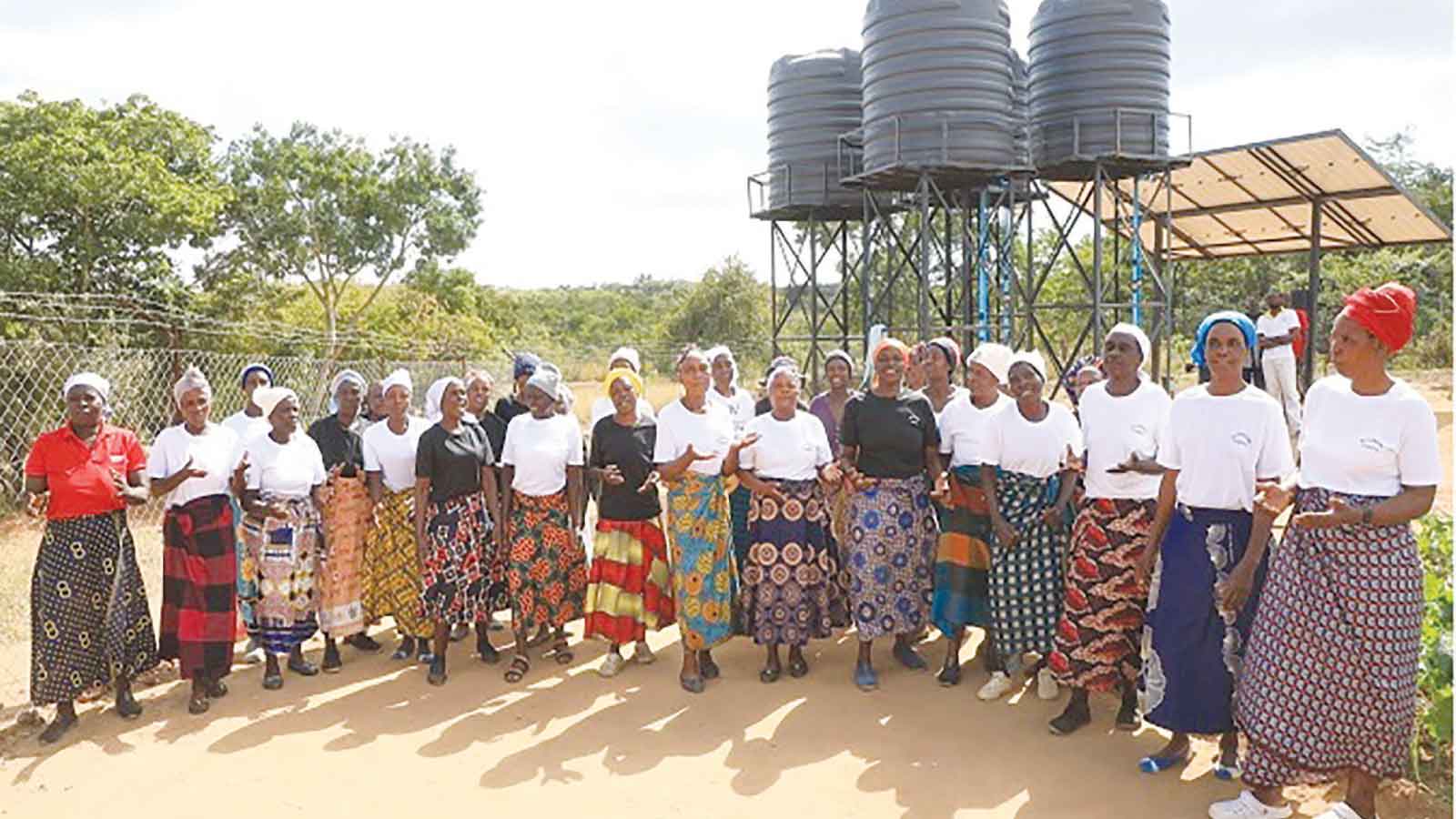
- Solar-powered borehole and water storage with tanks up to 20 000 litres capacity.
- Two fish ponds typically measuring 20m × 10 m each
- Piped water, washing stables, cattle troughs
- Greenhouses, orchards and poultry projects where practically possible.
These were launched in 2021 by President Mnangagwa at Jinjika Village as part of the Presidential Rural Development Programme and Rural Development 8.0. The global aim of VBUs is to bolster food security, escalate employment opportunities consolidate value in villages and diminish migration pressure.
The Agriculture Marketing Authority assists with the identification of markets and also determines what each area they can profitably produce.
This week, President Mnangagwa is set to commission the Finealt Bioeconomy Industrial Park in Mutoko, marking a major milestone in the Government’s drive to accelerate rural industrialisation, promote value addition and beneficiation and unlock sustainable economic opportunities for local communities.
The industrial park project, being set up by Finealt Engineering — an agency under the Ministry of Higher and Tertiary Education, Innovation, Science and Technology Development — is an integrated industrial hub producing biodiesel, cooking oil and soap, with a stock feed plant to be added later.
The park will utilise locally-available natural resources and by-products predominantly found in Mashonaland East Province, creating value-added products, while enhancing community participation in the provincial economy.
Testimonies by members of VBUs have really been heart-warming. Lives are being transformed through commercial enterprises such as market gardening, fisheries, poultry farming and other such projects that have given beneficiaries a good source of income.
“I can now afford to pay my children’s school fees well ahead of time. We now decide the food we want to eat unlike days of old when whatever was available, especially leaf vegetables like covo, is what we settled for. Look at even the way I am dressed. President Mnangagwa’s programmes have really transformed my life,” said one member of a business unit in Mashonaland East a few months ago as he was interviewed on television.
In Manicaland for example, VBUs have been established in areas such as Chisuma, Temaruru, Hakwata, Chisesa, Mutema Secondary, and Chief Mutema Secondary.
Speaking on these VBUs some time ago, the Zimbabwe National Water Authority spokesperson, Ms Marjorie Munyonga said; “These VBUs have proved to be a game-changer for the beneficiary rural communities whose lives have been transformed in terms of food security, employment creation, and enhanced food income generation.
Sunday Mail Deputy Editor Lovemore Chikova in his column Development Dialogue entitled; “35 000 registered companies, a fresh approach to village transformation” in The Herald of October 6, 2023, further sought various comments from beneficiaries.
He notes that headman Mboyamaswa was highly appreciative and his fellow villagers are spearheading a horticulture project which has now turned into a fully-fledged business enterprise after benefiting from solar-powered borehole.
In Matabeleland South Province, there is Sekusike Makorokoto Presidential Horticultural Scheme which has since changed the lives of the villagers. Chairperson of the village, Mr Bunzwani Maphosa, said the project changed the lives of nearly 150 villagers in the area.
He said; “Since we started farming, we have harvested four times, and this is our fifth crop. The garden has changed our lives. We have been able to supply the local market with our products and even sell to neighbouring villages such as Mayobodo. In the past, people used to travel as far as Bulawayo, just to get vegetables, but we are now the major suppliers here. Even our nutrition has vastly improved.”
VBUs are designed to make farming a business and not just for subsistence.
The Government allocated $70 million to catalyse rural development in 2024. At the time, the resources were meant to elevate vocational training, improve infrastructure and go towards meeting agricultural inputs. Funding is in ascendancy to date.
The entire concept is to make rural areas economically active, viable and attractive.
Requisite infrastructure such as roads, boreholes, irrigation schemes and other such are being installed or refurbished to aid business operations in rural areas.
Already, nurses, teachers and other health and teaching staff are finding the rural areas attractive. This has a bearing on the quality of staff in the areas where previously they had to be forced to take up the jobs against their will only so they could be employed.
The benefits have been immense and are cascading all the way down. Economically viable rural areas drive national industrialisation and help the country achieve its economic, health, education and other targets better and much faster than before.
The manufacturing sector gets 65 percent of its inputs from agriculture and the VBUs are strategic in this instance. Other sectors of the economy are also performing better. Village tourism is being enhanced as tourists get an experience of the rural set-up. This is a unique product set to attract more tourists seeking a more serene experience.
So much in terms of economic growth will come out of rural industrialisation.
The World Bank says Africa’s population is 4 5percent urban and 55 percent rural while the Africa Development Bank states that 60 percent of Africans are in agriculture but sell it raw. Produce such as maize, diary, horticulture, beef, cocoa, coffee could fetch three to five times more with value addition.
Furthermore, Africa accounts for only 2 percent of global manufacturing and 1,4 percent of manufactured exports. These are figures we can easily improve on as a continent through such initiatives as rural development. Value addition is now the operative phrase with immense potential to improve export earnings.
Indeed, industrialisation transforms low income and equally low productivity into greater incomes and more robust economies. It promotes higher revenues, creation of employment, fewer populaces trapped in poverty, reduces urban migration, and ensures better living standards in rural areas.
When a country is inhibited by poor industrialisation, it has dependence on mere commodities which are exhaustible and employment will be scarce.
So rural industrialisation can give impetus to the value addition drive.
Where there is no value addition, revenue streams are diminished. In the absence of industrialisation, populaces become susceptible to climate shocks whereupon one bad season can easily push people into poverty.
We cannot possibly talk about industrialisation without including rural populaces. Let’s start with the SADC Industrialisation Strategy and Roadmap, 2015-2063. It was approved in no less a place than Harare in 2015. It is in sync with AU Agenda 2063. Industry is only 13 percent of SADC’s GDP with negligible value addition.
There are three pillars which anchor this strategy:
Industrialisation: For the advancement of economic and technological transformation.
Competiveness: This entails a transition from just having resources to being competitive in quality, cost and human capital
Regional integration: Always key-utilisation not just of SADC, but African Continental Free Trade Area, to build value chains.
The continent’s demographics favour us. Demand for food will and is escalating. Furthermore, Africa has 30 percent of global minerals, putting an accent on value addition and beneficiation.
It is a difficult proposition to generalise but on average, the majority of Africans are in rural areas. The numbers themselves, country by country, widely vary. For example, Burundi has 84,84 percent in rural areas. By contrast, Gabon only has 8,69 percent rural.
In East Africa, 77 percent is in rural areas. Africa, on the whole, is the least urbanised continent. More than a half still live in villages or small towns. This accentuates the need to put emphasis on agro-processing, rural industrialisation and indeed the type that VBUs espouse.
We cannot perennially and eternally talk about Africa’s potential. It finds itself in expression, or it does not work.
Globally, Africa is now being viewed as the continent to be, where things are happening and need to be solidified. We have seen the rush for this country. Even a global icon like the Formula One icon, Lewis Hamilton is on record as saying he would want to see a Grand-Prix in Africa before he retires. In the same interview, he said that African resources should be utilised by Africans.
So, here we are. We have talked about inclusive growth. That invariably entails including rural communities. We do it for our respective communities and economies. We do it because we do not want to leave anyone behind.
We do it to also utilise the resources at hand, most crucially the land. It makes social, economic, logical, political even emotional sense. The VBUs are a game changer, they have breathed life into communities, we leverage on them, we build on them. We use them as a platform to achieve even more.
In God l trust.
X handle: @VictoriaRuzvid2; Email: [email protected]; [email protected]; WhatsApp number: 0772 129 972.