

 admin
admin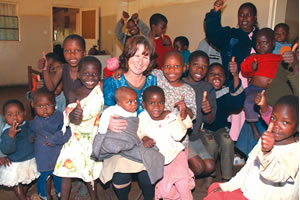
Mount Selinda, Chipinge, three years ago.
No one in the plantation knew where to locate her mother’s relatives and none had the faintest idea of where to trace her father, resulting in Agnes being taken to Chipinge by social workers.
She could barely walk and neither did she know her name, making it difficult for the social workers to find an extended member of her family to look after her.
As such she was taken to Daisy Dube Children’s Home at Mount Selinda Mission Hospital where she is now staying with 44 other children who came from different difficult backgrounds.
The children’s home is run by the United Church of Christ in Zimbabwe.
The home, founded in 1955 by Daisy Dube, provides for the physical and emotional well-being of the children all of whom have been removed from unsafe homes, orphaned or abandoned.
Of the 45 children, 26 are girls while the boys total 15. There are six toddlers the youngest being eight-month-old twins Nomatter and Rumbidzai whose mother passed away due to pregnancy-related complications.
While Agnes and the other 44 children wake up to a meal, have lunch and supper everyday, the institution is facing serious challenges – a reflection of the situation in many other children’s homes in far flung rural areas.
Unlike most children’s homes in urban areas that have regular visitors and donors, those in rural areas are in dire need of help.
A visit to the home last week painted a picture of an institution that is trying to do its best to make the lives of the children better, but is hindered by lack of finance.
Despite having electricity at the institution, workers have to fetch firewood everyday to heat bathing water and cook three meals a day as the only four-plate stove they had stopped working years back.
In the dining room area is a book shelve, a television set and DVD player.
Four old office desks are used during meal times by the children.
The walls of the bedrooms, kitchen, and dining room are stained and are crying out for repainting.
The toilets and bathrooms which are next to both boys and girls’ bedrooms need urgent renovations.
The wardrobe doors in both bedrooms have fallen off, electricity sockets need repairing.
The two old malfunctioning washing machines stand on the sides of two of the 12 beds in the boys’ bedroom.
“They no longer work and we have to do laundry of all 45 children manually everyday.
“We will not be able to cope if we do not do the laundry daily,” says Mrs Chamaida Dube, a worker at the home.
Home administrator, Mrs Maryjane Westa said the children are still living in dormitories and they urgently need to put them in family units just like many other city children’s homes have done.
“As the trend everywhere we need to put these children in family units so that they grow up around people they regard a sisters, brothers and mothers.
“The children learn to love and respect each other more than they do when staying in dormitories.
“Children belong in stable, loving families. We believe they lead physically, emotionally, and mentally healthier lives when surrounded by caring, nurturing adults in a family,” she said.
Mrs Westa added that they are failing to move towards the family unit concept because of financial constrains.
“We do not have the money to set up the family units. We get little or no outside financial help,” she said.
She added that Government, through the department of social welfare has been giving them US$15 for each of the 45 children every month and the money totals US$675.
However, the money sometimes does not come on time and they have to go it alone to meet daily requirements of the children. Even when the US$675 finally comes, it is never enough.
For instance, the home needs between US$600 and US$1 000 for food and milk formula for infants, US$900 for staff salaries and US$2 500 for miscellaneous expenses.
The department of social welfare has however, been paying for the children’s school fees.
The community has been of little help as they can assist by repairing some furniture.
Other urban children’s homes like Matthew Rusike, Chinyaradzo, SOS and Harare among many others adopted family group homes years back and are getting considerable funding from well wishers as they are well known.
Well wishers also visit regularly to help with cleaning, cutting grass etc.
For instance some family group homes at Matthew Rusike Children’s Home are sponsored by Action for Children, each housing 10-12 children and a house parent.
These were officially opened in September 2007.
The family group homes are landscaped with flowers and trees at the front and planted with vegetables at the back making them no different from homes any other child comes from.
With the children living in family groups in housing units, staffing was re-organised and more people were employed to cope with the new demands.
Even if the children are staying in family units, childcare development officers try to find family members and encourage them to foster the children. If this is not possible they are encouraged to have the children stay within the family unit for the school holidays. This gives the children experience of life outside the institution.
These officers also work closely with the communities where new centres are being developed to support the families without parents due to HIV/Aids.
First Lady Amai Grace Mugabe recently took 15 children from Harare Central Hospital into her state-of-the-art Children’s Home in Mazowe.
The facility comprises of family housing units.The abandoned children – 10 girls and five boys – are aged between three months and one-and-half years.
Amai Mugabe proposed to adopt the children from the hospital in December last year during the National Child Survival Strategy for Zimbabwe programme.
The 15 become the first beneficiaries at the centre that will accommodate about 600 children when it is completed.
The home has 30 houses with 16 measuring 365 square metres while the remainder are a massive 412 square metres each.
Each house has five bedrooms, five bathrooms, a lounge, a dining room and a kitchen.
So far 11 houses are ready for occupation while the rest are expected to be complete next year. The centre would be officially opened next year.
United States-based organisation NACAC has done extensive research on the dangers of Institutionalisation of children.
NACAC says research shows that institutional care negatively affects child development and adult productivity.
For example, paediatricians, public health experts, and child psychiatrists from Boston University School of Medicine and Harvard University studied the orphanage issue and found that young children are uniquely vulnerable to the medical and psychosocial hazards of institutional care.
“In the short-term, young children risk contracting serious illnesses and developing language impairments. In the long-term, children who spent time in institutional care stand a greater chance of becoming psychologically impaired and economically unproductive adults (Frank et al, 1996),” explains NACAC.
The organisation says children denied the opportunity to form a consistent relationship with a caregiver in their childhood years, such as institutionalised children, are at serious risk for developmental problems and long-term personality disorders (Sroufe, 1991).
“Close examination reveals that even good institutions harm young children, leave teens ill-prepared for the outside world, and cost over three times more than a permanent, loving, adoptive family (Ford & Kroll, 1995).
On average, institutionalised children were cared for by more than 10 different caregivers per year (Hodges & Tizard, 1978),” adds the organisation.
It further states that children who were adopted and, to a somewhat lesser extent, former foster care children experienced more intimate, consistent, caring, and closer attachments to their caregivers compared to
those who grew up in residential establishments.
Children who grew up in residential facilities seemed to experience few opportunities for closeness, individual caring, and continuity in care.
“Only one in every eight residentially-reared children expressed any real enthusiasm for the quality of care and attachments they experienced with house parents (Triseliotis & Russell, 1984),” adds the study.
But if no help comes soon, the kids at Daisy Dube children’s home will grow up in the dormitories and may never get an opportunity to experience what it feels like to belong to a family.



 Online Reporter