

 daniel chigunwe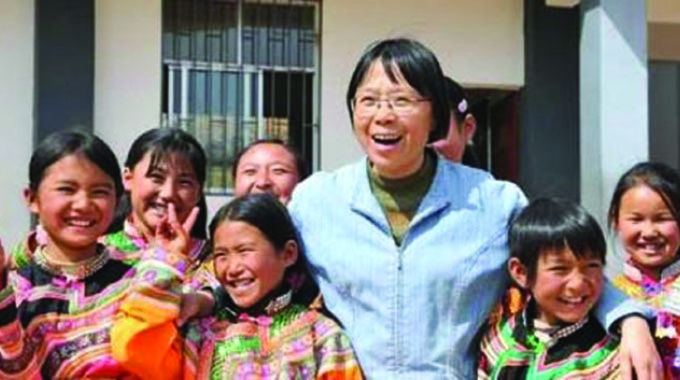
Ms G
For over 40 years, Ms. Zhang Guimei worked as a rural teacher in one of China’s poorest areas. This year, she turned 64. She has heart and lung conditions and more than a dozen other illnesses. She has been admitted to hospital for emergency care and cheated death multiple times. She can barely walk, trudging up and down the stairs holding tightly to the handrail. She has no children or property of her own. She is almost broke, today still living in the school dormitory.
Her salaries and monetary awards received over the years are most donated to schools, children and people in need, totalling one million RMB (more than 150,000 US dollars).
She is still at her job, the headteacher of China’s first tuition-free girls’ high school, “mother” of more than 130 children in an orphanage. For 12 years, her school changed life for more than 1,800 girls from extreme poverty. More than 40 percent got into China’s top-tier universities. Girls who received at least nine years of education increased from 50 percent to 90 percent. Early marriages and early childbearing are significantly down.
Ms. Zhang is an awe-inspiring figure in China.
In 1996, after her husband passed away, she moved from the city to Huaping, a poor village in southwest China’s Yun’nan Province, to teach. The poverty there was shocking. Students could only suppress their hunger with a bit of rice–vegetables and meat were unimaginable. Tuitions were paid with bags of coins. Girls were few and tend to drop out early.
Ms Zhang told her self better-educated mothers would change the life of at least three generations. She decided to establish a free school for the girls. But funding was almost impossible to find. One potential investor let the dog out to drive her away.
Another spat on her and called her a swindler. Many in her life thought she was having a pipe dream. Eventually, she appealed to the government as a delegate at the National Congress of the Communist Party of China and was granted funding by the local authorities.
The early days were tough. There was only one standalone building, with no fencing or toilets. Students had to borrow the space from a nearby school during mealtime.
Teachers slept next to one another on a single wide bed in the classroom. Not long after the school opened, nine out of the seventeen teachers quit. Ms. Zhang Hongqiong was one of those who stayed. One day, she came to Ms Zhang Guimei’s office with a resignation letter in hand. But when she saw the headmaster swallowing pills with water, she changed her mind, “I came here of my own volition. I am a member of the Communist Party of China. This is not the time for me to walk away from my responsibilities.”
Like Hongqiong, six out of the remaining eight teachers are members of the Communist Party of China. Their convictions were the only thing that kept them going. In front of the Party flag painted on a wall in the school, these teachers raised their hand and took this oath, “I shall fight till my last breath on this battlefield to end poverty.” But before they could finish the sentence, they were all in tears.
To stay mentally strong, they would proudly wear the Party badge to work, review the Party admission oath, hold study sessions on the political philosophies of the Party, and watch films and sing songs with revolutionary themes.
With a physical school in place and teachers on duty, it was still hard for the girls to get ahead; because educational resources were skewed in favour of the richer parts of the country. To succeed in exams, these girls had to work extra hard. Ms. Zhang Guimei runs her school like the military.
Rising at 5:30, washing up in five minutes, assembling in one minute, going from the classroom to the canteen in three minutes, finishing meal in ten minutes, and going to bed after 24:00, the young ladies lived a highly-disciplined life, timed to the clock. Today, the 1 800 girl graduates have built a good life for themselves, working as doctors, police officers pursing a master’s degree, and joining the military. Many, under the influence of their headteacher, became teachers themselves and volunteered to work in rural areas.
Ms Zhang continued to toil at her desk. She is deeply convinced in what she does, “We all live and fall sick and die. But when you are willing to give your own life to change a young girl life, it becomes a life worth living.”



 Online Reporter