

 Online Reporter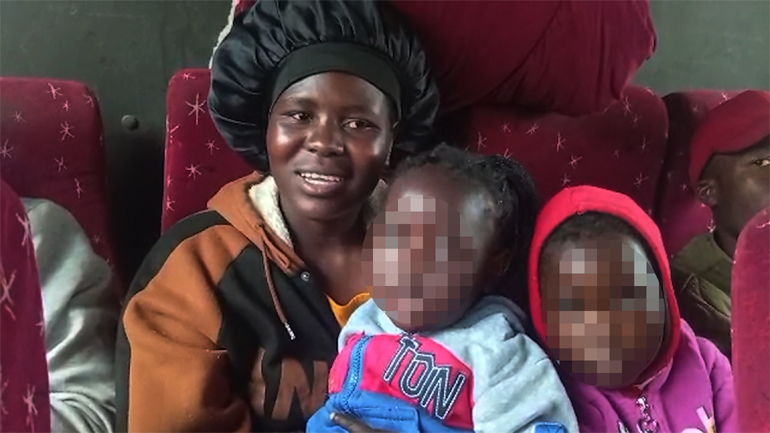
Ray Bande
Senior Reporter
WHEN Tanyaradzwa Magaisa (26) and her two minors arrived at Sakubva Bus Terminus in Mutare in the wee hours of Monday, straight from Robertson Township in Cape Town, after a gruelling week-long road journey, she had no idea how she would get to her Nyashanu Village home in Buhera.
Her husband and their other child were left behind at Beitbridge Border Post after the family failed to locate each other in a restless crowd of thousands of returnees from South Africa.
In such tortuous episodes, siblings are separated and families disintegrated.
Naturally, after enduring harsh weather conditions punctuated by extreme cold and sparse rainfall, people faced with such punitive circumstances scramble onto any bus and ask where it is headed once they secure a seat.
With no money to her name, yet saddled with the responsibility of ensuring her children, Tanyaradzwa (five) and Tinotenda (two) had something to eat, life had temporarily lost meaning and value.
Thanks to the benevolence of the local political leadership, ZANU PF candidate for the orphaned Ward Three, Cde Portia Youth, her husband, Mr Pension ‘Master Payee’ Gwinyai, and youth league chairperson, Cde Lucia Kanyangura, who woke up at 2am, rushed to Sakubva Bus Terminus, and ensured that returnees, especially children, received the safety and comfort they deserved.
They instantly mobilised resources that saw 86 returnees aboard a ZUPCO bus being served tea and bread, while the little ones feasted on cauldrons of porridge. Two bales of second-hand clothes were opened so that children at least had something warm to put on.
Children are the hardest hit by the ongoing anti-migrant tensions in South Africa as thousands of Zimbabweans continue to return home, some on their own and others with Government assistance.
Preliminary figures from the local Civil Protection Committee show that at least 3 013 children had returned from South Africa as of June 28. Seven of the children arrived unaccompanied.
Irrespective of name, surname, totem, religion and race, every child deserves a safe space in which to grow. There is no trust more sacred than the one the world holds with children.
After all, child rights proponents have long told us that there is no duty more important than ensuring children’s rights are respected, their welfare protected, their lives free from fear and want, and that they grow up in peace.
Even though the suffering of children being repatriated is a product of an unAfrican mindset, among some South Africans, their ex-President, Nelson Mandela, once said: “History will judge us by the difference we make in the everyday lives of children.”
He further postulated: “There can be no keener revelation of a society’s soul than the way in which it treats its children.”
Following such abrupt and violent relocation, the challenge of integration now awaits returnees from South Africa. This entails livelihoods, healthcare and, equally important, education for young ones.
Ministry of Primary and Secondary Education spokesperson, Mr Taungana Ndoro said: “We are pleased to report that every child who has returned from South Africa is being welcomed back into our education system with the dignity, care, and urgency they deserve, and is being systematically brought up to speed with our transformative Heritage-Based Curriculum.
“In line with His Excellency, President Emmerson Mnangagwa’s vision of leaving no one and no place behind, the ministry has deployed robust mechanisms to ensure that these returning young Zimbabweans are, not merely absorbed, but are properly assessed and placed at an appropriate learning level. We recognise that these children are returning home with diverse educational backgrounds, and our trained assessors are working diligently to evaluate each learner’s competencies. This guarantees a smooth transition and prevents the placement of any child in a grade that does not match their cognitive and developmental readiness.
“Every Zimbabwean child, from the age of four in Early Childhood Development (ECD) through to 18 years at the secondary level, is being enrolled in a registered school that is closest to their current place of residence. This proximity-based placement is designed to foster immediate community integration and to remove any barriers to regular school attendance. There are clear directives to all chief directors (Provincial Education Services), district schools inspectors, and school heads to accept every returnee child without delay or prejudice. We repeat, no child will be turned away, and no child will be left behind.”
Officials say children face the most disruption. Many left school abruptly. Some left clothes, books and toys behind.
Parents say they had to choose safety over property. At least, it is an advantage for returning Zimbabweans that the levels of the education systems in both countries are closely aligned.
In South Africa, they use “Grades” all the way through. There are no “Forms”.
Grade R → Grade 12 = Matric. It comprises the Foundation Phase: Grade R, One, Two, Three; Intermediate Phase: Grade Four, Five, Six, Seven; Senior Phase: Grade Eight, Nine — junior high school; FET Phase: Grade 10, 11, 12 — high school, which ends with NSC/Matric examinations.
South Africa goes up to Grade 12, not “Form Four”. A Zimbabwean “Form Four” is equivalent to South Africa Grade 11, while Zimbabwe “Form Six” is equivalent to South Africa Grade 12/Matric.
In other words, Grade Seven is the end of primary, Grade Eight is Form One, the start of high school, Grade Nine is Form Two, Grade 10 is Form Three, Grade 11 is Form Four (O-Levels), and Grade 12 is Form Six (Matric/A-Levels).
“The Ministry of Primary and Secondary Education takes immense pride in the fact that these children are now being immersed in the Heritage-Based Curriculum, a home-grown educational philosophy that anchors learning in our identity, values, and national aspirations. Central to this curriculum is the concept of hunhu/ubuntu — the essence of our humanity — which equips learners with a strong moral compass, a sense of civic duty, and an appreciation of our rich cultural heritage. Coupled with a focus on practical science, technology, innovation, and entrepreneurship, this curriculum is designed to produce learners who are not only academically competent but also skilled and ready to contribute meaningfully to Zimbabwe’s socio-economic development towards our Vision 2030 of becoming an empowered and prosperous upper-middle-income society.
“We are delighted that these young Zimbabweans, who had been separated from their motherland, finally have the golden opportunity to benefit from the immense quality and holistic nature of this curriculum. Their return is not a challenge, but a celebration of national belonging and a demonstration of the Second Republic’s commitment to the welfare of all its citizens, regardless of their previous country of residence. Government remains committed to providing the necessary teaching and learning materials, continuous teacher professional development, and psychosocial support where needed, to ensure that every returnee child thrives in their new learning environment.
“Together, we are building an inclusive education system that truly serves all the children of Zimbabwe. The doors of our schools are open, and the arms of our nation are wide open to receive them,” said Mr Ndoro.
The integration of children in communities, just like their adult counterparts, is also crucial.
Chief Clayton Zimunya said: “As traditional leaders, our foremost responsibility is to welcome our sons and daughters back home with compassion, dignity, and a sense of belonging. Those returning from South Africa have gone through a difficult experience, and it is important that they know they are valued members of their communities. We commend the Government for its swift response in facilitating the safe return of our citizens and for coordinating assistance to those affected. This demonstrates the Government’s commitment to protecting the welfare of Zimbabweans wherever they may be. At community level, we are working closely with village heads, headmen, churches, community leaders, and Government departments to ensure that returnees are received peacefully, supported emotionally, and reintegrated into their families and communities. We also encourage communities to avoid discrimination or stigma, at all age groups including children, because these are our own people who deserve our care and support.”
Ends



We can continue to pontificate over what Mandela said regarding how we look after our children but the bottom line is these people voluntarily left the country looking for greener pastures that they had not watered. What did they think the end result was going to be?