Online Reporter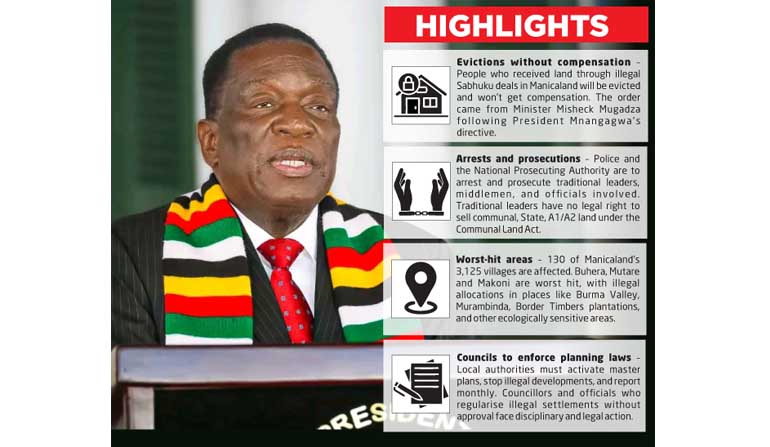
Ray Bande
Senior Reporter
RECIPIENTS of land acquired through illegal allocations in Manicaland — commonly referred to as Sabhuku deals — are being evicted without compensation, while those responsible for the transactions face prosecution, Minister of State for Manicaland Provincial Affairs and Devolution, Advocate Misheck Mugadza, has announced.
President Emmerson Mnangagwa has issued a firm and uncompromising denunciation of the illegal parcelling out of land across Zimbabwe.
Speaking at an all-stakeholders meeting on Wednesday, Minister Mugadza directed law enforcement and relevant State agencies to restore order in land distribution across the province’s seven districts.
The meeting, which brought together heads of ministries, departments and agencies (MAD), the Joint Operations Command (JOC), local authority representatives, and ZANU PF officials, resolved that the unlawful parcelling out of land by unauthorised individuals has created widespread disorder and will no longer be tolerated.
Minister Mugadza emphasised that beneficiaries of these illegal allocations will be evicted and will not receive compensation.
The crackdown specifically targets allocations made outside formal Government procedures, often by village heads and other local actors lacking authority.
Authorities blame these practices for undermining planning, fuelling disputes, and disadvantaging legitimate beneficiaries.
Law enforcement agencies have been instructed to identify and prosecute perpetrators, while local authorities will audit existing settlements to ensure compliance with legal land allocation processes.
“I direct all stakeholders as follows – the Zimbabwe Republic Police and National Prosecuting Authority to intensify arrests and prosecutions of traditional leaders, middlemen and implicated officials. There is zero tolerance for corruption. The Environmental Management Agency (EMA) must enforce Environmental Impact Assessment (EIA) requirements and environmental protection laws in ecologically sensitive areas – wetlands, riverbanks and forests are not for sale. Traditional leaders must operate strictly within the Traditional Leaders Act, and report illegal activities to authorities,” said Minister Mugadza.
He said traditional leaders have no right to sell land in the province, and those perpetrating the vice will face the full wrath of the law.
“Under the Communal Land Act (Chapter 20:04), communal land is vested in and administered by the State through rural district councils.
Traditional leaders are custodians of land and cultural heritage – they are not owners and possess no legal authority to sell or permanently allocate communal, State, A1/A2 farm land. Violations will attract disciplinary action through the Provincial Chiefs’ Council,” he said.
Although no district is spared from illegal land allocations, Buhera, Mutare and Makoni are the worst affected districts.
Giving a breakdown of the worst-affected areas, Provincial Director for Local Government Services and Administration in Manicaland, Mr John Misi, said Chigodora, Piki, Burma Valley and Village R Mutanda 2 Old Resettlement (Mutare); Murambinda (Buhera); Nyamazi and Nyarumvurwi
Resettlement areas (Nyanga); Kondo, Vheneka, Rimbi, Mabhiza, Musaonerwa, Manzvire and Maunganidze (Chipinge); and Border Timbers plantations, Bumba, Chayamiti, Chakohwa, Wengezi, Machongwe, Nhowani and Skyline (Chimanimani) are the hardest hit.
Mr Misi said areas along most highways and all service centres in the province have the highest number of illegal land allocations.
In total, 130 of Manicaland’s 3 125 villages are affected.
Buhera has 44 of 1 163 villages heavily affected, Makoni 26 of 686, Mutare 20 of 327, Mutasa 14 of 233, Nyanga 12 of 253, Mutare Rural eight of 315 and Chimanimani six of 114.
In Chimanimani, illegal allocations have encroached on timber plantations, while in Makoni boundary disputes among five chiefs have led to the appointment of de-facto headmen.
Some illegal settlers were settled in mountains, vleis, waterways, river valleys, pastures and fields, creating haphazard settlements that block drainage, threaten ecosystems and undermine planned development across Manicaland’s rural, old resettlements and peri-urban areas, where the legit land owners are crying for immediate Government intervention.
Minister Mugadza also warned councillors and local authority officials involved in illegal land allocations that the long arm of the law will catch up with them.
“Local authorities must also be vigilant against internal threats. No councillor or official is to participate in the regularisation of illegal settlements without full legal authority, proper planning approval and ministerial sanction. Those who do so will face disciplinary and legal consequences. This meeting must produce concrete commitments. Ministry of Lands: continue to provide policy direction, cancel illegal allocations, and issue State land protection notices. Public Awareness: intensify campaigns through The Manica Post, community radio and social media to educate citizens that communal land is not for sale,” he said, adding that no land offer letters can be obtained elsewhere apart from the relevant ministry.
“Where there are challenges in implementing policies as given or in enforcing the law, these should be brought to the attention of my Office and the Provincial Lands Committee for support and direction. As Government has repeatedly stated: ‘There is no need for anyone to obtain an offer letter from a window somewhere. An offer letter or a title deed must be processed in ministry offices.’ Citizens who bypass lawful channels expose themselves to eviction without compensation,” said Minister Mugadza, as he also directed local authorities to forge ahead with implementation of their master plans.
“The Regional, Town and Country Planning Act [Chapter 29:12] is the cornerstone of our physical planning legal framework. This Act authorises the making of regional plans, master plans and local plans, and empowers local authorities as local planning authorities to control all development within their jurisdictions. The Act is explicit: no development shall occur without an approved layout, permit or planning permission. Sabhuku deals thrive precisely where master plans are ignored. When local authorities fail to enforce planning regulations in peri-urban and communal areas, they create a vacuum that illegal land dealers rush to fill. Densely populated settlements then emerge without approved layouts or surveys, without Environmental
Impact Assessments and without roads, water, sewer reticulation, schools, clinics or any basic service provision, creating future liabilities that ultimately fall on the same local authorities to remedy.
“I am therefore directing that all local councils and rural district councils in Manicaland Province must immediately activate and begin implementing the master plans that have been allocated to them; conduct regular inspections to monitor illegal developments in peri-urban and communal areas within their planning jurisdictions; issue compliance and stop-order notices to illegal developers without delay; coordinate with the Department of
Spatial Planning on layout approvals and planning enforcement; and report monthly to this province on planning enforcement activities and outcomes,” said Minister Mugadza.