

 admin
admin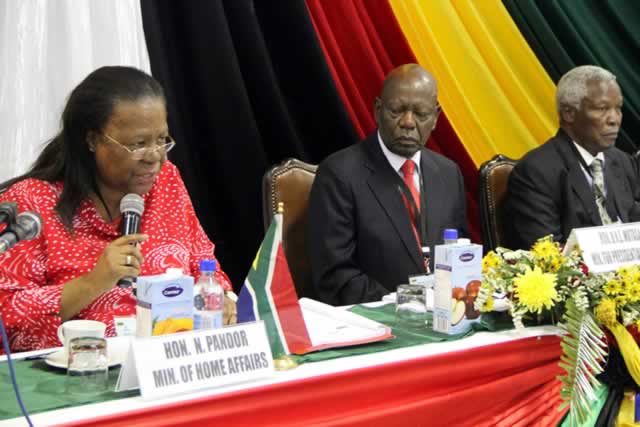

Prosper Ndlovu Senior Reporter
SADC is monitoring the political situation in Mozambique closely and will not allow the Alfonso Dhlakama-led Renamo rebels to destabilise that country, South African Home Affairs Minister, Cde Naledi Pandor, said yesterday.
In her remarks during the ministerial opening of the 8th Session of the Zimbabwe/South Africa Joint Permanent Commission on Defence and Security which ended in Bulawayo yesterday, Cde Pandor, who led the South African delegation, said Sadc member states would intervene if the situation got out of hand.
She said while peace prevailed in Southern Africa, the region remained vigilant in guarding against acts of banditry and terrorism within its member states.
“Our strong message to Renamo is that we will not tolerate any destabilisation in our region. We will not allow anyone to disturb the democracy we fought for,” said Cde Pandor.
She added: “Our opinion is that resolutions must be made on the table and not in a civil war.”
Dhlakama is hiding in the bush and has recently been engaged in sporadic attacks on the Mozambican military and civilian population with some casualties reported.
Head of the Zimbabwe delegation and Presidential Affairs Minister Cde Didymus Mutasa concurred with Cde Pandor and said Africa as a whole was facing a myriad of security threats that required strengthening of joint operations on defence matters.
“It is my fervent hope that our deliberations will result in the formulation of even more effective strategies to mitigate these challenges that continue to threaten our region in particular, and the continent in general,” said Cde Mutasa.
In a joint communiqué issued at the end of the conference, the two countries urged the Mozambican government to dialogue with Renamo and solve the impasse peacefully.
They commended efforts by Sadc and UN to establish an intervention brigade to normalise the situation in eastern DRC.
The commission noted with concern the security situation in the Central African Republic, Libya, Egypt, the threat of international terrorism in Kenya and hoped that the presidential run-off in Madagascar, scheduled for 20 December would restore normalcy in that country.
The commission deliberated on a wide range of issues pertaining to the defence and security of both countries and resolved to strengthen joint efforts to thwart transnational criminal syndicates in both countries.
“These syndicates are involved in acts of human smuggling and trafficking, money laundering, smuggling of precious minerals, drug trafficking, poaching and illicit trading,” read the communiqué.
The finalisation of an agreement between the South African and Zimbabwe Defence Forces to institute staff exchange training programmes was noted with satisfaction with recommendations for improved intelligence coordination towards maintaining consistent liaison and enhanced joint operations.
South Africa congratulated Zimbabwe for the successful holding of harmonised elections on 31 July that Zanu-PF won resoundingly.
The Zimbabwean delegation also paid tribute to President Jacob Zuma for his mediation role as Sadc facilitator in the events leading to elections and wished South Africa well in its polls next year.
The commission also called for the immediate and unconditional removal of the illegal sanctions imposed against Zimbabwe by the West and its allies.
The Minister of Defence, Dr Sydney Sekeramayi, Deputy Minister of Home Affairs Cde Ziyambi Ziyambi, Deputy Minister of Justice, Legal and Parliamentary Affairs Cde Fortune Chasi also attended the meeting.
Cde Pandor was accompanied by the Deputy Minister of Correctional Services Advocate Ngoako Ramatlhodi and senior government officials.
The delegates comprised heads of different security departments in Zimbabwe and South Africa including Zimbabwe Revenue Authority, Zimbabwe Parks and Wildlife Management Authority and Immigration.
Besides geographical proximity, Zimbabwe and South Africa have a common and long history of regional political, military and cultural ties dating back to the pre-colonial era.
South Africa is Zimbabwe’s biggest trading partner, with trade between the two countries running into billions of rand each year. The two countries have also signed a memorandum of understanding on migration to abolish visa requirements to ease the movement of people between the two countries.
South Africa will host the next session in 2014 on a date and venue to be advised.


 Online Reporter
 derick.khumalo