admin
admin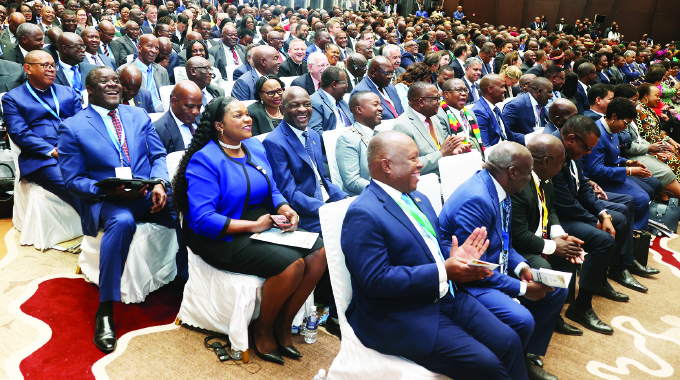
Zvamaida Murwira, Senior Reporter
On Saturday at Mount Hampden, Zimbabwe ascended to a pinnacle of honour as it played host to the 44th Sadc Summit of Heads of State and Government.
The event, monumental in its significance, unfolded in the embrace of the newly constructed Parliament Building – a true marvel of modern architecture, standing proudly as a symbol of Zimbabwe’s growing stature on the continental stage.
The air was thick with anticipation, a sense of historic moment palpable in every corner.
As the dignitaries from across Southern Africa gathered, the sprawling edifice of the Parliament Building, with its towering pillars and majestic dome, seemed to hum with the resonance of unity and shared purpose.
This summit, the first of its kind to be held at the complex, signified not only a meeting of minds but a convergence of cultures, aspirations, and visions for the future of the region.
At Saturday’s summit, President Mnangagwa assumed the SADC chairmanship at a colourful ceremony that brought regional leaders, heads of international organisations, Government Ministers from the region, diplomats accredited to Zimbabwe and business leaders among others.
The event cemented the regional bloc’s quest for deepening regional integration.
It was a massive show of warm multilateral relations between the 16 member SADC countries. And the event lived to its billing.
As early as 7am, a large crowd of delegates had gathered at the New Parliament Building.
Despite the venue ordinarily capable of containing a huge number of vehicles, organisers had anticipated that the spacious car park at the New Parliament Building could be overwhelmed, and organised an alternative one about 1km from the main venue.
Other delegates were asked to use shuttles to complete the journey to the venue. Upon getting to the venue, one could see the heavy presence of journalists with their cameras, a confirmation of the wide scope of this event.
National broadcaster ZBC already had its outside broadcasting vans in place, ready to roll their cameras and keep local and international viewers informed.
By 8am, Heads of State and Government started arriving, with host President Mnangagwa being one of the first to be at the venue.
Before the event started in earnest, the leaders had a photoshoot outside the main building.
In the meantime, delegates sitting in the Multi-Purpose Hall, the venue of the main event, were shown a brief educational video showcasing Zimbabwe’s endowment, both in terms of natural resources and human capital.
Zimbabwe is looking to attain an upper middle class income economy by 2030, in line with the National Development Strategy 1.
The first dignitaries to enter the auditorium were First Ladies, led by Dr Auxillia Mnangagwa.
As the Heads of State and Government walked in, a praise singer from Eswatini, as per the mountain’s kingdom’s tradition, recited a poem in honour of King Mswati III.
Zimbabwe’s two Vice Presidents Constantino Chiwenga and Kembo Mohadi were also in attendance.
Meanwhile, event directors, veteran broadcaster and Zimbabwean legislator Cde Supa Mandiwanzira and Ms Barbara Lopi, Head of Communication and Public Relations at the SADC Secretariat, rose to the occasion, as they kept delegates captivated throughout the event through their gratifying knowledge about the event and guests.
To signal the start of events in earnest, the Zimbabwean, SADC, and African Union anthems were sung.
There were introductions of heads of the SADC leaders and heads of international institutions that include, Pan African Parliament president Chief Fortune Charumbira.
Thereafter Sadc Executive Secretary Mr Elias Magosi delivered his introductory speech, followed by President Mnangagwa’s welcoming remarks as the host.
United Nations Economic Commission for Africa Executive Secretary Mr Claver Gatete also delivered his speech.
As per SADC tradition, Namibian President Dr Nangolo Mbumba, who was attending the summit for the first time after assuming office in February this year, following the death of Dr Hage Geingob, presented his maiden speech.
There was the announcement of regional winners of the 2023 SADC Secondary School Essay Competition, SADC Tertiary Institution Essay Competition and SADC Media Awards.
Zimbabwe Newspapers’ duo of Debra Matabvu and Kudakwashe Hunda were adjudged the best print journalist and photographer respectively, raising Zimbabwe’s flag high.
Outgoing SADC chairperson Angolan President João Manuel Gonçalves Lourenço delivered his speech before officially handing over of the regional bloc’s chairperson’s badge to his successor President Mnangagwa.
There was standing ovation as President Mnangagwa received the badge and a symbolic gavel, used to by a presiding official to call for order or attention at a meeting, from President Lourenco.
It was a busy, but eventful day in office for President Mnangagwa, as he was to return to the podium for the third time to deliver his acceptance speech. His speech marked the end of the official opening of the summit, as heads of States and Government went to the business sessions in closed door meetings.
President Mnangagwa’s assumption of the chairmanship of SADC came at the backdrop of futile calls from local opposition elements and some civic society organisations that sought to discredit the country, hoping the event would be moved away from Zimbabwe. But, the summit was a massive success.
As the summit drew to a close, the sun dipped low over Mount Hampden, casting a warm, golden light upon the New Parliament Building, as Mother Nature offered a final benediction to the day’s momentous proceedings.
The leaders, having forged new paths of cooperation and strengthened the bonds that unite the region, departed with renewed resolve and a shared vision for a prosperous future.
Zimbabwe, in hosting this historic summit, had not only reaffirmed its pivotal role within the Southern African community and the African continent, but had also showcased its enduring spirit, its commitment to progress and its capacity to lead.
As the last of the dignitaries departed, the New Parliament Building stood as a silent sentinel, a proud witness to the historic proceedings that had unfolded within.
It was more than a venue; it was a symbol of a new era for Zimbabwe and the SADC region, a beacon of hope, unity, and the promise of a brighter tomorrow.


 Online Reporter