

 admin
admin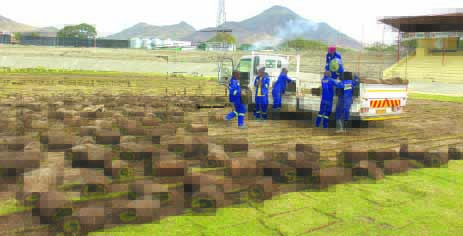
Ray Bande
Senior Reporter
RENOVATIONS going on at Manicaland’s home of football — Sakubva Stadium — are well on course as the contractor is targeting to complete the drainage works by the second week of September and then start working on replanting the lawn to meet the deadline.
Mutare City Council spokesperson Spren Mutiwi gave this newspaper a detailed account on the developments at Sakubva Stadium saying the local authority is confident of the return of domestic Premiership football to the Mutare match venue by the start of next year.
Mutiwi said: “We are targeting to complete the drain works by the second week of September and then we start working on replanting the lawn at Sakubva stadium.
“The main work which resulted in the renovations of Sakubva Stadium has started. We wanted to address the drainage of Sakubva Stadium. Currently the trunk drainage trenches are almost done. The open trenches we are doing have drained the surface of Sakubva stadium which was waterlogged two months ago.
“While we have the front group digging, shaping and standardising the drainage trenches, we have another group that has started laying the perforated drainage lines.” Mutiwi said the old drainage system had totally collapsed in various sections of the stadium.
“On the current drainage framework, we may not have exact dates as to when the old drainage system was implemented at the stadium. However, the system had totally collapsed in various sections of the stadium. The old system had three longitudinal drainage lines.
“In addition, it had 14 latitudinal drainage trenches filled with sand. On the periphery of the pitch was a circuit of a closed ring where both the latitudes and longitudes drained into.
“After the track, Sakubva has a secondary ring running at the foot of the terraces. After water drains from the trenches to the inner ring it leads to the outer ring which in turn drains into the outer ring. The outer ring also drains into the city’s major drains outside the stadium,” he said.
The Mutare City Council spokesperson said the use of the stadium for other programmes other than football badly affected the drainage system.
“This old system had collapsed in the pitch and the major reason was heavy trucks and machinery which came in and out of the stadium using the stadium for various programmes over the decades.
“Secondly some sections of the system were clay clogged, thereby seriously slowing the vertical draining of stadium.
“We are not dismantling the current system, but we are complementing it with a new system. Our new system has drainage trenches which are 60 to 80cm deep.
“At the bottom of the trench is a sand bedding of 10cm, this is followed by a drainage pipe which connects two ends of the inner drainage ring.
“The perforated drainage pipes are covered by three quarter stones averaging 50-60cm. Thereafter there is 10-20cm sand blanket. We will then open up the ring drainages, clean them up and repair damaged areas. From the tests done, we have noted that the lines are draining superbly.
“While working on the drainage, we have started stock piling sand, manure and garden soil which we intend to use as the root zone soil. We will plant the lawn on highly draining soil. To date we are on 50 percent progress on our work at Sakubva stadium,” he said.
Council has also gone ahead to renovate Chisamba Ground in order to reduce pressure on Sakubva Stadium when it eventually reopens.
“We are also working on Chisamba Ground and works are 85 percent complete. Currently the planting has been completed and the turf is now being evened.
“Focus is on making uniform growth in terms of the lawn height. We entered a routine maintenance exercise where we intend to make a world class turf with a deep green look.
“We have done top dressing. This process involves application of a thin layer of nutrient and rich soil to eliminate surface unevenness and bumpy ground. To date 230 cubic metre of top dressing soil and manure mixture has been applied on the surface.
“Lime and fertilizer application has also been done as we undertake a scientific approach in the management of the soil condition at Chisamba Ground.
“In essence, the optimum PH for couch grass (the lawn in Chisamba grounds) turf is around 6.5. We therefore applied lime to raise the pH levels.
“Thereafter we applied single super phosphate fertilisers for the root development of the lawn. We then applied lawn fertiliser for the balance of nutrients. This was followed by heavy watering. We will bring the final master stroke by applying the greening fertilisers in the next two weeks.
“We have been undertaking two cycles of irrigation in the Chisamba Ground for the past month from the day we started planting the lawn. However, for the past week we stopped watering the lawn for a week as a way of promoting a stable grass roots system. Yesterday (Tuesday) we resumed our normal irrigation cycles because of the heavy dose of fertilisers we applied.
“We started mowing the lawn at Chisamba Ground and we are going to do it at least twice a week and our target is to maintain a turf which is 2cm-2.5cm, which is an international best practice for any other international stadium.
“We are targeting a practice match for the council’s senior team at Chisamba Ground on the second week of September. A proposal for the match has been communicated to the city’s Engineering and Housing team and we are waiting for feedback.
“We are using the proposed match to assess the turf as we are still in the process of delivering a competitive turf at Chisamba Ground,” said Mutiwi.


 Online Reporter