Online Reporter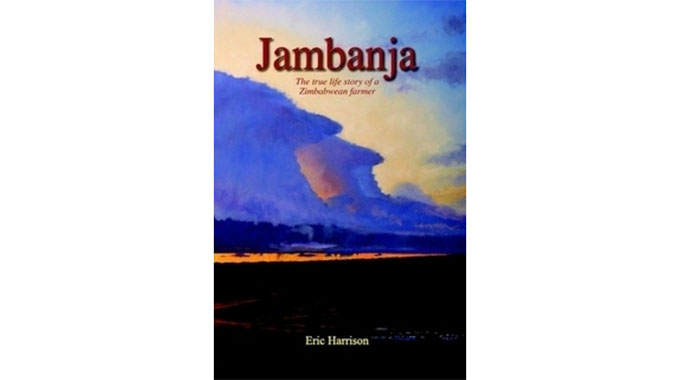
Elliot Ziwira
At the Bookstore
IN the opening chapter of the memoir “Jambanja”, Eric Harrison acquaints the reader with the sanctions slapped on Rhodesia after Ian Smith’s Unilateral Declaration of Independence (UDI) on November 11, 1965.
He also recounts how, despite the embargo and the challenges it imposed, Rhodesia managed not only to function, but to flourish.
By his own admission, Rhodesia prospered not because of resilience alone, but because fellow European nations—Australia, New Zealand, Canada and others—together with apartheid South Africa, buffered the illegal regime. It was, in essence, a European affair.
Rhodesia thrived as a European nation planted on African soil, with whites living parasitic lives sustained by black people’s land and heritage.
Harrison boasts that “industry was becoming self-sufficient and the typical ‘British bulldog’ attitude of the inhabitants’ forefathers kept the country going”. By “inhabitants’ forefathers”, he refers exclusively to white settlers and their ancestors.
Thus, in his framing, Rhodesia belongs to the British.
It is a European nation.
Even after Zimbabwe attained Independence in April 1980, this European enclave continued to flourish until the post-2000 Fast Track Land Reform Programme interrupted the centuries-old hierarchy of land ownership.
Harrison’s interior monologue during this period exposes the heritage question:
“Can I really blame the individual new intruders? What would I have done if I’d been born black? . . . After a long war against white rule and the land he possessed, the white man still dominated the land, the mining and the wealth. Who, in their right mind, would turn down an offer to become a rich man, especially when there was no cost involved at all?”
This confession summarises everything. It was about the land. It has always been about the land; stolen heritage, and nothing else.
Yet critics of Zimbabwe’s post-2000 land reforms incessantly claim that land redistribution was a political ploy.
Harrison himself raises the issue of “othering”, recognising how black people were alienated from their inheritance, stripped of both tangible and intangible rights, and rendered unable to bequeath anything meaningful to future generations.
He admits that even after Independence, “the white man still dominated the land, mining and the wealth”. And he labels Africans reclaiming their land “new intruders”, inadvertently revealing who the old intruders truly are.
Why then does Harrison insist that the Fast Track Land Reform Programme was engineered by ZANU PF solely to retain power, when the reasons behind the reforms are crystal clear even to him as a beneficiary of settler colonialism?
Another revealing thread is Harrison’s own neglect of Maioio Farm.
Like many farmers, he had not “replaced any of his old tractors” and had allowed his machinery “to wind down to a point where it was just operable”.
The buildings too were run-down.
Even the generator that powered the farm was removed by Harry’s son, Trevor. Yet Harrison insists on compensation—as though he has invested rather than inherited and depleted.
Of the 187 hectares of Maioio Farm, 105 were under sugarcane, 55 under citrus, and 27 hectares unused.
If “intruders” were only after oranges and sugarcane, what of the idle 27 hectares he could have requested to retain? His argument collapses under its own contradictions.
Harry also mourns the loss of tools he inherited from his father — “tools that were irreplaceable” — forgetting entirely that Africans too lost precious tools of livelihood, identity, and dignity over generations of dispossession.
Openly admitting to supporting the MDC, Harrison discloses that “the country’s powerful landed gentry” funded the opposition and various “human rights groups” to push for a NO vote in the 2000 Referendum.
The vocabulary here is revealing: “powerful landed gentry”. In his worldview, whites in Rhodesia/Zimbabwe are noble because they own land — African land — African heritage.
Playing politics of subterfuge and sabotage, this “powerful landed gentry” pours money into opposition coffers in the name of democracy, a brittle democracy where minority privilege suppresses majority aspirations.
Although the Referendum was not an election, Harrison claims that the MDC “won 55 percent of the votes as against ZANU PF’s 45 percent”, and that the results sparked “wild jubilation” among both local and foreign MDC supporters. British media celebrated with “End of Mugabe” headlines. For Harrison, this is normal.
For Africans who support ZANU PF because the party offers access to land, their heritage, it becomes a problem.
Heritage determines both power and dignity.
That “wild jubilation” erupted in foreign capitals hostile to black empowerment highlights that Britain and its allies are interested parties in Zimbabwe’s land politics.
The Hegelian notion of supremacy reveals itself not only through sanctions imposed after 2000, but also through the way the European nation within Zimbabwe regroups to safeguard its laager.
Harrison illustrates this European brotherhood at the wedding of “a true-blue Afrikaner” and “a beautiful English Rose”, attended by Afrikaners, English, French, Irish— “you name it”—all enjoying one another’s company.
The venue, an elite hunting camp reserved for foreign clients, symbolises the exclusivity they wish to preserve.
There, they indulge in “smoked trout” and “copious amounts of chilled Nederburg La Bonnet 1998”, while laughing at “a bunch of Warvets sipping chilled wine out of plastic mugs”.
The imagery is deliberate: Africans drink from plastic because glassware is reserved for the white master, the plunderer, the colonialist.
To maintain this hierarchy, the white supremacist must undermine anything that might empower the black African beyond mere existence.
By invoking tribalism, a colonial creation, Harrison attempts to pit Bitros against other Africans, pretending to “love” him more as a “Matabele”.
However, this is only textbook divide-and-rule.
As a contested heritage, the land question is fought on multiple fronts and from differing ideological angles.
Literary texts, as sites of struggle (Vambe, 2005; Wodak, 2001), draw from lived experience, merging creativity with reality.
And the reality of colonialism makes the African story and the settler’s story perpetual sites of confrontation, with land as the central character.
The Judicial Committee of the Privy Council — the highest court in the British Empire — ruled in 1914 that the Lippert Concession “as a title deed, is valueless”, and that the British South Africa Company’s occupation “did not rest on the Lippert Concession” (Chigwedere, 2001:22).
The court condemned the BSAC’s claims, declaring that “recognition could give no title where none existed already”.
Chigwedere observes that the BSAC’s claim “rested on nothing”.
The land belonged neither to the Company nor the settlers but to the Crown.
As Crown agents, the BSAC could only be compensated for expenses, not granted title to land it did not own.
Crucially, Britain, through its own courts, admitted that the land in Matabeleland and Mashonaland had been illegally seized and improperly distributed.
By accepting responsibility for the BSAC’s misdeeds, Britain establishes, at both legal and moral levels, that it “was Britain that seized our land and enslaved us”.
Therefore, “the land wrangle should not be between the Government of Zimbabwe and commercial farmers, but between the commercial farmers and Britain” (Chigwedere, 2001:22).
Seen through this lens, the “crisis” Zimbabwe has faced since 2000, frequently blamed on alleged violations of white property rights, was never about rights, but about social justice and historical redress.
Works by Bond and Manyanya (2002), Raftopoulos (2013), Bratton (2016) and others deliberately obscure this truth.
Zimbabweans earned economic sanctions not because they violated human rights, but because they dared to reclaim their ancestral heritage — land.
For an immersive reading experience, visit the Typocrafters (DigiHub) retail shop at Herald House, corner George Silundika Avenue and Sam Nujoma Street in Harare.