admin
admin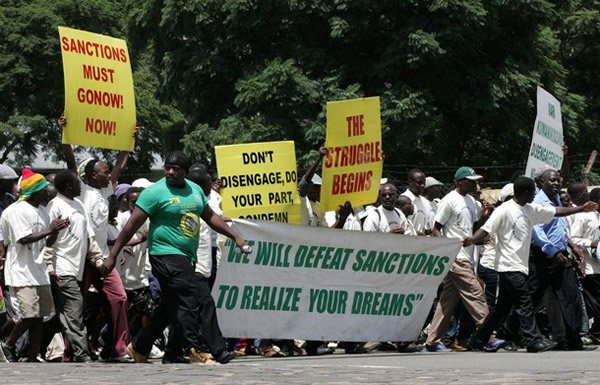
Honourable Sam Matema
For a very long time, the United States of America and her allies have presented, defined and projected themselves as champions of democracy and human rights defenders.
However, nothing could be further from the truth on account of the contradictions inherent in what they say and do.
Using Zimbabwe as a case in point, our relations with the family of nations globally have not been smooth post the ZIDERA (Zimbabwe Democracy and Economic Recovery Act) which was passed by the USA senate following Zimbabwe’s land reform programme.
Were it not for the resilience of the Zimbabwean people, economy and the astute and forward-focused leadership of the Zanu PF-led Government, Zimbabwe would have witnessed an implosion a long time ago.
This is the primary objective and preoccupation of the USA and her allies, with regime change as the ultimate target.
I submit, through the lens of the Sustainable Development Goals (SDGs), that largely, the sanctions on Zimbabwe have affected how she interacts and interfaces with the world.
SDG 17 speaks on partnerships to achieve the other 16 SDGs, and therefore affects various things, among them the right to self-determination, health, education, food, housing and the right to life.
The illegal sanctions are affecting how we work locally, in the diaspora, the corporate world, non-State actors and other nations, both regionally and internationally.
The USA has, through its proxies, interfered with the independence of Zimbabwe through the sanctions, with the ultimate objective of effecting a regime change.
The sanctions have weakened our relations with multilateral financing organisations, movement of funds and potential investments with a bearing on the capacity to produce adequate food for the citizenry.
This disturbs our efforts to achieve food security, as well as efforts to provide quality education and a quality health delivery system.
The sanctions have also curtailed the smooth flow of resources towards the development of key infrastructure that is meant to aid in the realisation of the aforesaid rights.
Since sanctions are an impediment to the realization of basic human rights and are having negative effects on the entire SADC region, it is time for their removal.
Akin to the migration in the Sahel region due to climatic conditions, there is a serious challenge of ‘sanctions migration’ in the Sadc region due to the pressure put on health and education facilities, as well as food, etcetera.
Some people have become sanctions refugees and their right to self-determination at a personal level has been weakened or taken away.
Self-determination speaks to the right to chart own path and course in the context of local social, economic, environmental and political considerations and expectations.
It speaks to territorial integrity and its unfettered defence.
The situation we find ourselves in has also seen some Zimbabweans within and outside her borders being paid to speak ill against their own country.
Honourable Sam Matema writes in his personal capacity. Feedback: [email protected]


 Online Reporter