Chronicle Editor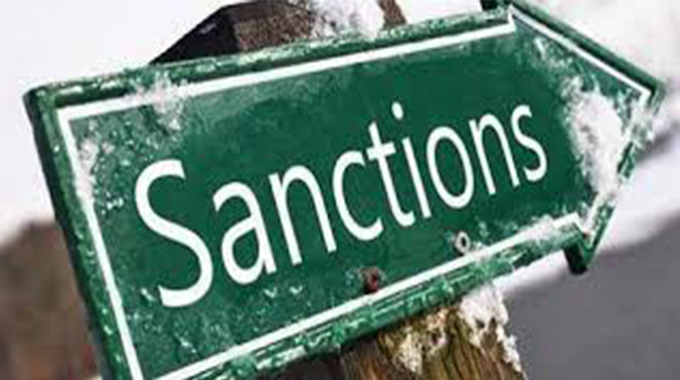
Innocent Mujeri, Correspondent
FOR over two decades, Zimbabwe has suffered under crippling sanctions, primarily imposed by the United States through the Zimbabwe Democracy and Economic Recovery Act (Zidera) and supported by the European Union.
These sanctions, initially implemented under the guise of promoting democratic reforms and punishing alleged human rights abuses have, instead, served as a death sentence for Zimbabwe’s economic and social development. Far from their intended purpose, the sanctions have become a calculated tool for economic suffocation, eroding the nation’s ability to grow and prosper, and depriving its people of access to essential services such as healthcare, education, and infrastructure.
While the sanctions are often portrayed as “targeted” measures aimed at select individuals and entities, the reality is that their effects have rippled across Zimbabwe’s entire economy, punishing ordinary citizens more than those in power.
International financial institutions like the International Monetary Fund (IMF), World Bank, and African Development Bank (AfDB) have been barred from extending credit or financial support to Zimbabwe due to these sanctions, leaving the country unable to fund vital infrastructure projects or support critical sectors.
Beyond the damage to its key industries, Zimbabwe has faced a debilitating isolation from global financial markets. International banks have been reluctant to engage with Zimbabwe for fear of violating sanctions and facing penalties. As a result, Zimbabwe’s financial sector has become increasingly disconnected from the global economy, making it nearly impossible for the country to access credit, invest in growth, or secure international trade deals. This has severely limited Zimbabwe’s ability to participate in global trade, which is essential for economic development.
Despite these devastating realities, the international community, particularly the United States, continues to justify these sanctions as a necessary tool for promoting democracy and human rights. This narrative is both hypocritical and disingenuous. While sanctions are ostensibly intended to punish those in power, it is the ordinary Zimbabwean citizen who suffers the most. The sanctions have done little to foster political reform but have instead entrenched poverty and inequality, undermining Zimbabwe’s ability to build a prosperous and just society.
The UN Special Rapporteur on unilateral coercive measures, Alena Douhan, after visiting Zimbabwe in 2022, called for the immediate lifting of sanctions, stating that they had exacerbated the country’s pre-existing social and economic challenges.
She highlighted that the sanctions had deprived Zimbabweans of their basic human rights, including the right to healthcare, education, and development. These rights are protected under international law, and their violation through sanctions is indefensible.

The sanctions imposed on Zimbabwe are not only illegal under international law but also morally unjustifiable.
However, the level of development and economic transform-ation achieved in the last six years without access to global lines of credit is an indication that Zimbabwe under the Second Republic is effectively defeating the illegal Western sanctions.
Since the advent of the New Dispensation in November 2017, Zimbabwe has taken bold policy reform measures to transform its economy, guided by the short-term Transitional Stabilisation Programme (TSP-2018-2020) and now the National Development Strategy (NDS1-201-2025), which continues to yield positive results.
Based on the progress registered in the last few years under the Second Republic, Zimbabweans must be proud of their resilience amid adversity and walk with their heads up while working hard to foster inclusive development that ensures no one and no place is left behind in terms of development.
The abundant natural resources in the country, blended with available skills and the adoption of new technology and innovation, have positioned the country for better prospects.
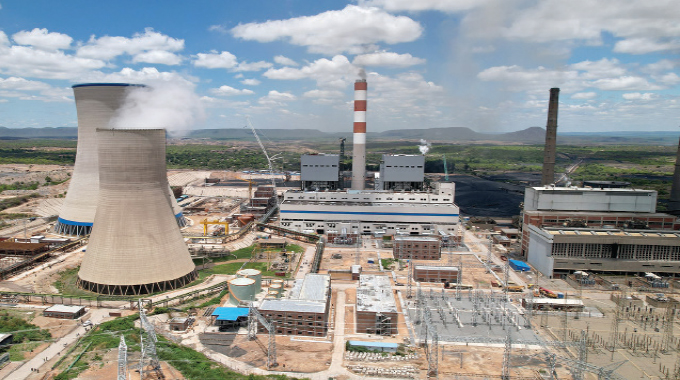
This has seen young technicians including females from the country’s institutions of higher learning increase participation in mainstream development, such as the Hwange Power Station Units 7 and 8 Expansion Project.
Instead of frustrating progress, the imposition of sanctions has inspired Zimbabweans to be more innovative.
With a less restrictive economic environment, Zimbabwe can only soar. It is time for the international community to recognise the human cost of these punitive measures and demand their immediate removal.
Zimbabwe deserves the opportunity to rebuild and recover from decades of economic destruction.
Only through the removal of these sanctions can Zimbabwe regain its position as a thriving nation in Southern Africa.
The world has a moral obligation to stand in solidarity with Zimbabwe and demand an end to these unjust and inhumane sanctions.



 Online Reporter