admin
admin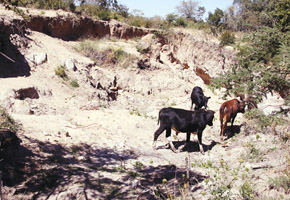
Some poachers have developed their own way of collecting this resource as they now collect it through what is known as sand panning which is not different from gold panning. This involves the mining of sand through digging trenches to reach the sand.
Some, however, cause soil erosion as they extract sand from riverbanks causing siltation. The mining of sand affects the environment with increase in land degradation.
Furthermore, sand poachers have caused disturbances in some residential areas with some residents complaining that the poachers cause havoc as they leave a trail of destruction after doing their business.
Sand extractors leave open gullies causing people who live around abstraction areas to lose their livestock which usually fall into the gullies. During the rainy season the gullies provide a breeding ground for mosquitoes, increasing the threat of malaria.
A snap survey in some affected areas around Bulawayo revealed huge holes with some having tunnels that stretch over 20 metres. It is also believed that some of the tunnels stretch under people’s homes. Many people fear even walking around those areas as they think the places are death traps.
Mr Nduduzo Nkomo, from Methodist Village near Pumula in Bulawayo, said the situation was very bad in the area.
“Abantu laba babulala umhlabathi (These people are destroying the environment), our cattle are dying each and every day as they constantly fall into these pits.
“We are afraid that some of these tunnels might be under our homes. We fear that they can collapse any time and our houses will be destroyed.
“We cannot do anything to stop them because they are very dangerous people as they once killed a city council ranger and many people in this area are afraid of them as they sometimes load their trucks during the day and travel at night,” he said.
Mrs Ntobeko Dube from St Peters, close to Methodist Village said the community did not tolerate sand poachers because they destroy the environment. If they catch them, she said they direct their trucks to offload the sand at St Peter Primary School.
“They sometimes are lucky because they travel at night as they know that during the day it is very dangerous as police and the city council rangers will be there,” she said.
Bulawayo City Council, police, Environmental Management Agency (EMA) and other authorities have somehow failed to control the sand poachers.
The poachers have basically gone unpunished over the years as some of them operate during the night using unregistered vehicles which in most cases are not roadworthy. Many of them are driven at night without headlights, contributing to road accidents.
Authorities fine poachers $20 if they are caught, but they always find their way back to business as they can raise the fines in a short period of time.
The poachers dig tunnels without proper tools or reinforcement mechanisms, so many of the burrows can collapse any time. Two months ago, a young man who was an amateur miner died at one of the tunnels in Robert Sinyoka after a tunnel collapsed.
But the poachers remain undeterred as their product has a ready market in Bulawayo as many people are building houses.
Bulawayo Mayor, Councillor Thaba Moyo said the council was doing all it could to stop sand poaching as council rangers patrol the areas often.
“The council has engaged in patrols in these affected areas as we try to curb these syndicates so that there is an end to this,” he said.
A few weeks ago Bulawayo councillors were divided on how to handle rampant sand poaching with some proposing the legalisation of the practice while others felt doing so would cause more chaos.
Fierce debate over the issue dominated a recent full council meeting with some councillors, including the Deputy Mayor Clr Amen Mpofu, proposing that council legalises sand abstraction for construction purposes.
Clr Moyo said the council was still trying to find a place where people could abstract sand.
“We are still in the process of finding places where they can abstract sand. There are people who poach as there is no legal place to get sand in Bulawayo and so council should give permits. This means as much as we deal with poaching there should also be a place where they can get sand from because if we do not do that they will simply go back and wreak havoc.”
“For now the council is doing all it can but our hands are tied as we do not have a proper solution to eradicate sand poaching,” he said.
However, some residents feel the fines levied on those found poaching are too little as offenders can easily raise the money.
A poacher who operates at St Peters agreed with the sentiments of some residents that the fines were too low.
“If we get caught by the EMA and the police during their patrols we pay them the $20 fine and go back to work. There is a ready market out there and most of the time we fail to satisfy the demand and the money we make on a daily basis is worth the risk.”
“Sand poaching is providing cheap sand for most people and as long as the prices on formal markets are high I don’t see us stopping this practice anytime soon.”
He also said they usually sold the sand at prices ranging from $40 to $50 per five cubic metres while the same amount of sand can be bought from $100 to $120 on the formal market.
EMA says it cannot eradicate sand poaching on its own.
The organisation’s communications and publicity officer, Mr Steady Kangata said everyone had a responsibility to ensure that sand poaching was eradicated.
“The police, city council and the communities where these crimes are committed must play a role.
We do carry out patrols in the areas but there is a need for stricter measures to deal with the problem.”
He urged local authorities to draw up environmental management plans through which they can find ways to reclaim the dug-up areas after sand extraction.
He also urged councils to find places where people can legally collect the sand from and also give them permits as a way to curb poaching.



 Online Reporter