Online Reporter
Trust Freddy and Tanyaradzwa Rusike-Check Point Desk
AS the sun hesitantly climbs out of the womb of its wise mother from the east, the streets of Harare are already bustling with energy.
Office workers rush to their destinations, while factory workers in their worn worksuits and students with colourful backpacks hurry alongside, all caught up in the morning rush, each racing against the clock.
On the other hand, vendors line the pavements, meticulously arranging their wares while keeping a hawkish eye on law enforcement agents who might attempt to apprehend them.
The streets are abuzz with pirate taxis, vendors and cart pushers, amidst a symphony of car horns and bustling activity.
Amidst the chaos, a sinister game unfolds at the corner of Agostinho Neto Avenue (formerly Speke Anenue) and Leopold Takawira Street, near the footbridge.
A lone man sits on a makeshift stool, shuffling three cups with lightning speed, surrounded by a syndicate of accomplices who cheer and bet with crisp US$20 notes.
This is the harsh reality of the shell game, popularly known as the “feja feja” – a form of a guessing game, preying on the vulnerable and innocent.
Some individuals are losing brand new phones, shoes, bus fare, or other valuables after betting, and the scam is now targeting tobacco farmers who have cash after selling their golden leaf.
The game appears simple, involving hiding a small object under one of several lids, cups, or shells, and then rapidly moving them around to confuse the participant.
However, the essence of the game lies in misdirection and sleight of hand, making it challenging to track the object’s location.
The scammer’s syndicate wins and collects crisp US$20 notes, much to the amusement of the onlookers.
A young boy, not older than 16, walks into the trap, his eyes wide with curiosity.
The scammer’s eyes light up, sensing an easy target.
“If you give us US$10, and you manage to guess where the ball is, you can take US$20,” a street scammer says with a sly smile.
The boy hesitates, but eventually agrees to play, betting his brand-new “Air Force” sneakers.
In a split second, his shoes are gone, and the scammer’s hands move with lightning speed.
The boy’s eyes widen in shock as he realises he’s been scammed.
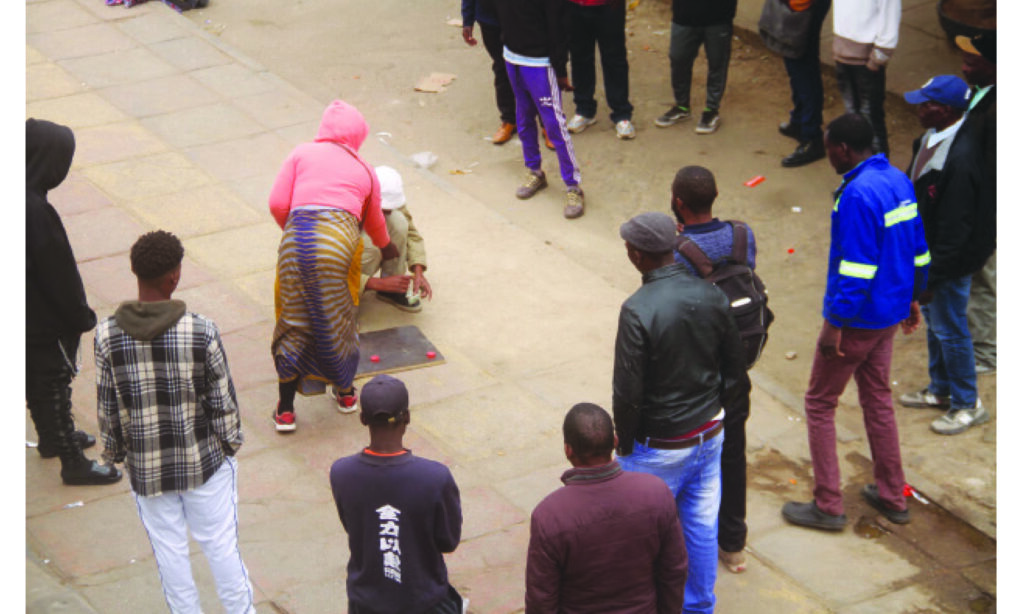
Shell game (feja feja) scam in action: An alleged female syndicate member collects US$20 after betting US$10 from the ring leader, surrounded by curious onlookers at the corner of Agostinho Neto (Speke ) and Leopold Takawira Road near Footbridge Mall. Picture: Edward Zvemisha.
“Ahh, how did it happen? It was in this lid,” he asks again, touching his head in dismay.
The scammer and his syndicate laugh and jeer as the boy walks away, empty-handed and defeated.
The writers observed that after the boy had fallen prey, the scammers move on, targeting new prey. The scammers, use one of their own to bet and win in the full glare of passers-by. This acts as a bait to curious on-lookers.
When one of the writers joined the spectators, the ring leader turned to him and asked him to guess where the ball was.
He correctly guessed and was handed US$20, but immediately the ring leader asked for the money to be handed back, saying a person can only walk away with the money after betting at least US$10.
Vendors operating close to the shell game players revealed that this is just a scam.
“All these three guys and including these two women are just pretending to be other players and he lets them win, but when they get an unsuspecting victim, they take all their money,” a vendor who only identified herself as Mai Tino, said.
She added that most of the time they will be playing against themselves, and when no one is playing, one of the syndicate members will take out money and play, win and they will all clap and yell, attracting spectators who will eventually lose their money.
Another vendor, Mr Jacob Karombo, said they mainly target farmers with money and those who will be coming from rural areas.
“This time they are targeting tobacco farmers who would have sold their crop. When they see anyone in work suits or dirty sneakers that they assume is a farmer, they will ask the person to take a guess. When they win, they are given US$10, but the majority end up being tempted to bet even more,” he says.
“If they gamble, they lose cash or some valuable items.”
For about 30 minutes, the writers watched this scam unfold, and some people believed they too could win.
Some individuals won after betting as little as a dollar, but the other syndicate would convince the winner to play again.
Bouncers could be seen threatening spectators who would attempt to take pictures.
After about 15 minutes, the team just shouted, “Police, police,” and fled in different directions but made sure that they were close to their spot.
When they noticed vendors returning to their spot, they also returned again, and it was alleged that they planted their people who would be alerting if there was any suspicious activity.
“They come here daily, early in the morning, and are always on the lookout for police,” an airtime vendor who requested anonymity says.
“Scammers are usually alert and whenever vendors shout “police,” they hide and come back once law enforcement agents are gone.”
The feja feja scammers mainly target busy areas where chances of duping passers-by are high.
The same scammers can move to different locations such as the Harare gardens, where there are no police patrolling, after completing an early morning “shift” near the footbridge.
When contacted for comment, Harare provincial police spokesperson Inspector Luckmore Chakanza said the victims often do not report the cases out of shame or unknown fear.
“We haven’t received any report,” he said. “People who fall victim to these scams often do not report this to the police. Many people are aware of these scams and the idea that they can make a quick buck out of it often makes them to be duped easily.
“We always conduct awareness campaigns in the CBD, warning individuals against betting on these get-rich-quickly schemes.
“Whether you’re from rural areas or from the city, we advise against coming to town with the expectation of doubling your money. If you have $100, refrain from giving it to someone who promises it’ll double it in minutes. Hold onto your money – there’s no such miracle to multiply your money within seconds of gambling,” he said.
The shell game is, however, not unique to Zimbabwe. It is done in various parts of the world including France and other European countries where scammers mainly target tourists.
Social experts say the shell game is a dishonest betting game in which someone hides a ball under one of three cups or shells, moves the cups or shells around quickly, and asks an observer to guess which one the ball is under.
The player then bets on which cup they think the object is under.
However, it is widely reported that when played casually on public streets, the shell game is usually a swindle.
The operator of the game palms the object instead of leaving it under a cup, making it impossible for the player to win.
Gambling has a long history in urban areas and researchers say this includes informal forms (kubheja (placing a bet), makasa (cards), feja feja and formal spaces (horse and dog racing, lottery, casinos and soccer betting).
With new and emerging technologies, gambling has shifted betting platforms to online platforms.
In Zimbabwe, organisers and participants in unlicensed gaming activities can face fines of up to $400, imprisonment for up to one year, or both.
This law is designed to deter illegal gambling and ensure that all gaming operations are conducted within a regulated framework under the Lotteries and Gaming Act.
Illegal gambling operations poses severe risks to public safety with unsuspecting citizens often targeted and victimised by these illegal activities.
The police say one of the most significant risks associated with illegal gambling is the potential for victimisation and crime.
Despite police crackdown on the streets of Harare, illegal gambling continues to give authorities a headache.
Analysts say staff shortages, outdated systems and regulatory blind spots makes illegal gambling operations to thrive unabated.
Gambling has shifted to online platforms and this has made it even harder for authorities to stop it.