Online Reporter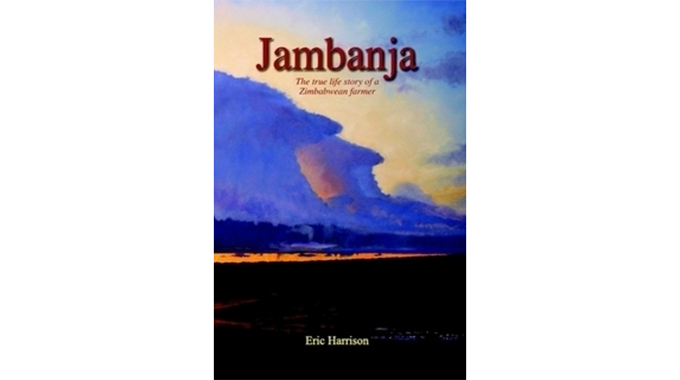
Elliot Ziwira-At the Bookstore
IN his memoir “Jambanja”, Eric Harrison recounts the Fast Track Land Reform Programme in Zimbabwe, initiated in 2000.
He portrays it as a sudden and unjustified act, claiming the late national hero and former President Robert Mugabe’s Government stole land from white farmers. However, this perspective overlooks the historical context of colonialism and the dispossession of indigenous people.
Insisting “the President of Zimbabwe changed the Constitution”, Harrison opines that “at a stroke of a pen” Zimbabweans “have been unjustifiably dispossessed of their land”.
He accuses the late revolutionary of “claiming” that the land “had been stolen”, and demonises him for reducing everything the whites had put “into developing the land” to “nothing”.
Harrison’s account overlooks the historical injustices inflicted upon black people through colonialism. The Rudd Concession of 1888 and the Lippert Concession of 1891 were instrumental in dispossessing Africans of their land, with the British government disregarding its own constitution and principles of justice.
Harrison’s narrative implies that the land was not stolen, despite evidence to the contrary. He portrays himself as a victim of the post-2000 Fast Track Land Reform Programme, but his grievances stem from a deeper resistance to change and a desire to maintain the status quo.
As highlighted in the memoir, he “bought” stolen land, if the borrowed $5 000 “paid” to get 187 hectares of prime land under Lot One of Mkwasine Estate could translate to buying.
His assertion that land reform came “out of the blue” in the mid-1990s ignores the historical context of land ownership in Zimbabwe.
The expansion of white farmers and the prosperity of the economy were built on the backs of impoverished black communities. The historical imbalances in land ownership were bound to be corrected, yet Harrison’s narrative fails to acknowledge the inherent injustices of the system.
Furthermore, his characterisation of African land as “underutilised bush” reflects a Eurocentric view that disregards the cultural and spiritual significance of land to Africans.
This perspective is rooted in a Hegelian supremacist ideology that prioritises Western values and knowledge over indigenous perspectives. The African philosophy of human worth and spiritual connectedness, embodied in the land, complicates land reforms in independent Zimbabwe.
Harrison’s account fails to appreciate this complexity. He seems to forget that it was at the “stroke of a pen” that the indigenous people lost their heritage through the Rudd Concession of 1888 and the Lippert Concession of 1891.
He carries the burden of proof that the land had not been stolen (Chigwedere, 2001).
This perspective is rooted in Eurocentric individualism, which prioritises capitalism and the commodification of land. In contrast, Africans view land as a communal resource, imbued with spiritual significance and passed down through generations (Lan, 1985).
The Eurocentric view, on the other hand, sees land as private property that can be owned, fenced, and gated (Bakare, 1993:50). The notion of “discovery” and “empty space” (Giddens, 1991) is particularly problematic, as it erases the presence and livelihoods of indigenous people.
Colin Saunders’ foreword to “Jambanja” exemplifies this concept, lamenting “unjust eviction” from land fashioned out of “untamed bush”. However, this same land was a vital source of livelihood for entire communities.
African perspectives on land ownership and use fundamentally differ from European ones. Land is not simply a commodity to be exploited, but a sacred resource that sustains life and connects societies.
The idea of collectivism and oneness permeates African life, where land is valued for its intrinsic worth, not just its economic potential.
Colonialism brought a destructive mindset, typified by Kingsley Fairbridge’s 1927 autobiography in which he wonders why there are “no farms” and “no people” on his arrival in Manicaland at the age of 13.
Fairbridge recounts fishing with dynamite and destroying the environment on his excursions in Mazowe.
This approach is echoed in Harry’s narrative in “Jambanja”, where he views Africa as a “primitive” land in need of “civilisation”. The colonial legacy of pillage and destruction is evident in both accounts.
It is, therefore, crucial to recognise the historical injustices that have shaped the present. The essence of heritage is tied to the land, in its broadest sense.
Hence, the new struggle for land reform is not just about economic empowerment, but about reclaiming cultural identity and spiritual connectedness.
Harrison informs us that when Harry leaves Rhodesia for the “beautiful”, yet “primitive” country of Angola, it is not for its “many natural resources such as oil and diamonds,” but for “the agricultural scene”.
Harry’s actions reflect a colonialist mindset driven by supremacist ideologies, overlooking the fact that natural resources, including oil and diamonds, are integral to the land. He sees himself as a disciple of Cecil John Rhodes, contributing to the empire through exploitation and domination.
Fairbridge’s account of his experiences on the outskirts of the empire, where he witnessed the construction of bridges and infrastructure through the exploitation of Africans, exemplifies this colonialist mentality.
Fairbridge writes: “A lad of 13, dressed in knickers and shirt sleeves, I walked on the outskirts of the Empire, where the shouting of men, the ring of hammers on stone, and the thud of picks in the baked earth were always in my ears . . . The stone faces of sleepy kopjes rent with dynamite that the bridges of the British people might be established in security” (Fairbridge, 1927: 40-41).
Through exploitation of Africans, whose “virgin velds”, they stole, colonialists established “bridges of the British people” on “the outskirts of the Empire”— a heritage they seek to protect through chicanery and tyranny disguised as aid and democracy.
In “Jambanja” Harrison downplays the significance of land to Africans, who have always relied on farming for sustenance, and had systems to protect and live in harmony with their wildlife.
Harry’s questions about land shortage and the system being wrong are disingenuous, given the historical context of colonialism and the exploitation of African land and resources.
Harrison’s selective amnesia about colonial history makes him a poor storyteller, as he focuses only on his own exploits and ignores the experiences of the African people. His claim to be a “Matabele”, despite being disconnected from the Ndebele history of displacement and struggle, is particularly problematic.
The Ndebele people lost their land, cattle, and heritage due to settler colonialism, yet his narrative fails to acknowledge this historical reality.
The collective memory of African communities articulates the extent of their losses, including the loss of over 21 million hectares of land and confinement to reserves that were unsuitable for human habitation (Chigwedere, 2001:27).
Therefore, Harrison’s claims about land scarcity and inadequacies of the system are dented by historical context. His account reflects a chauvinistic and Eurocentric perspective that ignores the experiences and perspectives of Africans.
Curiously, Harry’s acquisition of land and wealth was facilitated by the colonial government, which had taken the land from the indigenous people without compensation.
He “bought” stolen land from the Mkwasine Estate and quickly accumulated wealth, acquiring a private plane and sending his children to good schools. This prosperity was not due to his own efforts, but rather the privileges afforded to him as a white Rhodesian.
The colonial government’s support for white farmers, like Harry, was extensive, and included access to credit, markets, and cheap African labour. This system allowed white farmers to thrive, while Africans were dispossessed of their ancestral land and heritage.
Chigwedere (2001:33) notes that the Ndebele lost “anything from 100 000 to 200 000 cattle” to settlers through the Loot Committee, which were used to establish commercial farms and the Cold Storage Commission.
The legacy of colonialism continues to impact African communities, which are expected to compensate usurpers of their heritage rather than them being compensated. Harrison’s account ignores this crucial fact hinged on the historical context of land dispossession and the ongoing struggles of Africans.
He questions how indigenous people lived with the knowledge that the land had been stolen, yet it is clear that settlers achieved this feat through a century of plunder and exploitation.
Eurocentric ideologies recognise individual ownership and commodification of land, which is alien to African communities.
The establishment of conservancies, often owned by whites, like “Gerry the rancher, who had created a hunters’ paradise”, has further entrenched the dispossession of Africans from their land and wildlife.
They are priced out of the colonial laager—yet it is their heritage.
Exploiting the same “bush” settlers built tangible wealth for their offspring, and a legacy they defended in “the bush war”, which indigenous owners of the land referred to, and still refer to, as the liberation struggle or Chimurenga.
The Rhodesian nationalistic values that Harrison seeks to preserve are premised on the “bush” and the defence of individual wealth created through a system that rewarded whites. This perspective ignores the historical context of colonialism and the ongoing struggles of African societies.
When Harrison speaks of right and wrong, therefore, he has to understand that legality does not determine social justice. It is possible to be right without being just, or to be ‘wrong’ and be just, depending on ideological astuteness.
For an immersive reading experience, visit Typocrafters Book Shop at Herald House, corner George Silundika Avenue and Sam Nujoma Street in Harare.
Contact: Mercy—0771537929, Rose—0776131480, or Leon—0733100191.



 leeroy