Chronicle Editor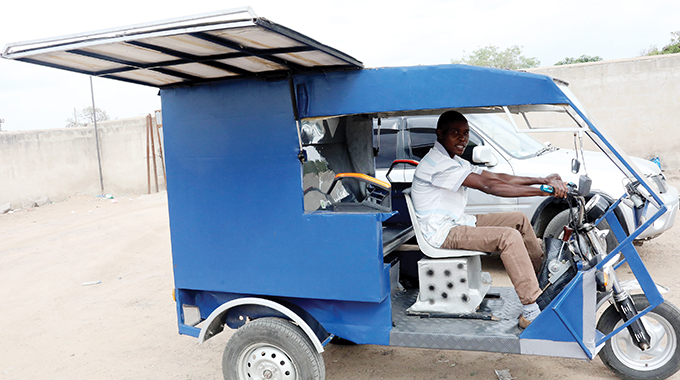
Peter Matika, [email protected]
DROPPING out of school for many people is the most terrible experience and a dead end in a society that believes education is the key to a brighter future.
Not so for Mr Charles Ncube (31) of Bulawayo’s Luveve suburb who, despite dropping out of school at Form Three, has fought for his space and distinguished himself as the innovator of a solar-powered three-wheeled vehicle.
Not only is the unique vehicle eye-catching but also has the ability to power home appliances in the midst of power interruptions, easing the burden on those with fuel costs headache.
It travels at a maximum speed of 50 kilometres per hour and gives him at least 200 kilometres when fully charged.
The scooter has a built-in load box, passenger seat and can carry a maximum weight of about 500kgs.

It features solar panels on its top and sides, which functions both as a roof and uses photovoltaic cells to convert sunlight and power the engine.
The innovative journey started about five years ago when Mr Ncube bought his first vehicle, a second hand model that he cherished so much.
On several occasions, he would run out of fuel and was forced to abandon it in the middle of nowhere.
The devastation from this experience reached an inspirational breaking point – thinking outside the box and coming up with an idea to develop an alternative solution to fuel, that is, having something exclusively dependent on natural energy sources.
Despite possessing minimal secondary education before dropping out due to financial challenges in the family, Mr Ncube said he capitalised on YouTube instructional content and embarked on his ambitious solar-powered vehicle initiative at the beginning of this year.
His project recently caught the attention of Finance, Economic Development and Investment Promotion Minister, Professor Mthuli Ncube, who was in the city last weekend and visited Cowdray Park where he donated food to the needy.

It was at this event that the youthful innovator showcased the completed scooter he engineered over a period of five months using a shoestring budget, much to the amusement of the large crowd and dignitaries.
In an interview, Mr Ncube, a resident of Luveve suburb, said despite all the limitations he encountered with education, it was his determination and zeal to show the world that no odds can hold him down.
“I launched this project about five to six months ago. I only have a basic education. Over the years, I managed to acquire knowledge in the field of mechanics, where I was working under the guidance of seasoned mechanics in both auto and ordinary mechanics,” he said.
“So, when I started this, many people didn’t think I could develop anything of such a nature but here it is,” said Mr Ncube.
He said he sourced most of the low-cost parts locally, mostly from scrap cars, while the solar engine and tech-components were imported from China.
“I engineered the body to meet the specifications I required. Most of the parts I sourced locally and then machined and modified them to my requirements,” said Mr Ncube.
“The battery, inverter and the electric conversion kit, I imported from China.”

Mr Ncube said his design demonstrates how a vehicle can make more use of sustainable materials.
“Having a solar vehicle like mine, which uses solar power for transportation will make for a cleaner atmosphere, thereby reducing the risk of dangerous gaseous emissions that have led to the death of thousands of people around the world,” he said.
“I can say the total amount I have spent on the scooter is approximately US$3 500. It is an all-terrain scooter and is compatible with all weather situations.
“I know most people will pose the question of whether it is able to charge in cloudy situations and the answer is a simple yes. All that has been modified to encompass all situations,” said Mr Ncube.
He said his focus is now on patenting the concept, as he wants to implement the concept in agro-machinery and larger vehicles such as buses.
“Fuel is a major strain for most motorists. It is a major setback and through this invention I know as a country we can develop something that will help assist in developing our economy,” said Mr Ncube.
“This uses natural energy and nothing more. It is friendly to the ecosystem.”
Mr Ncube said pollution is a significant challenge for many countries and it is his dream to see his innovation being adopted across the world.
“I decided to create my solar scooter also to reduce the risk of contracting non-communicable and respiratory diseases like lung cancer, asthma and other diseases caused by inhaling hazardous fumes emitted by cars using other types of fuel,” he said.
He said the setbacks he encountered while developing the scooter was a lack of a workshop and proper equipment.



 Online Reporter