admin
admin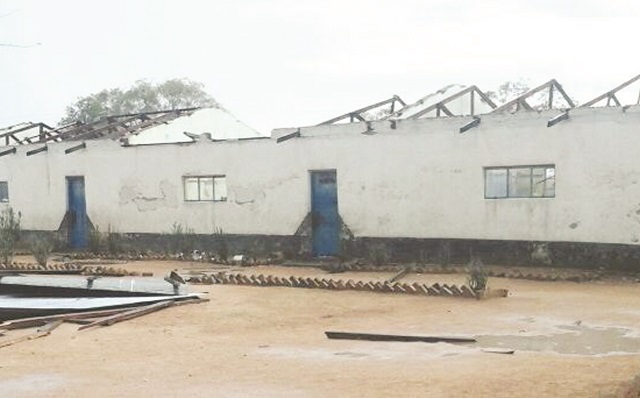

Sukulwenkosi Dube-Matutu, Plumtree Correspondent
IT has become a rather disturbing occurrence that each rainy season a number of classrooms mostly in rural areas are destroyed by strong winds, hailstorms and floods leaving school pupils disadvantaged.
Whenever this happens, pupils are forced to learn in the open until the buildings are repaired.
In worse scenarios lessons are abandoned for some time until order is retained.
This is a huge setback for pupils who might lose learning time or be forced to attend lessons under conditions not conducive for learning.
Mangwe constituency MP and Deputy Minister of Home Affairs Obedingwa Mguni said some of the school structures were now dilapidated and could not withstand harsh weather conditions.
He said in most incidences where schools were recently destroyed, the roofs were blown off.
Deputy Minister Mguni said this was a wakeup call to school authorities who he said should come up with a programme to rehabilitate school buildings and also ensure new structures are strong.
He said some of the schools were built in the 1940s but had never been renovated.
“We are experiencing climate change characterised by floods and strong winds. We have over the years witnessed cyclone- induced floods, hailstorms and strong winds. This has seen school buildings being destroyed and people drowning.
“This is a wakeup call for authorities to ensure that their structures are up to standard. Schools that are under construction should be properly built and old buildings need maintenance,” said Deputy Minister Mguni.
He said a lot of emphasis was being made on the need to construct more schools in order to reduce distances walked by pupils while maintenance of existing schools was being overlooked.
Deputy Minister Mguni said it was important to ensure that schools had proper structures to avoid disruption of lessons.
Many classrooms in remote rural schools, he said, were dilapidated and pupils were expected to learn from them.
While communities were mobilising funds to build new schools, they should also set aside funds to rehabilitate existing ones.
Deputy Minister Mguni said government and other stakeholders had to allocate funds specifically for rehabilitating schools.
“It’s also important for relevant authorities to consider citing of schools before they are build. It would be better if these structures are surrounded by trees which can act as a wind breaker instead of being built in open space.
“There is a need for close supervision on maintenance and construction of schools,” he said.
Deputy Minister Mguni said schools did not need to rely on Government to allocate them money to rehabilitate infrastructure but they had to mobilise own resources at times.
School Development Committees had to prioritise developing and maintaining classrooms among other things, he said.
Deputy Minister Mguni said education was crucial in eradicating poverty especially in rural areas and there was a need to ensure that pupils had access to quality education.
Bulilima Rural District Council chairperson Mr Morgen Ndebele said two schools in his district namely Gwambe and Ntambana Secondary Schools recently had their roofs blown off soon after construction.
He blamed this on substandard work by the builders.
Mr Ndebele said some communities in rural areas were constructing classroom blocks using cheap bricks as a cost cutting measure.
“Some communities use poor bricks to construct school buildings as such these buildings easily collapse in the event of heavy rains. In some cases communities engage services of incompetent builders who do a poor job and in the process compromise the strength of the buildings,” he said.
Mr Ndebele said the local authority had a responsibility to monitor and inspect the process of constructing the buildings and not the material that was being used.
He said when a community wanted to construct a school building, a technician was first sent to inspect whether the depth of the foundation was up to standard while also considering the type of land that the structure will be built on.
Mr Ndebele said the council technician also had a responsibility to supervise construction of the building up to roof level.
While the council had allocations for funding the construction of new schools, no funds had been set aside for rehabilitating old schools.
Two primary schools in Bulilima District namely Tjihanga Primary School in Nyele Ward and Ntoli Primary School in Gala Ward were recently damaged by severe winds leaving nine pupils injured.
Headman Manguba from Bulilima said the affected buildings were too old.
Pupils learning at Gwambe Secondary School in the same district were left stranded for weeks after the school buildings were damaged by strong winds a week after it opened. The damage was attributed to poor workmanship by the builders.
The incident occurred at 2pm while pupils were learning but they were lucky to escape unharmed.
A total of 10 schools in Mangwe District were also damaged by heavy rains which pounded the area recently.
These are Dukwe, Tjingababili, Nguwanyana, Makuzeze, Khahlu, Silima and Bulu primary schools as well as Mqokolweni, Tahangana and St Francis secondary schools.
Lessons at Tjingababili Primary School, which was the worst affected, had to be abandoned as the roofing to eight out of 11 classrooms was damaged by hailstones.
Mr Danny Nyathi who runs Nissi Construction Private Limited Company said properly built structures had a life span of 70 to 100 years.
He said the challenge was that school buildings were not being properly built which was putting the lives of pupils, teachers and other people at risk.
Mr Nyathi said the challenge was that some school buildings were being constructed without proper supervision.
@DubeMatutu


 Online Reporter