admin
admin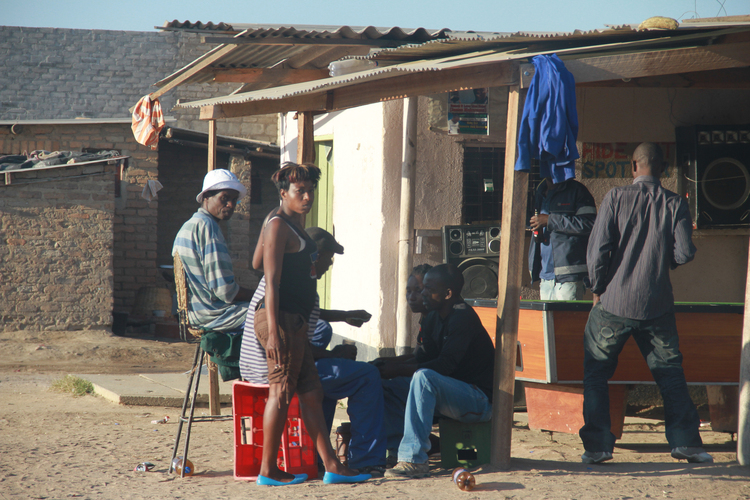
 Business is booming for 34-year-old Tarisai James who runs a shebeen at PaAnthony Shops in the sprawling informal settlement called Hopley Farm.
On busy weekends, he pushes nothing less than 300 bottles of popular brew Chibuku Super. He also sells a considerable quantity of lagers.
Patrons flock from as far afield as Mabvuku and Chitungwiza to enjoy a good night out at the joint.
“Business is going on just fine,” he says, nonchalantly. “Though there are days when it is low, generally all of us are doing well.”
The major drawcard for most patrons, however, is not the booze.
On the “sidewalks” of the gravel road separating the tuck-shops, scores of skimpily dressed women and girls mill around like they have nothing to do.
Like Tarisai, they too are enjoying brisk business.
These women are the reason why scores of men who converge on the area almost daily.
They offer a wide array of services — almost all of them illegal.
For as little as US$1, the women are prepared to have a quickie — or “chigwishu”, as they call it.
As the night wears on, one by one the women leave with clients. Some return after a few minutes. Other will not be seen until the next day when the whole dance repeats itself.
While the name Hopley may conjure images of buoyancy and optimism, for many of the estimated 40 000 residents here, it is an illusion.
Without the basic amenities of potable water, electricity and other infrastructure; and grappling with socio-economic issues like crime, sexual abuse and prostitution — sometimes involving minors — it does not look well for Hopley residents.
Life at Hopley is hardly pretty amidst the overcrowding.
The area is no longer a preserve of the Operation Murambatsiva-displaced, but a free-for-all settlement as people have been attracted by the prospect of owning residential stands.
It is cheap to rent space here, with a room costing around US$30 a month.
But beyond the low rentals, there is little to celebrate.
Hopley Farm, whose houses were constructed in 2005 under Government’s Operation Garikai/Hlalani Kuhle programme as the successor scheme to the urban clean-up campaign of that same year to de-congest Harare and rid it of illegal structures, remains devoid of local authority services.
Ms Chipo Muronza, who has lived here since settlement’s establishment, says: “The biggest problems have to do with the shebeens and prostitution. We hardly sleep at night because of the noise coming from the bars and prostitutes.
“We lack cleanliness here as there is no-one to collect garbage while the roads are so poor that commuter omnibuses are no longer plying some routes. There are no Government schools and the local colleges are run by unqualified teachers. Our children have to go to Glen View, Chitungwiza and other surrounding areas for education.”
Council has reportedly allowed stand-owners to form co-operatives for parallel development of the area.
A few communal taps have been installed to service the whole community with the residents complaining that the water comes in drips and drops. As if that is not enough, the settlement has only three boreholes, one of which has since broken down.
“We have the added problem of the people on whose residencies the boreholes have been sunk, they make incessant demands for money to have the boreholes repaired,” complains Ms Muronza.
Harare City Council director of health Dr Prosper Chonzi is aware of the dire situation at Hopley.
“Water isn’t only erratic in this settlement but the water table is also high which leaves room for a possibility that it might be contaminated, worsening the situation,” he says.
“We are actually sitting on a health time-bomb which is continuously ticking. The area recently recorded cases of typhoid which were quickly attended to but that’s not enough.”
Zesa is said to have committed to bringing electricity but without proper documentation for residential stands, the energy provider hasn’t been able to fulfil its promise. Hopley, which has a population of about 40 000 people and according to its Member of Parliament, Cde Shadreck Mashayamombe, has about 3 000 school-going children, has only one registered primary school.
Many boys spend their time looking for drugs like marijuana, and girls turn to prostitution.
The only decent school in Hopley Farm is Tamuka Primary School situated in Zone 1. However, there are many private schools in the area but residents have questioned the quality of education. Those who are better-resourced send their children to schools outside Hopley — either in Chitungwiza, Kuwadzana or Glen Norah.
Mr Malvin Goto who has lived at Hopley since 2008.
He says the lack of proper education facilities is discouraging and has called on Government and other authorities to expedite building of the necessary structures and recruitment of teachers.



 Online Reporter