Chronicle Editor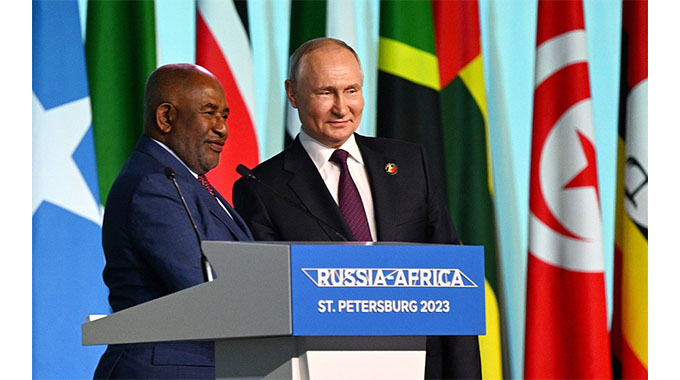
Nduduzo Tshuma in St Petersburg, Russia
AFRICA has displayed political will, demonstrated independence and interest in developing cooperation with Russia for the successful future of Russia-Africa relations which rest on the traditions of time-tested friendship, and historical experience of multifaceted productive interaction dating back to the early period in the process of African states’ formation.
This was said by Russian President Vladmir Putin at the end of the Second Russia-Africa Summit and Economic and Humanitarian Forum here on Friday adding that the event took place in a constructive and friendly atmosphere and produced tangible results.
Running under the theme, “For peace, security and development,” the two-day summit that ran from July 27-28 was attended by 17 Heads of State including President Putin’s Zimbabwean counterpart President Mnangagwa.
Addressing journalists from different countries in a joint press conference together with African Union chairperson and Comoros President Azali Assoumani, President Putin said the summit saw, among other agreements, the adoption of the St Petersburg Declaration.
“It formalises strategic areas for the development of Russia’s cooperation with African countries in long-term perspective.
“All our states confirmed their commitment to the formation of a fair and democratic multipolar world order based on the universally recognised principles of international law and the UN Charter,” said President Putin.
“They expressed their joint resolve to counter neocolonialism, the practice of using illegitimate sanctions and attempts to undermine traditional moral values.”
The Sochi agreement, President Putin said, resolved to hold Russia-Africa summits every three years.
“A dialogue partnership mechanism will operate in between Russia-Africa summits. Foreign ministries of Russia and African countries and the heads of the African Union will continue their regular political consultations,” said President Putin.
“We are also planning to establish a new permanent Russia-Africa mechanism for coordinating our positions on security issues, including such urgent problems as countering terrorism and extremism, ensuring food security, information technology, preventing the deployment of arms in space and climate change.”
President Putin said the large-scale Action Plan until 2026 contains specific goals on invigorating the Russia-Africa economic and humanitarian partnership and implementing decisions of the Petersburg summit as a whole.
“We are planning to build up our trade in quality and quantity and improve its pattern. We are also going to gradually switch to national currencies, including the ruble, in making financial payments on commercial deals. We will be removing trade barriers by aligning integration processes in the Eurasian Economic Union and the African Union and its free trade area,” he said.
“We intend to increase exports to Africa of Russian industrial products that have earned a good reputation on the continent, including machinery, automobiles, equipment, chemicals and fertilisers.”
President Putin said Russia will continue supplying Africa with crops both contractually and free of charge, help them develop their power industry to meet the growing needs of the African economies in hydrocarbon fuel and electricity generating capacities.
“Importantly, I am referring not only to traditional energy sources but also to Rosatom’s innovations.
“The Action Plan, along with several other inter-departmental and commercial documents signed on the sidelines of this summit, also provide for expanding industrial cooperation and carrying out joint information and communications projects,” said President Putin.
“In particular, our companies are ready to transfer applied technology to be used in public administration, in the banking and other sectors of the economy to our African friends.”
President Putin said an understanding was reached at the summit on the importance of more energetic efforts to promote cultural, academic, educational, sports, tourism, youth and other humanitarian exchanges.
“Russia is also offering a lot to its African friends and colleagues in this area.
Cooperation will continue in education and personnel training, and the number of African students receiving education in Russia will be increased, including government-funded students,” said President Putin.
“Branches of Russia’s leading universities, as well as secondary schools, including those with several subjects taught in Russian, will be opened in African countries through joint efforts. Relevant initiatives were examined in detail at the meetings that took place.”
President Putin said Russia plans to assist African partners in strengthening their national healthcare systems and enhancing their reliability, technological level, potential for fast response and resilience in coping with epidemics.
For this purpose, he said, an ambitious programme will be launched to assist African countries in combatting infections through 2026, for a total amount of 1.2 billion rubles.
“We still have work ahead at the summit but right now I still want to thank again all our African colleagues for accepting our invitation to come to St Petersburg and for coming,” said President Putin.
“I want to emphasise again that Russia sincerely aspires to build a truly strategic and diverse partnership with Africa and we see that our African friends are also seeking to work together with us, arm in arm.”
In his remarks, President Assoumani said Russia was a true friend of Africa having stood with the continent in difficult times.
He described the summit as a great success that would cement longstanding ties between Russia and Africa.
“We know who are true friends are. Russia stood with us during the most difficult times, during slavery, apartheid and slavery. So, for many centuries, we have had good relations with Russia but this time we need a new impetus to the relationship to take it forward,” said President Assoumani.
He called for an end to the conflict between Russia and Ukraine.
“What we need is a ceasefire because war is always unpredictable. The longer it lasts, the more unpredictable it becomes,” said President Assoumani.
“President Putin has shown us that he is ready to engage in dialogue and search for solutions and we need to convince the other party right now that we will be able to do that.”
Last month, a delegation of African Heads of State led by South African President Cyril Ramaphosa visited Russia and Ukraine on a peace mission to end the conflict between the two nations.
During the two respective engagements, President Ramaphosa presented a 10-point peace plan of the African Peace Mission towards ending the conflict.


 Online Reporter