

 Online Reporter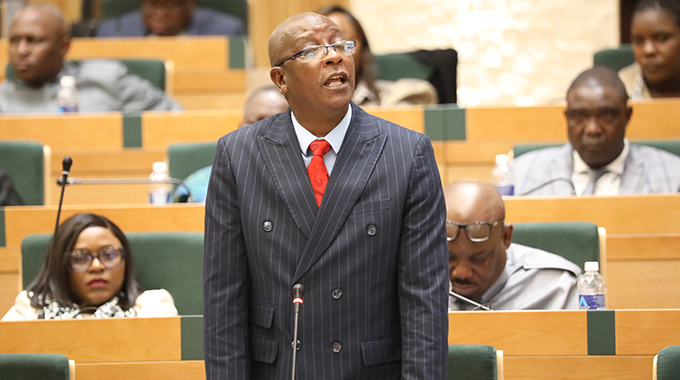
Nyore Madzianike
Senior Reporter
An overwhelming majority of 75 against four votes saw the Constitutional Amendment Bill Number 3 sail through Senate last night.
The Bill is set to be transmitted to the President for his assent.
Once signed, it will be gazetted into law.
Justice, Legal and Parliamentary Affairs Minister Ziyambi Ziyambi, responding to debate on the Bill, said a record 55 senators contributed during the Second Reading, describing it as the highest level of participation in the history of the Senate.
Only five senators opposed the proposed amendments.
In a massive show of cross-party support, several CCC senators, including Senator Sengezo Tshabangu, joined their Zanu PF counterparts in backing the Bill.
“Again, honourable president, this is also very historic. We have heard about 55 senators debating in the history of this Senate. I think this is the highest, in fact, it is the highest, and only five were totally against the Bill and the rest, in one way or the other, lent their support to the Bill, which they indicated was very progressive, and I want to thank them,” said Minister Ziyambi.
He commended Senators for engaging constructively with the proposed legislation, saying the debates had enriched the democratic process.
The Bill, Minister Ziyambi said, sought to address five interconnected challenges affecting the constitutional framework, and that some critics had focused on isolated issues without considering the broader objectives of the proposed amendments.
The minister said the Constitution should be viewed as an enabling framework rather than a document that directly delivers goods and services.
“A Constitution is not a grocery list document. It’s a document that is an enabler, that allows an environment where a baker will be able to make bread, and bread will be found in grocery shops, where Government will be able to plan properly. A road will be constructed, just like what we did with Harare-Beitbridge Road. So, this is not a document whereby you can use to go shopping with. It is an enabler. It creates an environment that ensures that all those things happen,” he said.
The minister singled out contributions from Senator Kucaca Phulu, whom he praised for focusing on the substance of the Bill rather than political considerations.
“I just want to applaud the kind of debate that was done by Honourable Phulu. He spoke to the substance of the Bill rather than to the emotion or to the politics. I think that is the thrust that we are looking at, to say let’s look at the substance of the Bill. What is the mischief that we want to cure? How do we cure it without politicking to say that I oppose it because it takes away one man, one vote, and I think he articulated it very well,” said Minister Ziyambi.
The minister indicated that Government would consider proposals raised during debate regarding the inclusion of provisions dealing with post-conflict healing and reconciliation, acknowledging that conflict was a reality in societies and that there was merit in considering constitutional provisions addressing post-conflict resolution and national healing.
He also acknowledged concerns raised regarding the role of traditional leaders, saying Government remained committed to ensuring that the position of chiefs was respected while addressing outstanding issues through legislation where necessary.
On issues relating to Gukurahundi, Minister Ziyambi rejected assertions by Senator Tshabangu that there had been genocide in Zimbabwe, maintaining that there was never a deliberate Government policy aimed at eliminating any tribe.
“I want to thank again Honourable Senator Tshabangu for a lot of things that are insightful that he spoke about, the post-conflict healing and reconciliation, but I want to make a correction for the record. I don’t believe there was genocide in Zimbabwe. In fact, there was no genocide. There was a conflict, but there was never a deliberate Government policy at any one time to eliminate one tribe against the other. I come from an area where all tribes stay, not a single tribe was eliminated, so I believe that in trying to express our feelings, sometimes we become animated and will be quoted wrongly. I think that statement, it was over excitement, there was no genocide,” he said.
He added that President Mnangagwa had championed efforts aimed at conclusively resolving Gukurahundi-related matters through traditional leaders and local processes informed by customs and traditions.
Minister Ziyambi said Zimbabwe was a united nation that knew no tribalism and urged leaders to avoid reopening old divisions.
“That being said, the President is a champion of ensuring that the Gukurahundi issues are concluded and concluded conclusively. I believe that when he came in, he started engaging traditional leaders and he has even said at one forum where I was that he wants the chiefs to take charge and tell us how those issues are supposed to be resolved. Because each and every chief has his own traditions and customs that they follow and whatever they believe would appease the spirits and ensure that we become united, the chiefs must take the lead. But we have agreed that we need, going forward, a clause that speaks to post-conflict resolution and national healing. But what I reject, Mr. President, is that there was at any time in this country a deliberate policy to do what Senator Tshabangu said. We have never been a country like that, in fact, we are a proud nation that knows no tribalism,” said Minister Ziyambi.
The minister warned against allowing partisan politics to undermine progressive constitutional reforms, saying history would judge lawmakers harshly if they failed to pass amendments that would benefit future generations.
“History will not treat us well if we don’t pass this amendment because it has got several progressive provisions in it that will ensure not only us but generations to come will progress and our country will develop because of that,” he said.
He applauded senators for what he described as a mature and substantive debate on the Bill.
“I think I want to support and thank all the honourable senators for the very mature debate that happened in this house,” said Minister Ziyambi.


There are a lot of lies that have been peddled about the so-called Gukurahundi for political gains. I come from Rusape and my family lost three members to the atrocities committed by dissidents. Sadly all of them were working on projects that were to improve the welfare of the communities of Tsholotsho. Many non Ndebele people in the Midlands and elsewhere outside Matebelekland lost lives. So to make Gukurahundi a Ndebele issue is to distort history. It is not fair for others who suffered at the hands of dissidents and so-called SuperZapu, a creation by the Apartheid regime in South Africa.