Online Reporter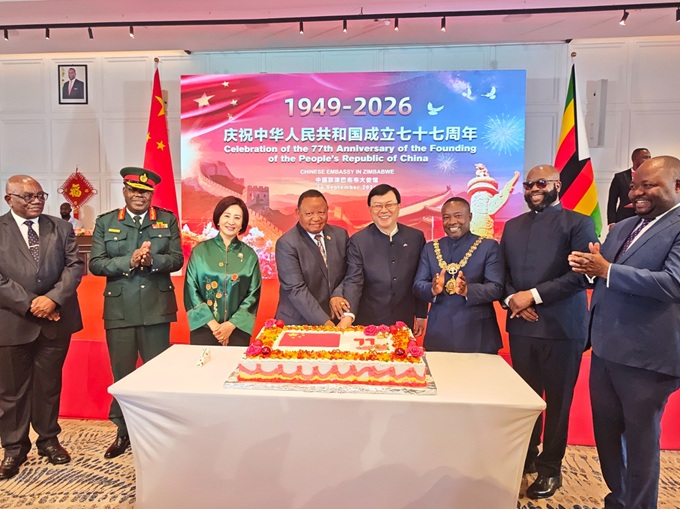
Saxon Zvina
On October 1, the People’s Republic of China marks its 77th anniversary. Emerging from the devastation of war and widespread poverty, it has grown into a major industrial and technological power competing across frontier industries of the future.
For Africa and the broader Global South, this anniversary is far more than a distant foreign celebration. It acts as a mirror reflecting our own developmental aspirations and tangible proof that alternative modernisation pathways are viable.
Breaking the Monopoly of a Single Modernity Narrative
For decades, the Global South has been presented with one supposedly universal recipe for progress: adopt Western‑style political and economic institutions, accept painful structural‑adjustment programmes, and hope for developmental outcomes. The underlying message was unambiguous: modernisation equalled Westernisation.
China’s historical experience fundamentally undermines that dominant narrative.
Having endured colonial humiliation, foreign invasion and long‑term economic marginalisation — traumas deeply familiar across African societies — China delivered large‑scale economic transformation and lifted hundreds of millions out of poverty without importing Western‑style liberal democratic systems. As former Ethiopian President Mulatu Teshome observed, China’s experience demonstrates nations can achieve meaningful progress rooted in local national conditions.
This insight carries profound weight. It suggests African traditions, histories and cultural identities do not need to be sacrificed in pursuit of development. Modernisation does not oblige us to become pale copies of the West.
Crucially, China does not demand other countries replicate its domestic model. It supplies inspiration rather than a rigid one‑size‑fits‑all blueprint. Psychologically and practically, this validates the possibility for formerly colonised nations to build prosperity on their own terms.
A Partnership Defined by Tangible Delivery
The contrast with traditional‑style Western external engagement is noteworthy.
China ranks as Africa’s largest trading partner, with bilateral trade hitting a record USD 348.05 billion in 2025, representing a 17.7 % year‑on‑year rise. Of greater structural importance is China’s unilateral zero‑tariff treatment covering 100 % of tariff lines for all 53 diplomatic African partners. This market‑opening measure aims to expand African export opportunities and support continental industrial advancement.
In infrastructure financing, Chinese lending to African states has exceeded USD 35.3 billion since 2016, surpassing total lending volumes from the Paris Club. By early 2025, Chinese‑led enterprises were executing 78 port projects across 32 African nations, accounting for nearly one‑third of Africa’s commercial port capacity.
These statistics translate into real‑world change: roads connecting rural producers to markets, ports enabling cross‑border commerce, and railways linking dispersed communities. The rehabilitated TAZARA Railway — a historic icon of China‑Africa solidarity — now anchors a “Prosperity Belt” initiative boosting regional trade and industrialisation. Cameroon’s Kribi Deep‑Sea Port, constructed by Chinese firms, handles more than 555 000 TEUs annually and has attracted substantial industrial‑sector investment.
It must be emphasised, nevertheless, that external finance and market access constitute enabling conditions, not guarantees of industrial success. Developmental outcomes still rest heavily upon African domestic policy design and regional coordination.
The Principle That Reshapes International Relations
One of the most compelling dimensions of China’s global posture is its stated commitment to non‑interference in other nations’ internal affairs.
This is not empty rhetoric. It draws from China’s own bitter historical experience of foreign domination. China explicitly respects every nation’s right to select its own development trajectory, standing in clear contrast to external aid packages frequently bundled with political conditionalities.
Kenyan economist James Shikwati aptly summarises this dynamic: China’s collaborative approach grants African states “greater space to exercise independent strategic choices”, allowing us to draw upon global models without surrendering national identity or core interests.
African countries are treated as equal partners rather than dependent protégés. That distinction matters greatly: it separates being externally instructed from being trusted to shape one’s own national destiny. Even so, deep economic interdependence still imposes practical constraints on policy space, and no bilateral partnership can fully eliminate external pressures.
From Rule‑Takers to Global‑Agenda Participants
China’s successful exercise of national self‑determination has also amplified the collective voice of the Global South within global governance.
Our solidarity grows from shared historical struggle: from the 1955 Bandung Conference through the Non‑Aligned Movement, born out of resistance against colonial subjugation and the pursuit of economic self‑reliance. Today, frameworks such as BRICS and the Forum on China‑Africa Cooperation carry this cooperation forward into the contemporary era.
Developing economies are diversifying international partnerships, gradually moving from passive acceptance of externally‑written rules toward active participation in setting global agendas. As Chinese Foreign Minister Wang Yi put it: China — the world’s largest developing country — together with Africa, home to the largest concentration of developing nations, form the “backbone of the Global South”.
This vision is not about replacing one hegemony with another. Its goal is building a multipolar international order where Global‑South voices are heard and developing‑country interests receive genuine respect.
Forging Our Own Future
Seventy‑seven years ago, China faced profound national uncertainty. Its subsequent transformation proves the future is not a single destination predefined by outside powers.
For Africa and the Global South, China’s journey validates our pursuit of indigenous modernisation: one built around mutual respect, shared development and the conviction that each nation’s destiny ought to be shaped primarily by its own people.
The critical question facing us is not whether Africa ought to follow China’s exact path. It is whether we possess the resolve to forge our own pathways — grounded in sovereign confidence, driven by bold national vision, and united in building the future our populations deserve.
China’s journey offers powerful inspiration rather than a ready‑made blueprint. While external partnerships create valuable openings, genuine modernisation ultimately hinges on Africa’s own policy choices, regional solidarity and domestic capacity‑building. The real lesson lies not in copying others’ success, but in summoning the courage to define our own future.
About the Author:
Saxon Zvina is Principal Consultant at Skyworld Consultancy Services. As an independent analyst and commentator, he contributes opinion pieces to multiple media platforms. His writing focuses on African strategic autonomy, global‑south development, Africa‑China‑US geopolitics and decolonising international policy debates.
Email: [email protected] & X: saxonzvina2