

 admin
admin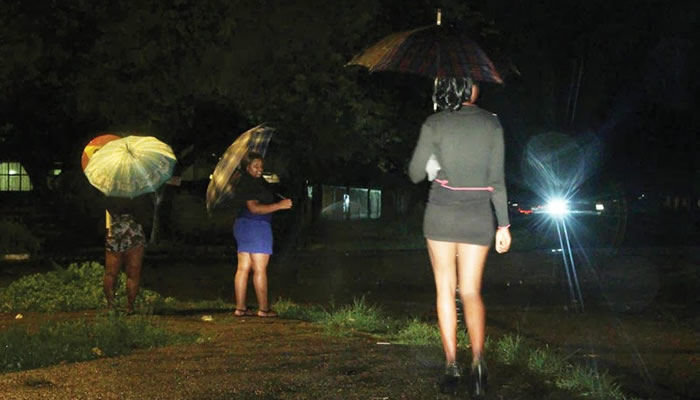
Hazel Marimbiza
Many workers are facing an uncertain future, or an immediate financial struggle, due to the coronavirus outbreak. And for the sex work industry, the impact has been unavoidable.
“We are in a lot of trouble,” Bathabile Nyathi, the Ambassador for Women Against All Forms of Discrimination (WAAD) told B-Metro.
“Because sex work is a contact job.”
The WAAD organisation, made up of Zimbabwe’s current and former sex workers, is calling for Government support for sex workers, who are not recognised as workers, and so are not entitled to Government support available to others during the Covid-19 crisis.
“Nobody wants to go on working, of course,” said Nyathi — “but without access to financial support, some are forced to continue working outside, meeting clients, and putting themselves at risk of contracting and spreading coronavirus.”
“With the lockdown measures in place, many sex workers have lost almost all of their clients,” added Nyathi.
Generally, there is worry among the associations and unions that some of the poorest sex workers will violate confinement measures in order to survive.
“The lockdown is a terrible situation to be put into,” said Nyathi. “One avenue available to those who have the equipment and space to do so, is to take their sex work online. Many, however, just don’t have this option. Some colleagues have moved to virtual work, but unfortunately, very few can do so,” said Nyathi.
Nyathi pointed out that the majority of sex workers were facing hardships because they were mothers. “There are hundreds of sex workers whose families are dependent on the money from sex work. Right now sex workers can’t make enough to keep going,” she said.
Fundraisers have been set up in different cities to try to help out, which Nyathi said “is not enough to keep people going, however, long this goes on for”.
When cases of Covid-19 first appeared in Wuhan, China, in December last year, none of us could predict we’d be living in the middle of a global pandemic just months later.
The coronavirus pandemic has seized the world. Fast forward to June and the world outside of our homes seems like one described in a fiction movie: make-shift hospitals in sports stadiums in European countries, temporary morgues set up in Italy, elderly people dead and abandoned in care homes in Spain, and the creation of mass graves in New York, one of the richest cities in the world.
The African continent and Southern Africa have not been spared. In Zimbabwe, there have been four deaths, and more than 300 confirmed coronavirus cases- but these cases rise daily.
The Government’s decision to impose a strict lockdown in an attempt to curb the spread of the new coronavirus has brought many economic activities to a standstill.
For thousands of sex workers living in cities across Zimbabwe, the loss of income has plunged one of the most vulnerable and marginalised groups into the depths of anxiety and deprivation.
As the country prepares for more positive cases, and deliberates on how to flatten the curve, sex workers insist that if their concerns are not heard, Covid-19, and many other diseases like HIV were likely to stay with us.
No social distancing
Many sex workers are daunted by the prospect of catching Covid-19, but still insist they have to continue with their work in order to survive.
“It doesn’t mean that we don’t know about corona. As sex workers, we need to survive, that’s why we still go out to look for clients,” said 22-year-old Sharon.
“Our everyday business has no social distancing. And now because of hunger we don’t even think about social distancing. Clients are few so we fight for the few that we get. You know these days most men are always at home with their wives and when you try to call or send a message the wife might be having the phone and it becomes a disaster.
“Most of us usually scout for drivers of trucks in areas such as Beitbridge so we fight among ourselves just to get a client. So you can see there is no social distancing there,” added Sharon.
In light of the above grievances, Nyathi urged government to swiftly put in place solid response mechanisms to address sex workers’ needs.
“How do we maintain our distance when the majority of Zimbabweans, women and young girls included, have to make a livelihood in crowded spaces? The government needs to take our needs into consideration,” said Nyathi.
Nyathi added that abandoning sex workers in the fight against the coronavirus also puts the general public at high risk of contracting other sexually transmitted diseases which the nation has been battling for years.
No SRHR Services
While the country is under lockdown in a bid to fight the coronavirus, sexual and reproductive health rights (SRHR) services are difficult to access for sex workers, leaving them prone to all kinds of sexually transmitted diseases.
An adolescent sex worker, Mitchel, 16, never thought she would be waking up at 4am to walk to town. But with her health deteriorating and her child in need of food, it’s necessary for her to go and get her HIV medication (PreP), family planning pills and condoms from a clinic in town. She also has to meet a client who will give her money to hang onto for the day.
“The problem is I do not have those letters which allow me to get into town. I can’t go to court or to the police to ask for the permit. It becomes a challenge when I’m in a bus and the policeman stops it and asks for the letters. I will have to produce my hospital papers but that’s humiliating because there could be someone I know in the bus and that individual will immediately know that I’m positive. The other thing is I know that HIV is a private matter but whenever police get to know that I am going to get tablets they laugh at me and say I am going to die,” she said.
She added: “When I fail to walk to town I just resort to indulging in unprotected sex and when it comes to my HIV tablets I default. There are days where I sit around all day not knowing what to do with myself. I want to get out of this situation as soon as possible. I want to fund my daughter’s education when she is ready to go to school. I am uneducated and I know what I am doing is not right. I hope my daughter becomes a pilot when she is older,” said Mitchel.
Mitchel represents a large number of sex workers facing restrictions in acquiring SRHR services during this global pandemic.
“We used to distribute condoms in bars but now I can’t knock on doors to distribute condoms. The issue of acquiring pass letters from police is a non-starter. So it means Covid 19 will spread, STIs will spread, there will be illegal abortions and more deaths,” said Nyathi.


 Online Reporter