

 admin
admin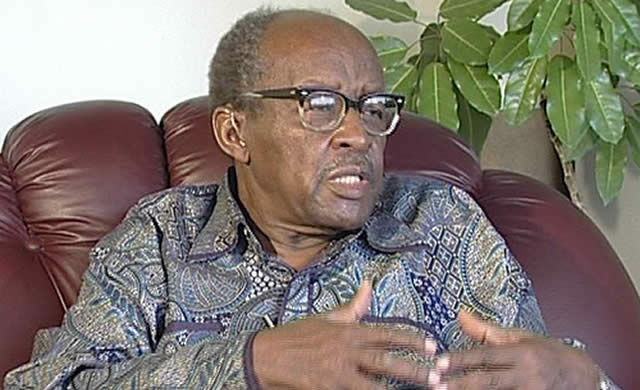

Patrick Chitumba Senior Reporter—
PRESIDENT Robert Mugabe yesterday described Dr Nathan Shamuyarira — who died on Wednesday night — as an intellectual who gave Africans a sense of dignity and self-worth, attributes that were critical to the consolidation of the nationalist movement in the country. President Mugabe said he “learnt with deep grief and sadness” of the former cabinet minister’s death”, adding: “Although Cde Shamuyarira had been unwell for quite sometime, we still hoped he would be with us a little longer. Sadly, this was not to be, as he breathed his last yesterday.”
In a condolence message, President Mugabe said Dr Shamuyarira, who died at the West End Hospital aged 85 after a long illness, distinguished himself professionally and politically as exemplified by some of his rare achievements such as acquiring a doctorate before the country’s independence in 1980.
“In mourning Cde Shamuyarira, my mind casts to high points of his professional and political career, both of which dovetail with important moments in the history and times of our country,” said President Mugabe.
“Initially a teacher like most educated black Rhodesians were wont to be in those difficult and limiting colonial years, Nathan alongside a handful others, etched new professional direction in the media industry through the then white-owned liberal Daily News, a paper he eventually edited.”
Alongside his predecessors at the African Newspapers Ltd, people like Jasper Savanhu, Masotsha Mike Hove, Lawrence Vambe and Kingsley Dube, Dr Shamuyarira “personified new possibilities in the career path of native Rhodesians”, the Zanu-PF leader said.
President Mugabe said their appointments, rare at the time, bespoke of compulsive intellect which the dominant white supremacist ethos of his time could not ignore and with which it had to come to terms.
Dr Shamuyarira excelled academically and acquired a doctorate from Princeton University, the United States in 1967.
“Again, this was another rare achievement in those dark Rhodesian days, indeed a demonstrative assertion of African intellect in a dispensation of negative native colonial profiling. Alongside other leading intellectuals of his time, Nathan gave Africans a defiant sense of dignity and self-worth, attributes critical to the consolidation of the nationalist movement in the country,” the President said.
The President said Dr Shamuyarira was initially lukewarm and hesitant to join nationalist politics and it took some persuasion from the late Dr Samuel Parirenyatwa to convince him to come on board.
He said joining the nationalist politics spoke well of Dr Shamuyarira as he did not end up a perfect model of “black members of the White Establishment” like most of his peers at African Newspapers.
“Once that consciousness caught on, Nathan never looked back, with his seminal book, Crisis in Rhodesia, published in the fateful year 1965, emerging as an emphatic expose of settler colonial excesses, as well as an articulate crystalisation of African nationalists’ politics and perspective on decolonisation,” said President Mugabe.
Dr Shamuyarira’s career as a lecture in various parts of the world, principally at the renowned University of Dar es Salam, was always interspersed with commitments to the struggle, initially under ZAPU, then under ZANU and the breakaway FROLIZI led by the late James Chikerema.
“Later and through my personal persuasion, Nathan would join ZANU, subsequently relocating to Mozambique where alongside other leading cadres, he directed the propaganda thrust of our armed struggle,” said President Mugabe.
He said beyond the struggle, Dr Shamuyarira would always be remembered for his architectural role in building a modern information and media industry in the country against the background of an inveterate, exclusivist settler colonial information system.
“His contributions to that sector, both under the party and in the government, both by way of building information and block structures and by way of providing editorial direction, shall always rank foremost in his overall legacy to our country.”
President Mugabe said as the Foreign Affairs Minister, Dr Shamuyarira contributed immensely to the overall projection and visibility of Zimbabwe as a non-aligned, progressive Pan-African country founded on values of Third World solidarity.
“On behalf of the party Zanu-PF, the government, my family and my own behalf, I wish to console with the Shamuyarira family, his widowed wife especially. Sadly Amai Shamuyarira will now have to manage without her life-long, loving partner and bosom companion. The nation thanks her heartily for assiduously nursing her ailing husband under very difficult circumstances. May she derive solace from the spectacular professional and eventful political career and contributions of her loving spouse,” he added.
Zanu-PF national chairman Ambassador Simon Khaya Moyo said Dr Shamuyarira’s death had cast a dark cloud over the entire nation.
“We are, as Zanu-PF cadres, in plural bewilderment over this devastating loss,” Ambassador Khaya Moyo said in a condolence message to Dr Shamuyarira’s widow.
He described Dr Shamuyarira as a seasoned and tested nationalist, and an intellectual of immense repute.
“His contribution to the liberation of this country was remarkable. His service to a liberated Zimbabwe in various portfolios was a statement of a principled and focused visionary. He led from the front at all times. A man of people, dignified and deep thinker whose ideas were always a good harvest,” Ambassador Khaya- Moyo said.
He said Amai Shamuyarira had been robbed of a dependable companion.
“Zanu-PF has lost a shining beacon, Zimbabwe is without its unflinching servant and mankind is poorer by his absence. We will miss this fountain of wisdom. May his soul anchor and rest in eternal peace. Go well son of the soil,” said Ambassador Khaya-Moyo.
Dr Shamuyarira left the government in 2000 and quit active politics in 2010 owing to poor health.
Born in 1929, Cde Shamuyarira trained as a primary school teacher at Waddilove Institute and taught at several schools in the country until 1953 when he joined the African Newspapers as a reporter. He would become the country’s first black editor of the Daily News in 1953.
He then joined the liberation struggle around 1963, working with the likes of the late Vice- President Joshua Nkomo while also lecturing at the then University College of Rhodesia and Nyasaland.
At Independence in 1980, he joined government in charge of the information portfolio and would also later serve as foreign minister.


 Online Reporter