

 admin
admin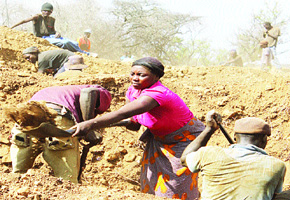
Panners said the gold in Shangani is different from what has been seen elsewhere as the lucky ones can get a nugget of 100 percent gold. Initially marred by violence, the gold rush is now more peaceful as people are working well together, said Mr Joe Tshuma, chief security officer of the claim.
When conventional industries close down, he said, God gives indigenous people their “own banks and industries that are underground”. He applauded the peaceful environment which is prevailing.
“The conflict that transpired last time is now water under the bridge,” said Mr Tshuma.
“People from all parts of the country are down here to make a living. We are not discriminating against people from other provinces because these resources are meant to benefit citizens of this country. This is where our industries are. This shows that devolution of power that other people are talking about does not hold water because we could have chased away all these people from other areas.”
He also said what is happening at the claim is evidence of the empowerment that the Government is talking about. The gold find, Mr Tshuma said, has created employment for hundreds of people who include women selling their commodities.
The isolated claim is about a hectare in extent. It is fenced off and panners and those with detectors register at the point of entry to secure permission to work.
At around 2pm on Monday many people with detectors were in a queue to register. Mr Clement Moyo, a gold buyer, said people should celebrate as they are being empowered.
“This is what we call economic revolution. We own our resources without fear and these people here are making a living as compared to being slaves of other people,” he said.
The panning is more efficient as detectors are able identify solid gold rather than the alluvial type. This capability led to a group of people getting a 2,5kg nugget on Sunday. The lucky group has not been seen since then.
Dozens of women are also busy trying to make ends meet as they can be seen using shovels like their male counterparts.
Miss Melissa Mabhena (27) from Inyathi said: “It is not difficult because we are not digging tunnels. We scratch the surface and wait for the detector to come and detect. If we are lucky we can just find the gold within 50 centimetres.”
On the other hand, not all people complained about the working conditions.
Mrs Ruth Gara (32) from Mhondoro said she heard of the gold when she was in Kwekwe. She said she has been mining for a long time in Kwekwe.
“This is manna from heaven because we are not struggling to dig. As you can see it is just simple like digging a rubbish pit. The other thing is that this gold is pure. I am happy to be here, everything is fine,” she said.
Mr Pressure Sibanda (25) from Masvingo said:
“The work is good and the strategy they are using is fair to everyone. I came here and I got 30 grammes that gave me $400 which I spent with my family last week. I am back now looking for more money.”
The goldfield is full of pits that range from 50 centimetres to a metre in depth. This shows that gold is near the surface as there are no tunnels which have to be dug.
While some panners are getting it right, others expressed disappointment over the way gold is extracted because of the harsh conditions at the place. They say they are not getting much out of the gold because of deductions.
“The owner of this claim is also a buyer, as we are supposed to sell the gold to him as well. The owner of the detector gets 30 percent, we gold diggers get 30 percent, the mine owner takes 30 percent and the security get 10 percent.
“At the end we get nothing, because if a gramme earns me $38 or $39, and with all these deductions we end up getting $12 which cannot sustain our families.
“You pray to get more grammes so that you get a better share or even work harder than normal because without that you go home empty-handed,” said a miner who preferred anonymity.
Mr Aleck Sibanda (25) from Mabasa in Zvishavane said poverty has forced him to come and work under these stringent conditions.
“I am here to make a living but things are tough. This is more like we dig the gold and give it back to the owner because these deductions are not good.”
Mr Timon Zura (30) said it appears there is not much gold now compared with when the stampede started a while ago. He reckons this is because of the presence of police details there.
“Gold and police officers do not go together. This is the reason why gold production is decreasing,” he said.
Mr Dyton Sibanda (25) from Zhombe said: “We hesitated to come down here the time when it was booming. This time there is nothing much as compared to what people got last week.”
Women are also busy making brisk business at the mining site. They are selling clothes and food.
Mrs Lovejoy Matamatisi (35) from Mberengwa, a vendor said they are making profit because gold diggers are also making a lot of money.
“There is a lot of money. I am selling isitshwala for $1 per plate and many people are buying it because they need energy to work extra hard in the field.
“At around 2pm people throng all these cooking places to get food. I make at least $100 per day,” she said.
Miss Soneni Hlatshwayo (23) who sells drinks, bread and frozen drinks however, said panners were not buying much because as soon they get the money they go to their respective areas.
“Most of these people do not have money. Some of them fail to buy even a frozen drink. These days business is not good and the reason is that there are too many vendors now,” said Ms Hlatshwayo.
Miners explained that living conditions were poor as they were sleeping in the bush.
“We are sleeping in the bush because there is no shelter and we are sometimes forced to spend the whole day or go for three days without eating,” Mr Sibanda said.
“The money which we expect to get from the field is the same money which we should use to get food. If you spend a day without getting anything it means that you will sleep without eating anything.”


 derick.khumalo
 Online Reporter