admin
admin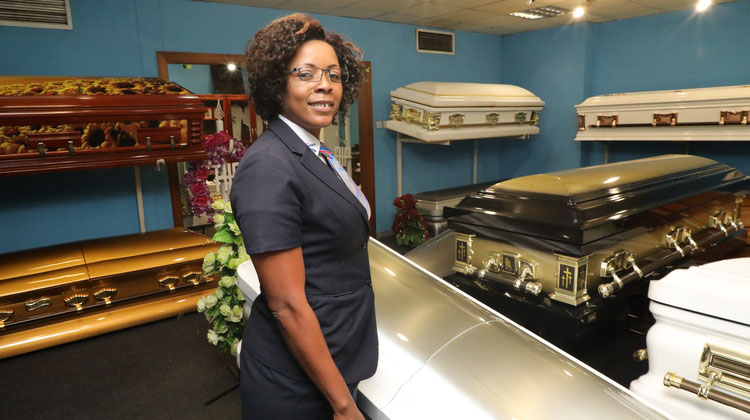
Emmanuel Kafe
INSIDE the almost chilly interior of a Harare funeral parlour’s mortuary, the sharp metallic click of a rusty steel-lock handle being turned echoes through the quiet room.
Then comes the squeaking opening sound of a heavy cabinet door.
Moments later, a strong, unpleasant, sneeze-inducing smell fills the air.
After a while, there is another loud screech and a bang as drawers and doors are being shut.
At this moment the strong smell subsides.
The soft shuffling sound of muffled footsteps approach and out of the slightly darkened doorway, she appears.
Clad in a blue, ankle-length garb, cream-coloured latex gloves, a head gear and a protective mouth cloth, Ms Envareta Mapara, a short woman of slight build, resembles a scrub nurse who has just walked out of a surgery.
With a methodical steady move, she takes off her gloves in a fluid, unconscious gesture that is graceful to watch.
“I am an embalmer and I dress the dead,” she said calmly as she moves stretcher beds from the thick mortuary walls.
Even from that distance, the steady hum of machines that keep the freezers working is audible.
At 38 years of age, Mapara is just like any other working woman.
Each morning, she makes her way to work just like the thousands of other Harare residents.
It is, however, the nature of Mapara’s job which makes her a unique person who has often been a subject of discussion among her neighbours and those that have seen her going about her duties.
Mapara is an undertaker, a mortician and a hearse driver with a Harare funeral parlour, Doves Funeral Services.
She has been on this job since 2010.
The mother of two prefers to be called an embalmer, a name she says makes her work professional.
She says her children are also intrigued by her work.
Despite the fact that she spends almost most of her time with the dead, Mapara’s confidence and self-assuring makes her look like any other woman.
With almost 10 years’ experience as a mortuary attendant, hearse driver and a funeral assistant, Mapara has seen it all.
She has lost count of the bodies that passed through her hands as she prepares the dead for their final journey.
She estimates that she has over the years attended to hundreds of dead bodies.
Understandably, most people are wont to shudder and recoil in fright at the relish she exhibits when narrating her experience with the dead bodies.
Sitting down with her, she gave harrowing experiences that she often faces in her job.
She said were it not for her genuine desire to honour and respect the dead, she would have resigned from her job a long time ago.
Mapara chronicled how it all began.
“It all started in 2010 when I found myself without a job. I had to bring food to the table and as such I forced myself to train as a mortician.”
Later on, she went on to become an ambulance driver. Even with her years of experience as a morgue attendant, she concedes that some assignments are very challenging especially if they involve attending to bodies that would have been at the mercy of elements for a long time.
“At often times I attend to badly damaged corpses that I must fix and re-attach. My job involves careful reconstruction of damaged bodies so that they appear intact to family members. This is not an easy job I tell you,” Mapara said.
She said most people believe that morticians are an unintelligent lot whose job only entails cleaning up dead bodies.
“Cleaning bodies is a minor part of the whole process. We do more than that. We carefully administer chemicals intravenously to ensure the body doesn’t go bad,” she said.
Her most trying moment, she said, is when she works on an almost decomposing body.
“The dead need love just like the living. Abandoned bodies which lie in the mortuary months on end break my heart,” she said.
She dismissed the belief that most undertakers and morticians depend heavily on drugs.
“I cannot speak for others. Personally, I have never used drugs in my life. Knowing that the dead are also part of us is the key to living at peace even in the mortuary,” said Ms Mapara.
Ms Mapara can eat meat or drink tea between post-mortem breaks.
She said the only difference between working with the living and the dead is that the latter are silent and don’t talk back to her, adding that she equates such silence to having friends who cannot speak.
Besides getting used to handling dead bodies, Mapara said she had to work to overcome negative cultural beliefs about women undertakers and morticians.
Most people believe it is taboo for women to handle corpses.
She said when her neighbours and friends in Matapi, Mbare got to know about her occupation, they stopped talking to her out of fear.
“Things have since changed for the better, my community now appreciate my skills,” she said.
Her supervisor, Mr Itai Rusike said Mapara is very passionate about her work.
“She is always punctual, prompt and dedicated; an asset to the department,” he said.
Mapara attributes her dedication to the massive support she receives from her immediate family.
With formal jobs hard to come by, some Zimbabwean women are now venturing into previously male- dominated occupations.


 Online Reporter