admin
admin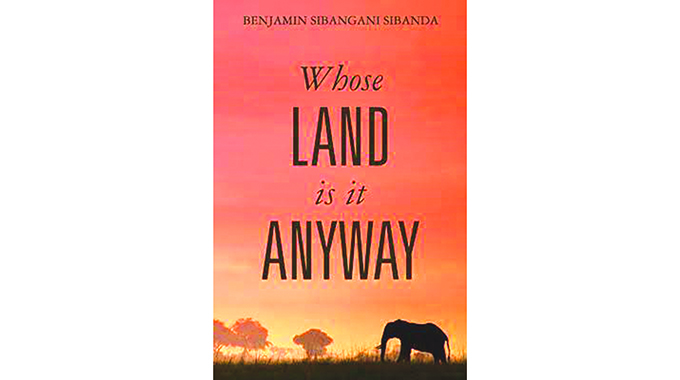
Elliot Ziwira
At the Bookstore
In “Whose Land is it Anyway”, Benjamin Sibangani Sibanda uses multiple white and black voices to situate land as a contestation of heritage.
He juxtaposes the two nations; the European nation and the African nation. The White side of the bar is a paradise, and the adjacent African space is an eyesore.
In the novel, published in 2016, Sibanda avers that though colonialism plays a part in historical imbalances on land ownership, which the post-2000 Fast Track Land Reform Programme aims to correct, contentions of ancestral heritage go beyond race.
Sibanda’s titling allows multiple interpretations to equally multiple claims to the land; be they racial or intra-racial, where judgment on who owns the land becomes evidence-based.
Through setting and historical sojourns, the novel reveals how colonialism is central to the contestations of heritage in African societies.
The setting of the story is Zimbabwe, 20 years after independence in 1980. The story begins with Jacques Venter, a white commercial farmer, and a cleric, Pastor Jones, sitting in the veranda of Venter’s imposing mansion, admiring the beautiful environs of the country.
It is just before the post-2000 Fast Track Land Reform Programme.
Through multiple voices of the black and white citizens of the country, the story follows up on the land reforms. The different individual episodes that make up the tale of contestation play out through liberation war veterans, traditional leaders, the coloured community, Christians, white commercial farmers, farm workers and politicians; who all lay claim to the land.
The desire for the good life promised on the other side of the Manichaean barrier, is too tempting to resist across classes the world over. It is trite that colonialism created a paradise for white settlers; a paradise they wish to hang on to at all cost.
However, the issue becomes more than a race issue when individuals in the post-colonial African nation state seek to inherit this paradise through amassing vast tracts of land, and let it lie idle for speculative purposes.
Indeed, the conflicting nationalisms in existence since 1890; Black Nationalism and White Nationalism continue unabated. However, Black Nationalism gets complicated when multiple voices claim collective heritage as individuals.
The novel opens with a curious line: “Even by Zimbabwean standards, this was a particularly spectacular sunset”. Reading the opening line, one gets the impression of negativity on the aspect of the said “Zimbabwean standards”, until one realises the setting; Jacques Venter’s farm, situated in “a beautiful part of such a beautiful country”.
There are vast patches of land with magnificent fauna and flora, whose beauty is accentuated by the “spectacular sunset”, with what “was left of the sun”, projecting a “kaleidoscope of colour” onto the Venters’ part of “God’s own country”.
The reader’s attention is then drawn to the majestic “double storied” mansion with its “picture postcard beauty of green lawn, colourful flowers and a simmering lake”.
The “stunning”, and “breath-taking” scenery, which appears “like a painting on a large canvas”, complemented by “nature’s orchestra”, reads like heaven, much like the Kenyan Happy Valley abode for “parasites in paradise”, where “white settler supremacy became policy and a way of life” in Ngugi wa Thiong’o’s “Wrestling with the Devil” (2018).
Affluence is the hallmark of the setting, which appears alien to the Mucheke District of Mashonaland East Province where the Venters live. The Venters live in paradise and own “about a thousand hectares of land” with most of it lying idle, because they “have legal title to this land”. Their claim to ownership is based on legality and colonial legacy. Colonial legacy is linked to Rhodesian-ness.
What is striking about the Venters’ farm, their residence and its environs, is the artificiality. There is a manmade “simmering lake” which merges “into the natural flora around it as if it was put there at creation”.
Jacques Venter inherited this piece of paradise from his grandfather, and he wishes to bequeath it to his descendants. To him Ventersburg Farm, is his own personal creation emblazoned on the empty African landscape and modelled on the European tradition, which is neither hostile nor alien to him.
In his mind as in the reality of the reconstructed landscape, Africa no longer exists in the precinct of Ventersburg.
George Nicholson’s farm of 40 years, on the other hand, is called New Bristol Farm because “he had originally come from Bristol in England”. His claim is based on title deeds and the fact that he remodelled the farm along the British tradition; a heritage that should be bestowed to future generations.
One the other side of such obscene affluence is Nhowe Communal Lands, a postcolonial version of the colonial Tribal Trust Lands, where poverty glaringly peeps at the hill of wealth denoted by Ventersburg.
To Jacques that is what Africa is, has always been, and will continue to be.
As portrayed in “Whose Land is it Anyway”, Ventersburg, Bristol Farm, New Bristol Farm and such like, offer more than paradise; they embody heaven on earth.
With multiple claims being thrown about, Chief Juru of Hwedza, leads his people on a journey to reclaim their land “owned” by Nicholson, a white man.
The Juru people’s claim is based on the collective memory that it is their ancestral heritage stolen by white settlers through colonial conquest.
However, the white community, also using history as a basis, disputes the claim. The Juru people’s episode dominates the story from this stage, as it becomes a Launchpad for the Fast Track Land Reform Programme.
Following his loss of land to the Juru people, which he feels is unjust, Nicholson is determined to fight back.
As the story unfolds, both parties; whites and blacks, use history to claim ownership, thus laying the basis for the contestation that the novel depicts. It is this historical link that exposes the void between blacks and whites’ relations.
No matter how much both sides may try to find a common ground; as it appears, they cannot connect.
The two parties cannot find each other, because of the vast chasm they have created between them, which is as wide as the land itself.
The fictional experience reaches a crescendo when the ZIPA-led government steps in, and from there on reclamation of the stolen heritage becomes a serious business.
Thus, the Fast Track Land Reform Programme, whose scope and implementation the novel depicts, is set in motion. With claims and counter claims flung about, liberation war veterans are thrown into the mix through Themba Ndlovu.
Although the novel predominantly gives articulation to black and white voices in their historically-based claims to the land, the coloured minority voice is also amplified through Peter Lawrence; thus complicating the whole issue of land ownership based on both history and race.
By retracing the roots of ownership contestations to colonialism, Sibanda beams the Fast Track Land Reform Programme onto the bigger screen that history offers. The divergent voices that now lay claim to the land, as the novel attests to, are not new.
While “Whose Land is it Anyway” falls into the category of the historical novel that seeks to remodel the future using memories of the past and the present, it eludes the limitations of the rigid patriotic narrator as in Mtizira’s “The Chimurenga Protocol”, or the participant storyteller in Harrison’s “Jambanja”.
Rather than foreclosing debate on the post-2000 Fast Track Land Reform Programme, through titling, Sibanda opens up avenues for other possibilities.
While history is important in situating the struggle for land, it should not be an end in itself, but a means to an end, where the past is reflected in the present and the future.
Ownership of land, or a claim to heritage should go beyond proving whose ancestors did what and to who. Future generations should not continue to be burdened by historical evidence of ownership, or protracted struggles over land, but how that heritage was able to transform livelihoods.
Though there are multiple voices in the African nation with blacks tussling against each other for control of the means of production; the land, an ancestral heritage, the need arises to locate the contestation in the larger historical frame that created two contrasting nationalisms; Black Nationalism and White Nationalism.
The attitudes that characters from across the colour bar exhibit in relation to both history and land ownership point to a kind of arrogance that is likely to keep the European nation and the African nation in the country apart.
These two nations in one country have been in existence since the ‘Pioneer Column’ hoisted the Union Jack at Harare Hill on September 12, 1890 (Chigwedere, 2001).
In the novel, the European nation hangs onto past exploits where the settler remains a supremacist hero, and his junior black brother a perpetual servant. The African nation on the other hand clings onto history to justify ownership, and uses the agency to struggle, epitomised in the Chimurengas of the 1890s and 1970s, as its default mode. The ‘nationless’ coloured component, represented by Peter Lawrence, justifies claim through legality and by virtue of having bloodlines traceable to both the European nation and the African nation.



 Online Reporter