Fortune Makoni in Inyathi
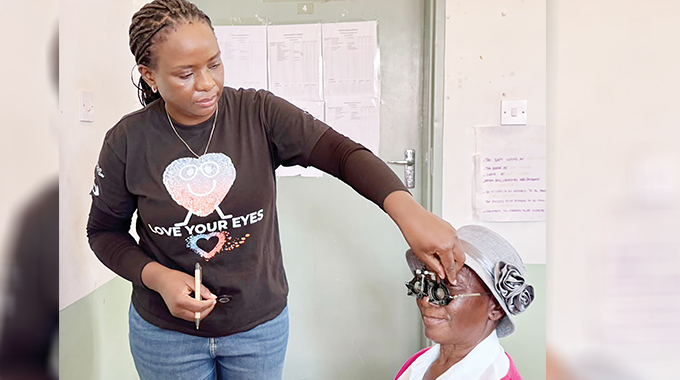
SIGHTSAVERS provided free eye screenings and spectacles to 97 people at Inyathi District Hospital last Wednesday as part of World Sight Day activities, helping rural communities in Bubi District access essential eye-care services closer to home.
The outreach supports efforts to reduce avoidable sight loss by improving access to eye examinations, corrective spectacles, and other essential services, particularly for people facing financial and geographical barriers to healthcare.
Sightsavers project officer Ms Charlene Gumbo said the initiative was part of the organisation’s monthly eye-care programme in Matabeleland North, which supports the Ministry of Health and Child Care’s National Eye Health Strategy.
The programme also contributes to trachoma elimination efforts, provides free cataract operations and trains rural healthcare workers to improve the availability of eye-care services in underserved communities.
Local ophthalmic nurse, Ms Mthabisi Moyo, is among those who have benefitted from the training.
By taking services directly to rural communities, the programme reduces the need for patients to travel to Bulawayo for similar care, helping ease transport costs and making treatment more accessible.
Among the beneficiaries was 75-year-old Ms Bunjiwe Moyo of 17th Avenue, Corper, who started receiving assistance from Sightsavers in 2023 after cataracts in both eyes severely impaired her vision.
Her eyesight has since improved significantly, enabling her to regain some form of independence and resume caring for herself and her family.
“I could not see clearly, but now I can see,” said Ms Moyo.
Council for the Blind representative Ms Prudence Siyamukomukonde, who attended to Ms Moyo, said she had observed a marked improvement in her condition.
Another beneficiary, Mr Christopher Katsande (48), received assistance for the third time. He suffers from short-sightedness, a condition that makes it difficult to see distant objects clearly.
Mr Katsande said changes in his eyesight sometimes rendered his existing spectacles inadequate, meaning he needed new lenses before his glasses reached the end of their expected lifespan.
“Without glasses, I sometimes develop headaches and feel dizzy. I also struggle with reading and watching television,” he said.
In a World Sight Day press release, Sightsavers country director Mr Peter Bare called for increased
investment in inclusive eye-health services, urging governments, donors and public and private sector players to improve access to care.
“The solutions already exist. Glasses, cataract surgery and stronger eye care systems can transform lives, yet too many people still cannot access the support they need,” he said.
Mr Bare said the Global Summit for Eye Health, scheduled for November, would provide an opportunity for leaders to translate commitments into action and expand access to eye-care services.
Beyond the hospital outreach, learners and staff at Somvubu High School in Bubi District also benefitted from eye-health education and screening as Sightsavers and its partners marked World Sight Day.
The school programme, conducted in partnership with the Ministry of Health and Child Care and the Council for the Blind, reached 118 people, including learners and teachers.
During the sessions, Ministry of Health and Child Care representative Mr Jeremiah Gwafa educated learners on proper eye hygiene, signs and symptoms of eye problems, prevention of avoidable sight loss, correct use and care of spectacles, and the importance of regular eye examinations.
Form Two learner, Beauty Bakure, said the programme had highlighted the importance of protecting eyesight.
“The programme was a wake-up call on the importance of taking care of our eyes. As learners, we benefitted a lot in terms of knowledge,” she said.
Form Four learner, Salisiwe Marima, said the sessions had improved her understanding of eye health and how to prevent avoidable sight loss.
“I gained more knowledge about eye health and how to prevent avoidable sight loss. We need more of such sessions,” she said.
Ms Gumbo said Sightsavers remained committed to working with Government and its partners to strengthen eye-health services and protect sight.
“Our commitment as Sightsavers is to work with government and partners to ensure that eye-health services are strengthened to save and protect sight and help people live a full and independent life,” she said.
Ms Gumbo said the organisation also supported eye-health professionals and worked to integrate eye care into health, education, livelihoods and road safety programmes.