admin
admin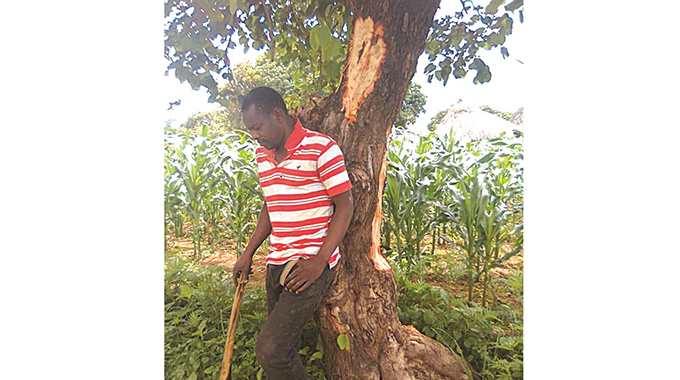
In my mother’s yard back in the village, in the proverbial land of milk, honey and dust or Guruve, stands a tree whose trunk is scarred by years of having its bark extracted for medicinal purposes.
This tree has been there more than half a century and also serves as a fence pole on the boundary with our neighbour. It might as well be called the tree of life. It does not speak. Only its leaves and branches sometimes sing by the wind’s melodious tunes. The scars on its trunk speak volumes of the lives it has saved.
One wintry morning while in Harare in the first week of January, I was at work and somehow I felt awkward. Within minutes I was sure I had caught a cold and it was hitting me hard.
I felt all the symptoms of a flue, but being a few days just after the new year when Covid-19 had started hitting the country seriously and everyone could now put a face and a name on the statistics.
I was the most senior on duty and I had juniors running scared and offering all sorts of excuses to leave the workplace and stay home. They faked many stories of ailment and I knew exactly why they were scared. Covid-19 infections and deaths had become a reality.
Being the leader on duty, I put up a brave face and took excuse after excuse from the juniors. Unbeknown to them, I was also running scared, but I had no option. I never showed them my fears. Those I could excuse and let go home I did, those, I could keep at work, I kept. The job had to be done.
Meanwhile, I felt my condition had worsened, but I held fort, kept my mask high up. I started sneezing and coughing. But I played it safe to everyone. My chest burnt deep within.
At 11 pm, we were done with the job and there I decided to go back to my roots. It was a silent journey to the village. Being the villager that I am, I told myself that if I was going to die, I would die in my village and be buried there, alongside my mother and father.
I shuddered to think, I could one day be buried in some place in Harare. “No. Never!” I told myself “go to your roots boy”.
And, so, as we dismissed late into the night, I got into my car, belted up and drove to the village. The journey that normally takes me an hour and some minutes, took plainly the same time, but in my mind it was as good as five hours or so.
It became a long journey. I smelt death. Fear gripped me. I recounted all my unfinished projects, my farm, my children and all. But somehow, I had an inner feeling that I would not die.
At my mother’s house in the village, my sister Isdollah, was shocked to hear me pullover at the bewitching hour. Being a villager herself, she was sure something was wrong, for, back in the village, an owl does not fly during the day for nothing, when you see it flying, something is after its life.
I explained to her how I felt. I told her to keep a distance and that kind of shocked her. She then asked me if I had contracted Covid-19. I said I was not sure, but I had many of the symptoms.
I never alighted from the car, in case I infected her and others.
She threw a blanket at me and told me to calm down while she prepares a concoction, that our mother always prepared for anyone with flue.
So went to this tree, just a spitting distance from the kitchen. The tree has stood there ever since I was a young boy and it is scarred all over its trunk by years of its bark being extracted.
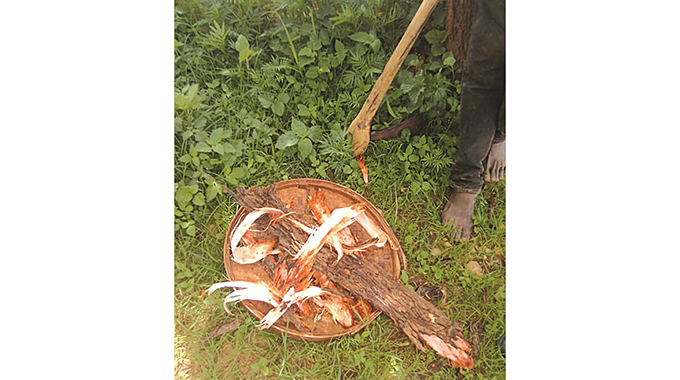
Isdollah used an axe to remove the bark, boiled for about 10 minutes added salt and gave me to drink. It was a cup full. It tasted funny and sour and I felt like vomiting.
I hardly vomit in my life. I am known at home and at work for mixing any dish of relish with milk or ocra, but I never vomit.
But Isdollah insisted, that is how it works. She said it cured flue within hours. But I never vomited until somehow, I fell asleep. When I work up in the morning, I was fine. I drove back to work happy and strong. I carried some for friends and it has been our regular concoction. It clears mucus quickly, but I did not say it is a cure for Covid-19. But it certainly cures flue. I can challenge anyone on flue.
The tree whose English name is Monkey Bread is also known by Shona names Mutukutu, Mucherekecha, Musekesa, or Mubhuku, depending on the region and Ihabahaba in IsiNdebele. Its Botanical name is PiliostigmaThonningaii (shumach).
It is a common tree in the highveld woodlands and wooded grasslands. On many occasions it stands alone as a medium-sized deciduous tree, seven to nine metres high.
The bark is rough and dark grey, brown in colour. The flowers appear separately male and female between December and February and ripen from June to September, depending on the region. The fruit is a large, red-brown pod when ripe, which does not split to release the seeds, but simply falls down and rots with time. People and livestock like them. The bark contains a fibre that can be made into a string or rope.
Ash from its burnt wood is soapy and is used for washing and bathing. The fruits are green before ripening and at that stage they can be used as a substitute for soap.
A decoction of the bark, mixed with salt is used to treat coughs in the village while a mixture of the powdered routes tobacco is used as a stimulant.
Grinding the pods when they are tinder dry and brown, gives some powder equivalent to mealie-meal in nutritional value. Then it is also good firewood. Outside this it has no other known value, at least in my village.
My fear had come from the scenario that about a week before the new year, Covid-19 fanged the journalism fraternity, killed one or two colleagues and infected a few others. That was very close to me because it hit the people I knew. I could put real faces to the statistics.
Fear gripped the media fraternity, used to writing about other people and not itself. The death of Foster Dongozi, the Zimbabwe Union of Journalists secretary-general and ZBC diplomatic correspondent Janet Munyaka had indeed announced to the journalism fraternity that the virus would spare no profession.
There was fear all over the place. There are so many such trees that have served many purposes in our lives that have suddenly found their way into the lives of many people as the world battles Covid-19. Not that they are treatment, but they add value to the immune system and the general health of individuals, so much, that they are handy and useful.


 Online Reporter