


 Andrew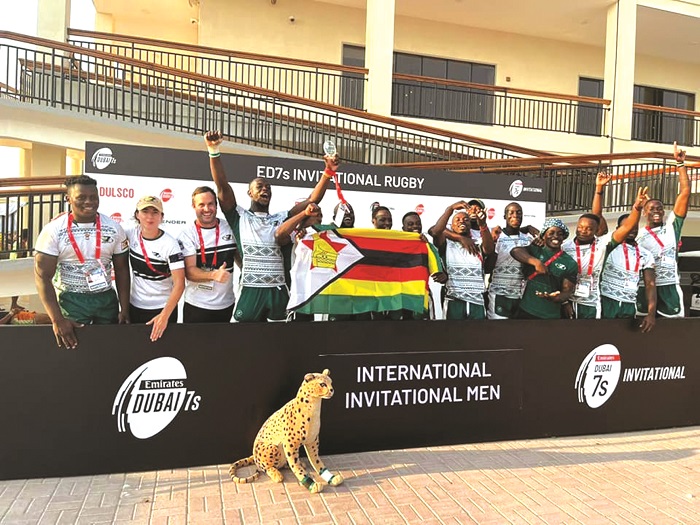
Tinashe Kusema
Deputy Sports Editor
IT is hard not to feel some semblance of solicitude for Graham Kaulback and his men, especially after a season of mixed fortunes on the international rugby sevens stage.
Any attempts to quantify the success or failure of the rebuilding project have been futile exercises. Every success the team may have achieved on the pitch has been dogged by failure, and vice-versa.
While the Cheetahs did manage a second-place finish at the Africa Cup back in April and qualified for the 2022 Rugby World Cup Sevens, they badly let themselves down with some lifeless performances at competition in Cape Town, South Africa.
There was a disastrous tour to Chile, sandwiched between the Africa Cup and the World Cup, and a disappointing Dubai Invitational Sevens Tournament at the backend of the year, which did not produce the desired results on the pitch.
The retirement of some of the older and more experienced players – Tafadzwa Chitokwindo and Kudzi Mashawi in particular – opened the door for some exciting new players like Godfrey Magaramombe, Tapiwa Malenga and most recently Shadreck Mandaza.
Mashawi, the handpicked leader of the Cheetahs Academy side, called time on his international sevens career after the World Cup. Now, Taddy Hwata looks to have stepped up commendably to fill that void.
Despite the rocky start, the national Sevens assistant coach, Ricky Chirengende, appears optimistic about the Cheetahs Academy project.
For Chirengende, the missing pieces appear to be size, game control and what he calls the X factor. Chirengende did not hesitate to buy into Kaullback’s vision when the call to duty from the Cheetahs’ coach came.
“When the post for the Cheetahs’ job came up, I did apply, together with Daniel Hondo and Graham (Kaulback).
“At the time, Danny Hondo got the job, which was fair, as he had more experience and he was more suited to get the job at the time.
“When he (Hondo) stepped down, Graham took over and gave me a call to see if I was still interested.
“I had done seven years in South Africa, in the sevens structures, with the Sharks, and so, I felt this was a good opportunity to come back and give back what I had learnt,” he said.
The biggest selling point for Chirengende was the ability to start on a clean slate with a fresh squad that was hungry, eager and willing to learn.
He insists that the sevens game has huge potential in Zimbabwe, as the talent is there in abundance and, given time, it will grow.
Chirengende, also acknowledges that results have not particularly gone the way of the team on the pitch but argues that it should not be a measure of the project’s success or failure.
“The project has started off well. I feel like we have a good base now and we have got the guys to a very good skill level.
“Our players are highly skilled now; they can run, pass, step and their tackle technique is getting better by the day and with each tour.
“What is now missing is the strength and, maybe, to add a little X factor here and there.
“We have seen it on the international stage, games and cups are sometimes won by moments of brilliance.
“These are the X-factor moments, and we have seen a lot of guys who have done these things and win cups and games for their clubs and countries,” he said.
He added that the technical team has sought to give the players the freedom to express themselves and play without fear of making mistakes.
“It’s been a year of highs and lows.
“We did very well in Uganda at the Africa Cup, and even went there with a fully locally based squad (except for maybe Shingi Katsvere). “Chile did not go down well and we did the best we could, but I think the problem was that we just had too long a break in between tournaments and ended up struggling and playing against teams that were battle-hardened already.
“Without that being an excuse, we then saw that we were still behind in both Chile and later the World Cup and that was a huge wake-up call,” he said.
He noted that the positives include the fact that they unearthed fresh talent, among them Spartans’ players Tapiwa Malenga and Pride Nyameni at the Chile tourney and later Mandaza from the Dubai Invitational.
Magaramombe played in every tournament the Cheetahs took part in, while Hwata returned and quickly took up the leadership roles.
With the Cheetahs on a break, and asked to bulk up with some good muscles, they will have such competitions like the Challenger Series, Olympic Qualifiers and Africa Cup at the backs of their minds.


 Bongani Ndlovu
 Online Reporter