Online Reporter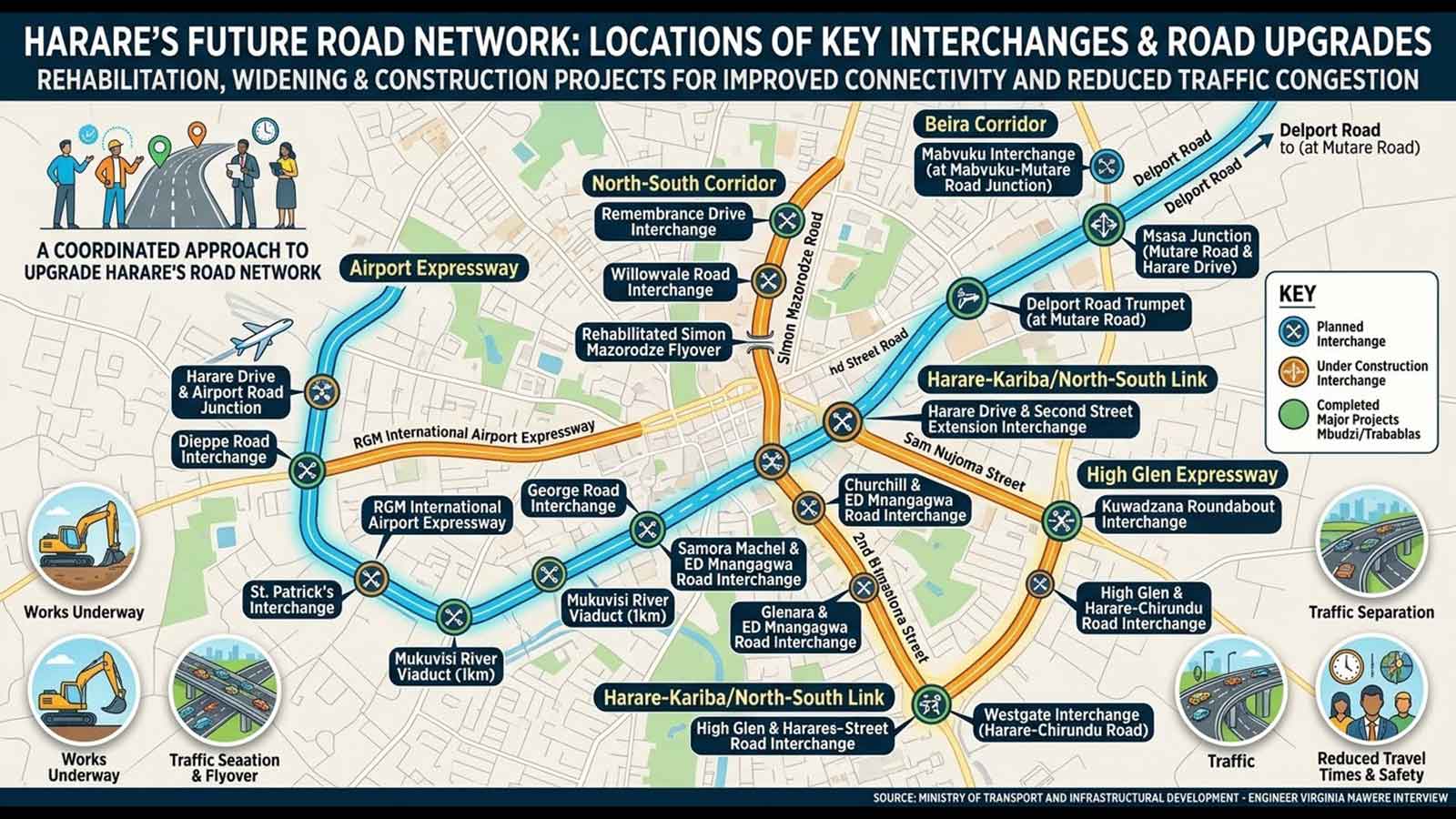
Sunday Mail Reporter
THE Government is embarking on probably the most ambitious and extensive overhaul of Harare’s road network since Independence, targeting major arteries such as Simon Mazorodze, Delport and Willowvale roads in an exercise aimed at easing congestion, improving connectivity and boosting trade.
Work on Simon Mazorodze Road, which is the urban section of the Harare-Masvingo-Beitbridge highway, began last week.
The scope of the ongoing works will include interchanges at two critical junctions — Willowvale and Remembrance Drive — as well as rehabilitation of the flyover.
While the five-kilometre stretch of Simon Mazorodze Road will be completed by year-end, work on the interchanges and flyover is expected to end by March 2028.
The overall extensive programme, which will enhance Zimbabwe’s drive to become a regional logistics hub, will also see the construction of multiple traffic interchanges, a modern expressway to provide a direct link between central Harare and the Robert Gabriel Mugabe International Airport.
Several of the projects have already moved to the implementation stage, with works underway on Delport Road, Simon Mazorodze Road and the Airport Expressway.
Deputy director for construction and maintenance in the Ministry of Transport and Infrastructural Development Engineer Virginia Mawere said the projects were being implemented as part of a coordinated approach to upgrading the capital’s road network.
“There is quite a lot of activity in and around Harare. This is part of our coordinated efforts to upgrade the city’s road infrastructure,” she said.
The programme is covering major transport corridors including key roads, junctions and feeder routes that collectively carry large volumes of traffic into and across the capital.
Delport Road takes shape
Among the projects underway is the 19-kilometre Delport Road, which will connect Mutare Road to Airport Road and ultimately Seke Road.
The road is being upgraded to a surfaced standard and will include two trumpet interchanges — one at Seke Road and another at Mutare Road.
A trumpet interchange is a type of grade-separated junction that uses curved ramps to allow traffic to enter or leave a major road without stopping at a conventional intersection.
Eng Mawere said work had already started, with site clearing underway and completion targeted for next year.
“I am happy to report that we have actually started work on Delport Road,” she said.
“The road is approximately 19 kilometres long and is going to be upgraded to a surfaced standard, connecting Mutare Road all the way to Airport Road and ultimately connecting to Seke Road.”
Construction of the Delport Trumpet Interchange along Mutare Road is expected to begin within two months.
The project is expected to provide an alternative route for traffic from the eastern parts of Harare, reducing the volume of vehicles travelling through the central business district, particularly traffic heading towards Chitungwiza and Seke.
“Furthermore, Delport Road is a key element of the Sunway City Special Economic Zone (SEZ),” said Eng Mawere.
“Given that road infrastructure is an enabler of economic development, we are confident that this will be a key catalyst that the special economic zone requires to attract and facilitate development into the SEZ.”
Airport expressway
In addition, development of the Robert Gabriel Mugabe International Airport Expressway, which will establish a direct connection between the airport and central Harare, has also commenced.
Works have started at the Harare Drive-Airport Road junction, where crews are clearing ramps and beginning construction to allow traffic diversions and facilitate work on the main structures.
Teams are also being mobilised to the Mukuvisi River, where the missing link to the central business district (CBD) will begin.
The project involves the upgrading of nine junctions into interchanges and is expected to take three years.
Among the planned interchanges are those at Glenara Avenue and ED Mnangagwa Road, Churchill Avenue and ED Mnangagwa Road, and Samora Machel Avenue and ED Mnangagwa Road.
The road will also be upgraded to increase its capacity as traffic volumes in Harare continue to grow.
One of the major structures will be a one-kilometre viaduct at the Mukuvisi River.
A viaduct is a long bridge-like structure that carries a road over an obstacle such as a river, valley or other lower-lying area.
Eng Mawere said the project would fundamentally improve access to the airport.
“This expressway will reduce the travel time between the CBD and the airport,” she said.
She said motorists currently had to pass through several neighbourhoods when travelling to the airport, exposing them to congestion and capacity constraints.
“So, we are confident that, by virtue of being constructed as an expressway, it is going to provide direct access to the airport,” she said.
Simon Mazorodze works accelerate
Works are progressing on Simon Mazorodze Road, which is also an important component of the North-South Corridor.
About five kilometres of roadworks remain, while the junctions with Remembrance Drive and Willowvale Road are also set for upgrading.
The existing Simon Mazorodze flyover will be rehabilitated and reinstated.
The road component is targeted for completion by the end of 2026, while the three major structures are expected to be completed by March 2028.
Eng Mawere said the project was intended to separate different streams of traffic and eliminate points where vehicles converge, reducing congestion and improving safety.
“And what we want to achieve is, first and foremost, separation of traffic,” she said.
“Separation of traffic is important because it reduces congestion.”
She said the junctions targeted for upgrading had become major congestion points where motorists spent excessive time waiting in traffic.
“By separating traffic, we eliminate conflict points and ensure that we have a safer and more reliable road network within that area,” Eng Mawere said.
More interchanges planned
The Government is also upgrading Sam Nujoma Street (Second Street) and Second Street Extension as part of the Harare-Kariba road project, with the urban section already dualised from the Nemakonde Way junction towards the new Parliament building junction.
The dualisation will continue towards Mazowe, while an interchange is planned at Harare Drive and Second Street Extension.
Harare Drive itself has several junctions earmarked for upgrading, including its intersections with Mutare Road at Msasa, Borrowdale Road and Nemakonde Way.
Another major intervention is planned along High Glen Road as part of the North-South Corridor link.
The route will connect the Harare-Masvingo-Beitbridge, Harare-Bulawayo and Harare-Chirundu highways, with major interchanges planned at the Harare-Chirundu road junction and Kuwadzana Roundabout.
Other smaller overpasses will also be constructed along High Glen Road. The road itself will be upgraded.
The Kuwadzana Roundabout interchange is earmarked for 2027, although designs are still being developed.
The authorities are also planning further junction upgrades, including at Westgate along the Harare-Chirundu road and several locations along Harare Drive, with the works targeted for implementation over the next three to five years.
The scale of the programme, Eng Mawere said, reflected a deliberate shift in how the Government approached Harare’s road infrastructure.
Rather than concentrating resources on individual bottlenecks, the ministry was now looking at entire corridors and the network of roads feeding into them.
She said the approach had been informed by lessons from the Trabablas project, which initially focused on the Mbudzi Roundabout.
“But emanating from that, we saw that the road network consists of a network of various junctions, feeder roads and main roads,” she said.
The Beira Corridor, for example, is being treated as a connected system involving the Mabvuku Junction, Msasa Junction, Delport Road, the Delport Trumpet and feeder roads such as Chiremba.
Similarly, the Simon Mazorodze corridor is being addressed together with feeder routes such as Willowvale Road.
“As Government, we are looking at this holistically and not just looking at a particular corridor, section or junction,” Eng Mawere added.
“We are upgrading the network as a whole to ensure that motorists get maximum benefit from whatever infrastructure upgrades are undertaken by Government.”