Lovemore Kadzura
Post Reporter
GOVERNMENT and its partners are taking proactive steps to enhance natural disaster detection and response mechanisms – with contingent measures being put in place to equip civil protection committees, ensuring they are well-prepared when called to action.
Government is working with World Vision and World Food Programme (WFP) to roll out urban preparedness programmes in Mutare, Bulawayo, Gweru and Epworth.
At regional level, the initiative is being implemented in Lesotho, Madagascar, and Mozambique, with funding from the European union (EU).
The programme seeks to enhance the capacity of national and subnational structures to prepare for, and respond to hazards that could cause disasters in cities. It involves collaboration with the humanitarian coordination management architecture, starting with the Department of Civil Protection, provincial civil protection committees, and extending to districts and municipal authorities.
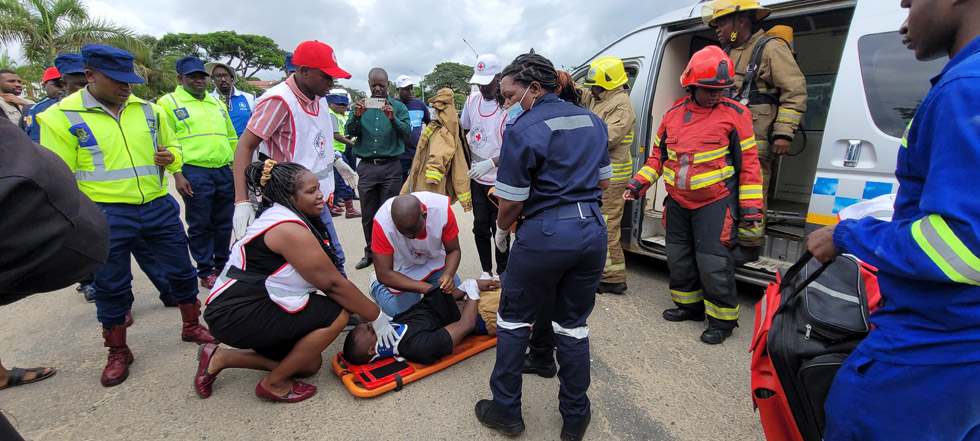
A live simulation exercise was conducted in Mutare last week, testing the city’s response to various disaster scenarios, including heavy rains, fire breakouts, road traffic accidents, and drowning. The city identified hazards, their timing, magnitude, and potential impact on residents.
The exercise assessed the city’s preparedness and the effectiveness of its emergency response systems.
Through this exercise, Mutare tested its emergency response systems, assessing preparedness and system effectiveness.
The simulation also evaluated coordination among the district civil protection committee.
Assistant Mutare District Development Coordinator, Mrs Joyline Nyamunokora said the live simulation showed that Mutare City Council was well-prepared and equipped to respond to natural disasters effectively, minimising loss of life and property.
“We trained district civil protection committee members, mainly from Mutare City Council, on disaster response. The three-day exercise revealed that the council can respond to disasters such as flooding, fire, and accidents. However, some gaps were identified, including the need for more stakeholder training and simulation exercises.
“In terms of equipment, it has emerged that the city has enough equipment to effectively respond to disasters. They have five fire tenders, a fire ladder, two functional ambulances and functional fire department. They have trained personnel that can rescue drowned people though they require further training from Zimbabwe Republic Police’s Sub-Aqua Unit,” she said.
Mutare City Council Housing and Community Services assistant director, Mr Noel Mushangwe said the simulation exercise gave them a chance to review their disaster response mechanisms.
He further revealed plans to establish a simulation complex, where staff and personnel from other local authorities will undergo regular training to ensure constant response to distress calls.
“As a city, we are benefiting from this programme, and were able to review our disaster preparedness and multi-hazard contingent plans. Simulation exercises help us assess our response capacity and train our teams to respond to distress calls.
“We had the city council’s fire and health departments, Red Cross, and Zimbabwe Republic Police participating in the exercise to identify gaps and areas for improvement. Going forward, we need more of these exercises to strengthen our reaction and response times. Mutare City has partnered with Manicaland State University of Applied Sciences to develop a programme to train responders nationwide. As part of this programme, we plan to establish a simulation complex where we can conduct regular drills. We have benefited from a partnership with the Belarus Government, acquiring a fire ladder. We intend to partner with Belarusian institutions to train our personnel, focusing on practical skills. Having equipment is not enough – we must be able to use it effectively,” said Mr Mushangwe.
Mutare Residents and Ratepayers Association programmes director, Mr David Mutambirwa praised the Government for the exercise, saying it will keep council alert and prepared to save residents from losing lives and property.
“We are glad the Government is monitoring cities’ and civil protection committees’ preparedness to respond to disasters. Mutare is vulnerable to natural disasters due to its geographical location and rivers, making it prone to flash floods during rainy seasons,” said Mr Mutambirwa.
Residents feel safer when stakeholders regularly check their preparedness, he added.
Chairperson of Housing, Health and Community Services committee, Councillor Jeffery Nyamana said they are implementing policies that prioritise residents’ safety.
He said council is investing in equipment and resources for emergency services and planning to establish a sub-aqua unit in response to rising drowning cases.
“The council is putting policies in place to ensure residents’ safety. We’re investing in equipment and resources, and planning a sub-aqua unit after recent drowning incidents,” said Councillor Nyamana.
Simulation exercise tests Mutare emergency response