

 Chronicle Editor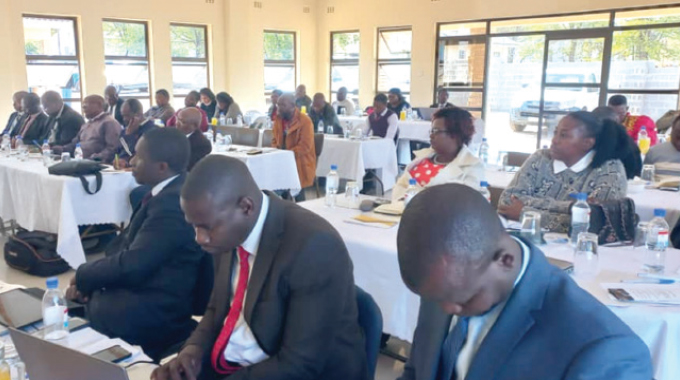
Sukulwenkosi Dube-Matutu, [email protected]
SKILLS Audit and Development Minister, Professor Paul Mavima has called for co-ordination between tertiary institutions and industry to ensure that graduates being churned from colleges and universities have the requisite skills to adapt to the evolving work environment.
Addressing participants during a Matabeleland South provincial skills consultative workshop in Gwanda recently, Prof Mavima said the industry has to ensure that students are adequately trained during their internship.
President Mnangagwa established the Ministry of Skills Audit and Development last year as a way of addressing the findings of the 2018 National Critical Skills Audit, which highlighted that the economy is suffering from acute skills shortages yet the country has a huge population of educated people, especially the youths who are unemployed.
The skills shortage points to the need to re-align what is being produced by training in critical skills, which are required by various socio-economic sectors.
This also reflects the redundancy of some of the available skills and the need to develop the required skills as well as modernise them for both the present and the future in line with the country’s industrialisation and modernisation agenda.
The country’s skills base remains at 32 percent, which effectively translates to a 68 percent shortage of requisite skills. The country mainly lacks skills in areas around science, technology, engineering, medical sciences and agriculture.”We lack in those areas, sometimes even up to 95 percent of the thresholds yet international standards say we are supposed to have so many doctors per certain number of patients. We have a serious lack in our primary healthcare institutions,” said Prof Mavima.
“We are at about five percent of the required number of doctors and even nurses.
“The skills shortages also point to misalignment between what is produced by our institutions and what is required by the various sectors.”
Prof Mavima said the industry should provide fundamental opportunities for students to experience the world of work before graduation.
“When we send our students for attachment, don’t expose them to menial work, but get them into the real work which they are being trained in,” he said.
Prof Mavima said the one-year internship required by most tertiary institutions is critical in terms of preparing students for service in the industry.
He said regular consultations should be held between institutions and industry so that industry players can clearly state the specific skills they need.
Prof Mavima said as part of efforts to bridge the gaps that exist in skills development, training institutions will be capacitated to produce skilled professionals who can meet the skills requirements for both public and private sectors.
“We hear so many times industries say they are being given half-baked graduates. There is a need for good communication and co-ordination between the industry and institutions so that we can align the curriculum to the requirements of the industry,” said Prof Mavima.
“We will also dialogue with institutions so that they can tell us what they need for them to be effective in developing skills. This dialogue will be conducted at all levels of training that is from primary and secondary education to technical, vocational institutions, polytechnics and universities.”
Prof Mavima said for Zimbabwe to remain competitive in the corporate global economy, the country should enhance its skills in critical technical areas that will aid the growth of manufacturing.
He said the country should venture more into sustainable agriculture and reach the highest levels of productivity in the mining sector.
Prof Mavima said the country is still lagging behind in the development of emerging technologies such as artificial intelligence, design thinking and data science.
In a speech read on her behalf by the Director for Infrastructure, Planning and Environmental Management in the Office of the President and Cabinet, Mr Daniel Njowa, Matabeleland South Provincial Affairs and Devolution Minister, Dr Evelyn Ndlovu said the development of the province requires critical and relevant skills to spearhead rural industrialisation.
“Skills development is at the core of any meaningful socio-economic development of any nation. It doesn’t matter how vast our natural resource endowments are, without the prerequisite skills we won’t be able to explore and exploit what we have into tangible products and services,” she said.
“Our livelihoods can’t be changed with resources alone without the critical skills to value add and beneficiate them. The development of our province requires critical and relevant skills to spearhead the rural industrialisation and exploit the indigenous knowledge systems as essential ingredients for the rural development strategy.” —@DubeMatutu



 Online Reporter