Online Reporter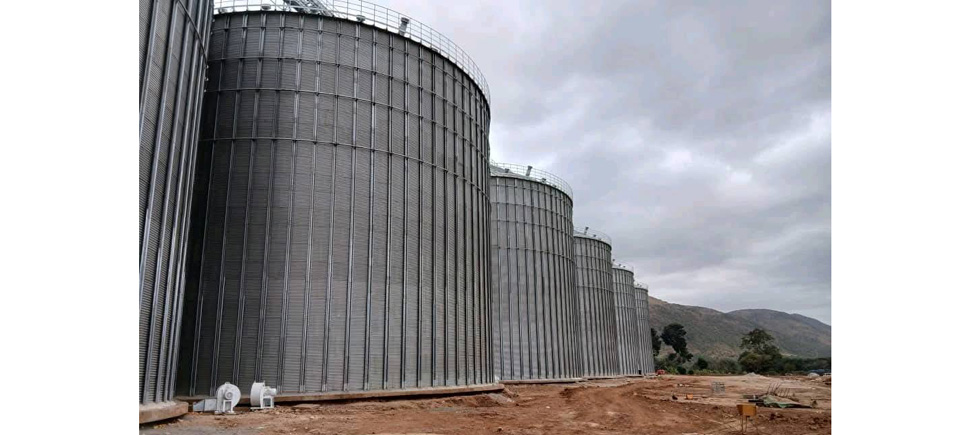
Lloyd Makonya
Correspondent
THE recent visit by Lands, Agriculture, Fisheries, Water and Rural Development Minister, Dr Anxious Masuka to Grain Marketing Board (GMB) depot in Mutare has reignited national interest in Zimbabwe’s bold strides towards agricultural transformation.
Accompanied by Minister of State for Manicaland Provincial Affairs and Devolution, Advocate Misheck Mugadza, Minister Masuka toured the AI-powered grain silos now nearing completion.
While the visit itself has already made headlines, this feature explores how such infrastructure can serve as a springboard for economic growth, food security, and improved rural livelihoods.
The state-of-the-art silos at the Mutare depot expected to be finalised by end of July as stated by officials, are not just an upgrade of outdated infrastructure, but represent a seismic shift in Zimbabwe’s approach to grain storage.
Unlike the traditional systems that have long struggled with inefficiencies, losses, and quality degradation, these modern facilities are equipped with artificial intelligence (AI) technology.
Through the use of smart sensors and automated climate control, the silos can monitor grain temperature, humidity, and pest activity in real-time, adjusting internal conditions to preserve optimal storage.
This results in dramatically reduced post-harvest losses, improved grain quality, and longer shelf life.
These advancements come at a critical moment.
Manicaland Province alone has already harvested 471 000 metric tonnes of grain this season, comprising 394 000 metric tonnes of maize and 77 000 metric tonnes of traditional grains such as sorghum, millet, and rapoko as reported by Advocate Mugadza.
In the past, much of this bounty would have been threatened by outdated storage systems, where post-harvest losses could reach up to 30 percent.
With the introduction of AI-managed silos, those losses are expected to fall to less than five percent, securing additional tens of thousands of tonnes of grain that might otherwise be wasted.
In economic terms, this is not just a technical improvement, it is a major boost to national agricultural productivity.
The broader economic implications are significant. Agriculture contributes between 12 percent and 15 percent of Zimbabwe’s Gross Domestic Product (GDP), and supports over 70 percent of the population, especially in rural areas. By improving post-harvest handling, the country is strengthening a key link in the agricultural value chain.
Zimbabwe will be able to store its grain more securely and for longer periods.
The GMB will benefit from enhanced capacity to manage strategic grain reserves, enabling it to cushion against shortages and price shocks.
Grain processors and other downstream industries will also gain from a more stable and reliable supply of high-quality grain.
Furthermore, the silo upgrade is a major step forward in the implementation of the National Development Strategy (NDS1) which has laid solid foundation for NDS2, which envisions an upper-middle-income economy by 2030.
NDS1 which is transitioning into NDS2 starting 2026, places strong emphasis on infrastructure development, food and nutrition security, and the modernisation of agriculture through technological integration.
The AI-powered silo project is therefore not an isolated intervention, but part of a well-coordinated strategy to transform the country’s food systems.
It reinforces Zimbabwe’s commitment to achieving national food sovereignty, reducing reliance on imports, and building climate resilience in the face of recurring droughts and changing rainfall patterns.
Beyond the national policy landscape, the benefits of this investment will be felt at the community level.
Smallholder farmers, many of whom operate without on-farm storage, will benefit from increased holding capacity and efficient storage through GMB depots.
This will help reduce exploitation by middlemen and improving incomes.
Young people and local entrepreneurs stand to benefit from job creation in silo maintenance, grain transportation, logistics, and processing consequently creating a ripple effect across rural economies.
At the same time, improved grain storage enhances the State’s ability to support vulnerable communities.
With better-preserved reserves, Government can strengthen school feeding programmes, emergency food aid, and nutrition interventions, especially in districts frequently affected by drought or food insecurity.
It also enables more strategic national planning and better preparedness for shocks such as pandemics or regional supply disruptions.
In every sense, the AI-powered grain silos in Mutare are a symbol of smart governance and visionary leadership of His Excellency, Dr Emmerson Dambudzo Mnangagwa.
They show what is possible when technological innovation is matched with political will and strategic investment.
As the July completion date approaches, the Mutare GMB Depot stands as a testament to how modern infrastructure can be leveraged to transform not only the agricultural sector, but the broader socioeconomic landscape of Zimbabwe.
This development is, not simply about storing grain, it is about storing value, dignity and resilience.
It is about safeguarding the harvests that feed the nation and unlocking the potential of agriculture as a driver of inclusive economic growth.
From the fields across Manicaland to the over 16 million Zimbabwean mouths to be fed, this is a project whose benefits will be far-reaching and enduring. Zimbabwe’s grain story is being rewritten and it is one of innovation, security, and hope.