admin
admin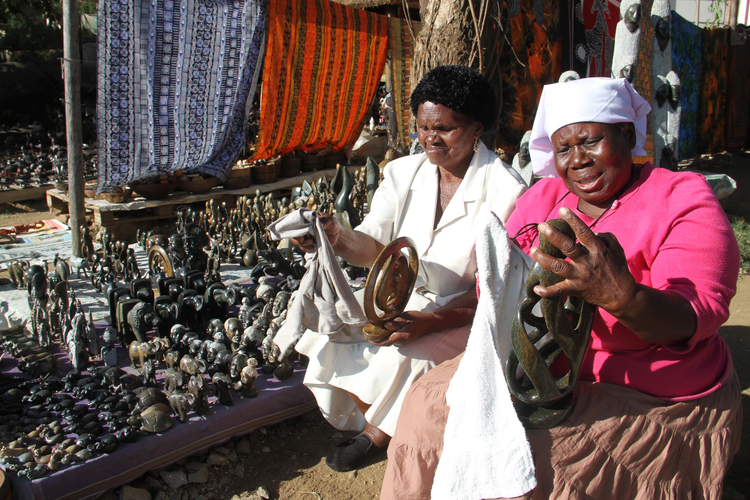

Africa Moyo and Darlington Musarurwa
THE serene environs at Newlands Shopping Centre in Harare — far from the madding crowd that Harare has become and miles away from the hustle and bustle of the capital — especially stretches along Enterprise Road that are adorned by all manner of sculptures, are deceptive.
There is a contrived peace: The moment a car pulls up adjacent to the hand-made crafts, the normally laggard-looking individuals that guard the wares energetically spring to action, accosting potential customers.
The flurry of activity and gesturing only subsides when the customer leaves, and the serenity returns again.
It is a daily cycle.
It is also a daily routine that 62-year-old Mrs Ivy Mutakura has known for the past 27 years she has been selling sculptures and printed clothes.
In this part of the world tie dye garments and garments with animal imprints are a seller.
But there is one problem: As the dollar becomes elusive, so does customers; as consumer demand softens, her life becomes hard.
Business normally picks in the six-month period to September, but slumps in the intervening period.
Presently, she is reeling from the curse of the dry business cycle.
Proceeds from her business help her pay rentals, pay school fees for her orphaned grandchildren, buy food and raise bus fares to go to work.
Although she only makes tie dye garments, she sells some sculptures as well.
“Customers are few these days. Business normally improves from October up to March of the following year.
“Mostly tourists that would have come for Christmas buy a lot of our products as they go back to their respective places. Whites are the bulk of our customers,” said Mrs Mutakura.

Though successive generations of locals have nurtured and mastered the ability to carve eye-catching artistic impressions out of wood and stone, most Zimbabweans are inexplicably not attractive to these handicrafts.
It seems over years, the wares evolved to become the white man’s preserve.
While traditionally sculptures used to be shipped to Europe and the United States of America at ease, sky-rocketing cargo costs have become both punitive and prohibitive.
For sculptures, it now makes economic sense to only send few and generally small items in order to contain costs.
Also, despite investing a lot of skill and craft in breathing life into their artistic impressions, sculptures now have to discount their prices just to make a sell.
In fact, prices for all items are now often negotiated.
“Our prices are negotiable; for two-metre (printed) cloths, we charge US$20 but the price can come down even to US$15 because if we were to be rigid, nothing would be bought.
“We also do potato prints which we charge US$25 but that can be negotiated downwards to about US$20,” said Mrs Mutakura.
She said on bad days she can raise money that is only enough to take her home and back.
Crucially, she sincerely believes that Government can chip in by providing financial support.
That way, she is convinced, it would be possible to produce a variety of products that can appeal to different tastes and customers.
“We take care of orphans, but we are struggling to fend for them because a lot of our money is going towards rentals and bus fare.
“Therefore, we badly want someone to help us with loans so that we can boost our operations.
“The absence of loans has seen us losing some business because we are unable to make all the products demanded by our customers. We are able to pay back the loans; we cannot run away because this is our office.

“Government should help the elderly like us who are taking care of orphans. It is not like I do not want to rest at my age but I cannot go around asking for money and food from neighbours because they are equally struggling,” said a pensive Mrs Mutakura.
Mrs Mutakura’s challenges are a microcosm of what is happening in the arts and craft industry.
Inconvenient workplaces
The challenges facing this unique breed of entrepreneurs are not restricted to cyclical fluctuations in demand, but also convenient locations to practice their art.
Newlands Shopping Centre and Enterprise Road is thoroughfare to surrounding affluent suburbs such as Highlands, Chisipite, Greendale and Grange. lt therefore provides a lucrative catchment area.
Mr Bvumai Chiripanyanga, 35, who carves most of his pieces at his home in St Mary’s, Chitungwiza, has to cart his products to his market place in Newlands, a distance of 28 kilometres.
Often, sculpturing is an in-situ vocation — one has to make his products where he works, a practice that normally adds an allure to the business.
Barring instances where enterprising suppliers bring soapstone, which is a key raw material in sculptures, to the artists, they have to source the stones themselves from as far afield as Guruve, Mutoko and Zvishavane.
“Newlands is just a market for my products, but I make most of them at home. Of course other customers come and get some of them at home.
“There is also a lot of business during major holidays such as Christmas and Easter.
“Most of our customers are whites, and blacks come in from time to time,” explained Mr Chiripanyanga.
His artefacts range from animals chiselled from stone and abstract images, including anything that a customer requests.
Though his work is not paying him handsomely, he is able to fend for his family.
He is a man married to his art; it is like an obsession.
City Council sympathises with weavers

Besides those who are obsessed with transforming stone into art, there are weavers who make a range of products from basket chairs, pouches, brooms and winnowing baskets.
Similarly, the basketry business is far from rewarding.
Mr Solomon Ngarivhume, 53, has been making a number of products opposite the Vehicle Inspection Department (VID) in Eastlea since the early 1980s.
He gets his raw materials from Mbare where wholesalers bring them from Muzarabani, Mashonaland Central province.
But business has been so low that even the Harare City Council has since decided to slash its monthly rentals for basket weavers by a massive US$45.
Mr Ngarivhume and seven other people operating from the area are now paying US$15, which he reckons remains high given the circumstances.
“Business is low; it is not too well at the moment, may be it is because of cash shortages.
“The little we are getting is spent on food and transport,” he said.
However, he never gives up.
He always expects “the next day to be better”.
Unlike sculptures, the basketry business is mainly driven by demand from locals.
Mr Ngarivhume says a number of officials from the Ministry of Small and Medium Enterprises and Co-operative Development have visited their premises in the past and promised to organise funding for them.
However, nothing has materialised yet.
“They used to come promising to provide us with assistance but they have not been coming in recent times.

“We hear there is money for SMEs and have always hoped to get some.
“Worse still, we cannot approach financial institutions seeking loans lest we get arrested after failing to repay because of the depressed business.
“If there was money, we were going to change our designs, but at the moment we cannot. So we have accepted that we cannot get any money from anyone,” said Mr Ngarivhume.
Pockets of success
It is not all doom and gloom.
Zimbabwe Applied Arts and Crafts Association chairperson Mr Enock Kolimbo told The Sunday Mail Business last week that business in the arts sector is doing well, depending on where one is operating from.
Mr Kolimbo said during the recently concluded Harare International Festival of Arts (Hifa), many artists had decent pickings.
However, sculptors and weavers such as Mr Chiripanyanga and Mr Ngarivhume, respectively, said they could not attend Hifa because they failed to raise funds to book a stand and ferry their products to the venue.
“I can say business is fine (sic) at the moment, but it depends with where you are operating from.
“I was at Hifa this year selling patchwork jackets; they were bought quite well, mainly by the Japanese.
“We sell quite a lot to Americans. This is because locals do not appreciate our culture and tourists understand Zimbabwe’s culture better.
“So, it depends on the nature of visitors that we sell our products to. Some of the tourists prefer cloths while others go for sculptures. As long as your sculptures have good designs, then there will be customers wanting to buy them,” said Mr Kolimbo.
Mr Kolimbo has been in the business for over 20 years.
He is based in Warren Park, Harare, and specialises in painting cloths (tie dye) and says he is proud of his work.
Mr Kolimbo conceded that artists are reeling under cash shortages affecting the market.
He said because of the liquidity crunch, some artists are now exploited by customers or middlemen who want to buy in bulk but offering half the price for products.
“People end up losing their products literally for nothing because in most cases they just want money to buy food for the family but they end up failing to go back to work.
“This has resulted in most artists being looked down upon as they literally work for middlemen who buy cheaply from them and get more profits when they resell the products,” said Mr Kolimbo.
Contribution of cultural industry to economy
The cultural industry, under which the arts and crafts sector falls, is enormous in the country as it contributes millions of dollars in exports every year.
Exports soared in 2009, peaking to US$16,4 million, but the trend has since changed.
Shipments dropped to US$14,7 million in 2012, with the cultural and natural heritage and visual arts and crafts domains constituting the largest proportions of exports of cultural products, according the Cultural Statistics Survey (CSS) 2012.
The CSS was conducted under the direction of the Zimbabwe National Statistics Agency (Zimstat) and was commissioned by the Culture Fund of Zimbabwe Trust through the then Ministry of Education, Sport, Arts and Culture.
In 2012, arts and crafts contributed US$3,5 million in exports.
The survey successfully interviewed 734 individual artists and 99 institutions in the cultural industry in Harare and its major surrounding areas (Chitungwiza, Norton, Ruwa and Epworth).
The CSS says the country’s culture sector has enormous potential to contribute to both national and household income from local and export sale of various goods and services.
However, a baseline survey conducted in 2009 by the Culture Fund of Zimbabwe Trust concluded that data and information on the cultural industry is poorly documented due to lack of a centralised information and knowledge management system.
The sector also employs about 22 288 people, with the visual arts and crafts accounting for 9,4 percent, of which 49 percent of the individual artists in the domain are not registered.
Visits to other countries
Players in the arts and crafts industry try to broaden their markets by visiting a number of countries to market their products.
Mr Kolimbo said last year, they went to Mozambique on a trip organised by the SMEs ministry. A 20-member delegation also went to Zambia about two years ago on a trip facilitated by the World Crafts Centre.
Three years ago they went to India and their tickets were sponsored by the Culture Fund.
“We carried other members’ wares to India and sold them and brought their money,” said Mr Kolimbo.
But other sculptors said they never got their money and therefore they have since stopped sending their wares with other members.
About the association
Mr Kolimbo says the Zimbabwe Applied Arts and Crafts Association was formed in 2010 to raise awareness among players.
Exact figures of members are not yet available as the membership drive is ongoing.
“I should say the big number is doing baskets with most of them working as communities, then we have others doing stone carving, cloths and recycling (of cans, bottle tops, creating bags and caps and giraffes).
“As crafters we do not have a lot of money to focus on the association because we have to work hard to feed our families.
“But we did membership drive in Masvingo, Mutare and Marondera. We also hold workshops to grow our membership,” said Mr Kolimbo.
Members of the association pay US$25 in monthly subscription fees.
Those that are unable to pay are still assisted.



 Online Reporter