admin
admin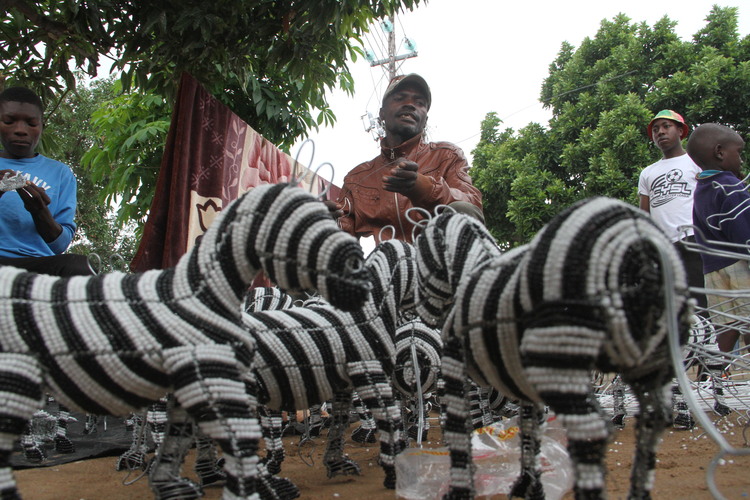
Africa Moyo
Ensconced beneath a mango tree next to their lodgings in the bustling high-density suburb of St Mary’s in Chitungwiza, umbrellas handy in case it rains, two men furiously weave crafts using galvanised wire.
Chitungwiza in general and St Mary’s in particular is teeming with entrepreneurs.
They do not have cushy offices and secretaries and underlings in designer suits to bark instructions at. They are part of an informal sector that in 2012 was said to have handled more than US$7 billion.

The place known as kuMapostori is a hive for SMEs that make anything from aluminium buckets to window frames, and from furniture to woven crafts.
The duo of Mr Lawrence Chikazhi (44) and Mr Norman Muchemwa (39) have stuck to the business of making beaded animals for 24 years now.
Their home, from where they operate, is always busy.
The simple allure of their craft always attracts young boys from the neighbourhood who are eager learn the art.
Mr Chikazhi says they have been in the business of making beaded animals like zebras, elephants and sheep since 1992.
The two men have never known formal employment, having started the craft during their school days and at times even supplementing their fees from the deft work of their hands.
They use galvanised wire because of its pliability, strength and rust resistance thanks to the zinc coating. The wire comes in different sizes such as 0,4mm, 0,7mm and other bigger specifications.
Says Mr Chikazhi: “We started doing these crafts in 1992, and this is my full-time job … We never went to school to learn how to make these things. We just started this business in our spare time, mainly after school, using pliers, but the quality of our crafts has vastly improved now. So, from time to time we would pay our own fees from proceeds made from selling the products.”

But as cash becomes increasingly scarce on the market, buyers now dictate prices.
This is not work for someone who wants a house in Borrowdale Brooke or to drive a Bentley.
For Mr Chikazhi and Mr Muchemwa, the business only allows them to send their children to school, buy food and pay rentals.
Yet the middlemen and retailers who buy their wares for resale make a killing.
There is a thriving market for their products in countries like South Africa, Botswana and Tanzania. And tourists take their products to far flung places like Europe, North America and Asia.
Some of their raw materials come from South Africa, and the cross border traders who bring these in make a tidy profit for their role.
The problem Messrs Chikazhi and Muchemwa have is straight forward: they need direct access to raw materials and markets.
Prices and markets
Prices for their products range from US$1 to US$10.
Mr Chikazhi says most of their clients are cross-border traders, curio shops in central Harare and people with market stalls in areas such as Newlands and Avondale Shopping centres in the capital.
Tourists and other foreigners used to be among their biggest customers, but they ceased frequenting St Mary’s around 2002/3.
Some clients take their products to tourist magnets like Victoria Falls, from where the items find themselves in foreign climes.
“A lot of our customers are cross-border traders but our wish is to go out there and sell on our own so that we generate more money because when some of the customers come to buy the products in bulk, they peg their own prices.
“For instance, a product that we will be selling for US$5, a customer would offer us US$3 and at times we end up accepting because we want money to survive. In the end, we fail to realise profit since the price will only see us recovering raw material costs.
“We also sell to whites from time to time; they used to come here up to 2002 and 2003 but we haven’t seen a lot of them since then.
“This is why we wish to go to places such as Victoria Falls and sell on our own although the challenge is that we can’t be away from work for long since we have to produce,” outlines Mr Chikazhi.
With business generally low across all economic sectors due to an illiquid market, Mr Chikazhi says in a good month they generate business worth between US$150 and US$200.
Business normally peaks towards month-end.
“We are always left with nothing to invest in big things such as property. So, we are just able to send our children to school. I have three children that I send to school; two of them are in primary while one is in secondary school,” says Mr Chikazhi.
His colleague, Mr Muchemwa, also says all his proceeds go to taking care of his family. He too has three children in primary and secondary school.
Investment
The absence of meaningful collateral constrains their ability to access loans from banks, and as a result these tradesmen survive from hand-to-mouth. Government has a dedicated ministry for the sector, underlining the value that policymakers have on fledgling businesses.
A Finscope Macro, Small and Medium-sized Enterprises (MSME) survey developed by FinMark Trust in 2012 said there are 2,8 million MSME owners in Zimbabwe, owning 3,5 million businesses and employing 2,9 million people (excluding owners).
Such statistics inform Government’s determination to assist SMEs, which have become a key economic driver with estimated turnover of US$7,4 billion in 2012.
Mr Muchemwa says they are waiting for Government assistance, and he reckons that an investment of just US$1 500 will grow the business exponentially.
“We need money to have good stocks of raw materials. Beads are going for US$70 per box; each box contains 50 pockets and if we can get at least 20 boxes and significant quantities of wire at once, then we will be able to fulfil our orders. More importantly, we can also hire other people to help us, that way we create employment.
“The problem is that these days, clients no longer want to leave a deposit for the products they want because they claim to have been robbed of their money by some unscrupulous artists in the past and they don’t trust anyone anymore,” explains Mr Muchemwa.
They also need secure premises away from the elements.
Getting land from local authorities is both bureaucratic and expensive, hence the need for central Government’s intervention.
Before, the two craftsmen used to take their wares to Chitungwiza Arts and Crafts Centre in Old Zengeza 4 but stopped because of the requirement to pay 10 percent commission for everything sold.
Empowerment
Zimbabwe has adopted a black economic empowerment stance where Government is equipping citizens, mainly youths, with life skills.
A Youth, Indigenisation and Economic Empowerment Ministry was created to look into these issues and to mobilise appropriate funding.
Mr Chikazhi says their business is playing a part in supporting youths with psychomotor skills so that they become employers in their own right, and several school goers come to them to learn the craft and earn a bit of money.
Their own children are already conversant with most aspects of the trade, apart from making frames for the animals.
“We are trying to equip young people with self-sustaining skills and we are now working with our children when they come back from school. Other children from the community who wish to learn this trade in their spare time also come and we teach them,” says Mr Chikazhi.
For their efforts, the boys get as much as US$10 when the products have been sold, but the figure can rise depending on the amount of effort invested.
Away from the plush offices of policymakers and politicians, many other master craftsmen and women are weaving an economy, keeping communities afloat with the little they put together on their own.
Will they get the support they deserve?
Smedco searches for US$10m boost
Business Reporter
The Small to Medium Enterprises Development Corporation (Smedco), a statutory body, needs about US$10 million to fully discharge its mandate.
Independent estimates suggest SMEs contribute over 50 percent of GDP and employ about 60 percent of the population.
Last year, Smedco received US$3 million from the Jordan-headquartered Arab Bank for Economic Development (Badea) for recapitalisation.
Secretary for Small and Medium Enterprises and Co-operatives Development Mrs Eveline Ndlovu told The Sunday Mail Business Government was mobilising resources to recapitalise Smedco.
“Smedco requires more than US$10 million to increase its operating capacity which is way lower than the expected capacity. Capitalisation of Smedco will be key to financial inclusion of the sector it represents.
“Efforts are currently underway to capitalise Smedco through formation of a micro finance bank,” said Mrs Ndlovu.
Smedco last year disbursed loans to 200 micro and small-sized enterprises and four co-operatives whose membership exceeded 60.
The corporation is also formalising SMEs by facilitating their licensing with Government estimating that more than 85 percent of MSMEs are unregistered.
At the recent national financial inclusion strategy launch, Reserve Bank of Zimbabwe Governor Dr John Mangudya said Government’s strategic goal was to have an inclusive financial system that was responsive to the needs of all Zimbabweans by 2020.
“My hope is to make sure we increase the overall level of access to formal financial services within the country from 69 percent in 2014 to at least 90 percent by 2020.
“We can also increase the proportion of the banked adults from 30 percent in 2014 to at least 60 percent by 2020 only if we incorporate the informal sector into the formal banking sector,” Dr Mangudya said.
He noted that a recapitalised Smedco would be required to identify clusters that can be nurtured throughout the country.


 Online Reporter